

sufficiently by changing the charge compensating metal cations. However, substituting, e.g., a fraction of the 3.6 charge compensating metal cations by an organic cation
can have much impact. An enormous increase of the luminescence intensity was
observed when attaching the BuImz
+
Sil stopcock to nanosized ZL (NZL) composites,
the channels of which contained Eu
3+
(L n ), if L was a β-diketonate (TTFA or DBM,
Table 3) [77]. The imidazolium salt was used because it bears a positively charged part
which easily enters the negatively charged NZL-channel upon exchanging a cation
present in the neighborhood and because the bulky triethoxysilane moiety can react
with the OH groups present at the channel entrances. The modification reaction was
performed as reported in Fig. 19; see also Fig. 9.
We name the composites [Eu
3+ L n ]-NZL, where L is equal to TTFA (Table 3), and
composites modified with the stopcock: BuImz
+
Sil-{[Eu
3+ L n ]-NZL}. Figure 20
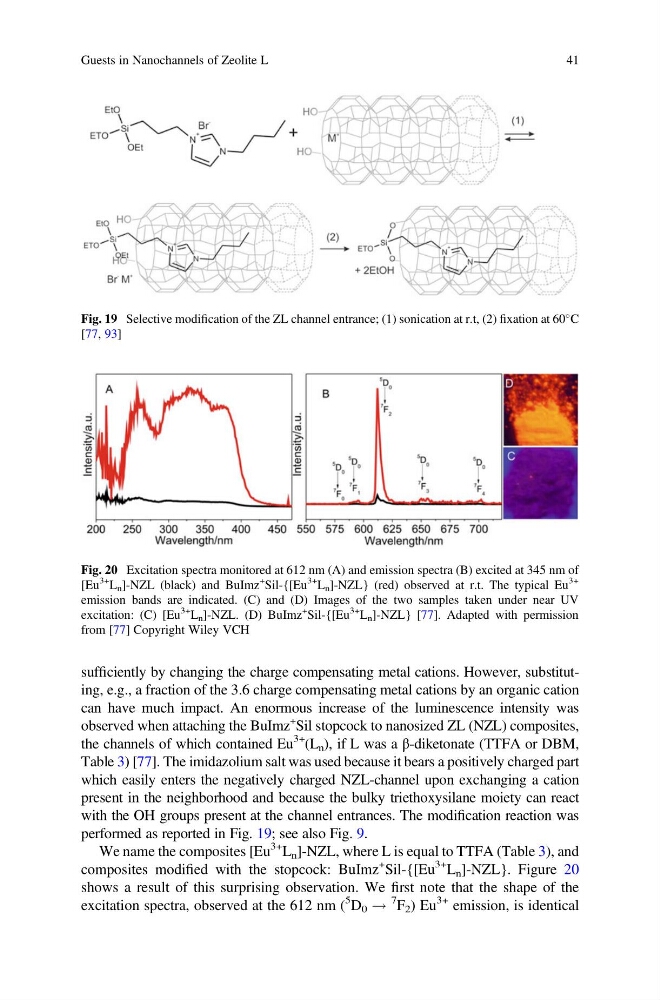
shows a result of this surprising observation. We first note that the shape of the
excitation spectra, observed at the 612 nm (
5 D 0 !
7 F 2 ) Eu
3+ emission, is identical
Fig. 19 Selective modification of the ZL channel entrance; (1) sonication at r.t, (2) fixation at 60
C
[77, 93]
Fig. 20 Excitation spectra monitored at 612 nm (A) and emission spectra (B) excited at 345 nm of
[Eu
3+ L n ]-NZL (black) and BuImz
+ Sil-{[Eu
3+ L n ]-NZL} (red) observed at r.t. The typical Eu
3+
emission bands are indicated. (C) and (D) Images of the two samples taken under near UV
excitation: (C) [Eu
3+ L n ]-NZL. (D) BuImz
+ Sil-{[Eu
3+ L n ]-NZL} [77]. Adapted with permission
from [77] Copyright Wiley VCH
Guests in Nanochannels of Zeolite L
41
can have much impact. An enormous increase of the luminescence intensity was
observed when attaching the BuImz
+
Sil stopcock to nanosized ZL (NZL) composites,
the channels of which contained Eu
3+
(L n ), if L was a β-diketonate (TTFA or DBM,
Table 3) [77]. The imidazolium salt was used because it bears a positively charged part
which easily enters the negatively charged NZL-channel upon exchanging a cation
present in the neighborhood and because the bulky triethoxysilane moiety can react
with the OH groups present at the channel entrances. The modification reaction was
performed as reported in Fig. 19; see also Fig. 9.
We name the composites [Eu
3+ L n ]-NZL, where L is equal to TTFA (Table 3), and
composites modified with the stopcock: BuImz
+
Sil-{[Eu
3+ L n ]-NZL}. Figure 20
shows a result of this surprising observation. We first note that the shape of the
excitation spectra, observed at the 612 nm (
5 D 0 !
7 F 2 ) Eu
3+ emission, is identical
Fig. 19 Selective modification of the ZL channel entrance; (1) sonication at r.t, (2) fixation at 60
C
[77, 93]
Fig. 20 Excitation spectra monitored at 612 nm (A) and emission spectra (B) excited at 345 nm of
[Eu
3+ L n ]-NZL (black) and BuImz
+ Sil-{[Eu
3+ L n ]-NZL} (red) observed at r.t. The typical Eu
3+
emission bands are indicated. (C) and (D) Images of the two samples taken under near UV
excitation: (C) [Eu
3+ L n ]-NZL. (D) BuImz
+ Sil-{[Eu
3+ L n ]-NZL} [77]. Adapted with permission
from [77] Copyright Wiley VCH
Guests in Nanochannels of Zeolite L
41