

The magnitude of f of organic dyes is often in the order of 1 but can also be larger.
For the cyanine dye PC21
+
, one finds a value of 1.4, and for the perylene dyes DXP
and similar, it is 0.76. Assuming a ZL particle of 30 nm size, fully loaded with a dye
with f ¼ 1 that occupies 3 u.c., we find an oscillator strength of up to 3,000. This is a
very large value. It can be compared, e.g., with the oscillator strength of 11, reported
for a GaAs quantum-sized particle of about 7 nm diameter, consisting of roughly
20,000 atoms [180]. This simple reasoning does not apply for dye-ZL particles larger
than about 100 nm because then saturation phenomena and inner filter effects
complicate the situation [181].
7.3 Influence of the Acidity of the Channels on the Guests
The structure of the water organization inside the channels of ZL was studied by Fois
and Tabacchi in detail and compared with its MOF mimic [182]. Water is the most
frequent co-guest in the ZL host-guest composites that have been investigated so far.
Brönsted acidity is therefore an issue in all these composites. We illustrate its
importance by the following simple argument. A total of 3.6 mobile positive
charges, contributed, e.g., by 3.6 potassium cations, are present on average in each
u.c. in the same volume that is used by the guests. Twenty-one water molecules are
present in this volume in a fully hydrated composite. Replacing one of the 3.6
positive charges by a proton means that the ratio of the hydronium concentration
to water molecules [H 3 O
+
]/[H 2 O] is 1:21. This means that the Brönsted acidity in
such a nanochannel corresponds to that of 2.5 M hydrochloric acid. Attention is
therefore advised if composites are washed with pure water in order to remove some
unwanted molecules or ions from its surface because the pure water should be
considered as a 10
À7 to 10
À6 M H 3 O
+ solution. Such a procedure, hence, favors
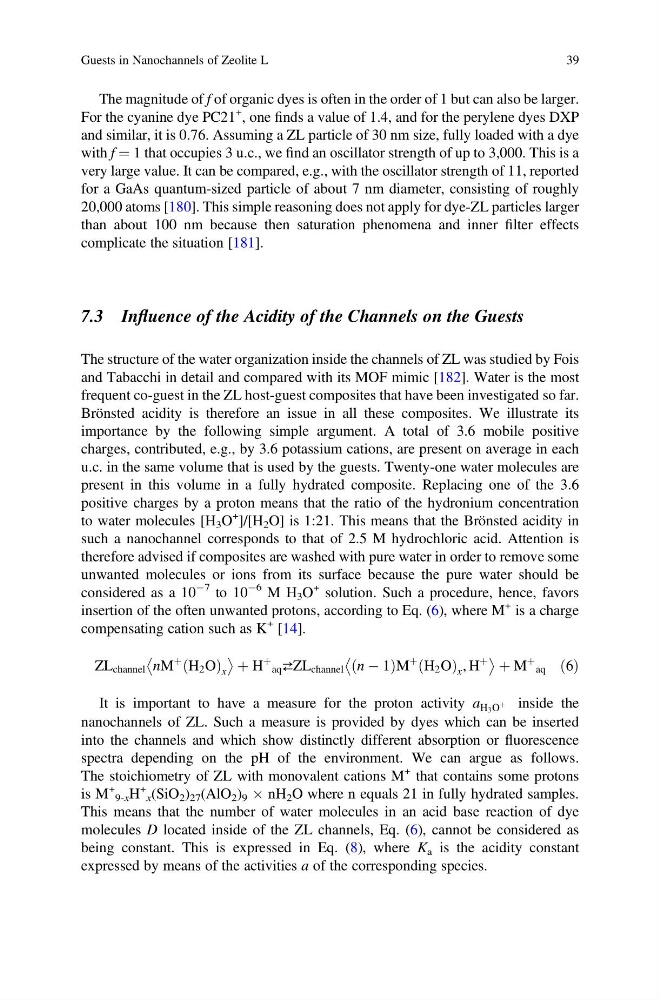
insertion of the often unwanted protons, according to Eq. (6), where M
+ is a charge
compensating cation such as K
+ [14].
ZL channel nM
þ H 2 O
ð
Þ x
þ H
þ
aq ⇄ZL channel n À 1
ð
ÞM
þ H 2 O
ð
Þ x , H
þ
þ M
þ
aq ð6Þ
It is important to have a measure for the proton activity a H 3 O
þ
inside the
nanochannels of ZL. Such a measure is provided by dyes which can be inserted
into the channels and which show distinctly different absorption or fluorescence
spectra depending on the pH of the environment. We can argue as follows.
The stoichiometry of ZL with monovalent cations M
+ that contains some protons
is M
+
9-x H
+
x (SiO 2 ) 27 (AlO 2 ) 9 Â nH 2 O where n equals 21 in fully hydrated samples.
This means that the number of water molecules in an acid base reaction of dye
molecules D located inside of the ZL channels, Eq. (6), cannot be considered as
being constant. This is expressed in Eq. (8), where K a is the acidity constant
expressed by means of the activities a of the corresponding species.
Guests in Nanochannels of Zeolite L
39
For the cyanine dye PC21
+
, one finds a value of 1.4, and for the perylene dyes DXP
and similar, it is 0.76. Assuming a ZL particle of 30 nm size, fully loaded with a dye
with f ¼ 1 that occupies 3 u.c., we find an oscillator strength of up to 3,000. This is a
very large value. It can be compared, e.g., with the oscillator strength of 11, reported
for a GaAs quantum-sized particle of about 7 nm diameter, consisting of roughly
20,000 atoms [180]. This simple reasoning does not apply for dye-ZL particles larger
than about 100 nm because then saturation phenomena and inner filter effects
complicate the situation [181].
7.3 Influence of the Acidity of the Channels on the Guests
The structure of the water organization inside the channels of ZL was studied by Fois
and Tabacchi in detail and compared with its MOF mimic [182]. Water is the most
frequent co-guest in the ZL host-guest composites that have been investigated so far.
Brönsted acidity is therefore an issue in all these composites. We illustrate its
importance by the following simple argument. A total of 3.6 mobile positive
charges, contributed, e.g., by 3.6 potassium cations, are present on average in each
u.c. in the same volume that is used by the guests. Twenty-one water molecules are
present in this volume in a fully hydrated composite. Replacing one of the 3.6
positive charges by a proton means that the ratio of the hydronium concentration
to water molecules [H 3 O
+
]/[H 2 O] is 1:21. This means that the Brönsted acidity in
such a nanochannel corresponds to that of 2.5 M hydrochloric acid. Attention is
therefore advised if composites are washed with pure water in order to remove some
unwanted molecules or ions from its surface because the pure water should be
considered as a 10
À7 to 10
À6 M H 3 O
+ solution. Such a procedure, hence, favors
insertion of the often unwanted protons, according to Eq. (6), where M
+ is a charge
compensating cation such as K
+ [14].
ZL channel nM
þ H 2 O
ð
Þ x
þ H
þ
aq ⇄ZL channel n À 1
ð
ÞM
þ H 2 O
ð
Þ x , H
þ
þ M
þ
aq ð6Þ
It is important to have a measure for the proton activity a H 3 O
þ
inside the
nanochannels of ZL. Such a measure is provided by dyes which can be inserted
into the channels and which show distinctly different absorption or fluorescence
spectra depending on the pH of the environment. We can argue as follows.
The stoichiometry of ZL with monovalent cations M
+ that contains some protons
is M
+
9-x H
+
x (SiO 2 ) 27 (AlO 2 ) 9 Â nH 2 O where n equals 21 in fully hydrated samples.
This means that the number of water molecules in an acid base reaction of dye
molecules D located inside of the ZL channels, Eq. (6), cannot be considered as
being constant. This is expressed in Eq. (8), where K a is the acidity constant
expressed by means of the activities a of the corresponding species.
Guests in Nanochannels of Zeolite L
39