

3.1 Inner Filter
The inner-filter mechanism (i) follows a trivial mechanism, where the donor (the
UCNP) emits light at a wavelength where the acceptor (the chromophore) absorbs.
In this case, the detection system will detect a quenching of the fluorescence
intensity of the donor but without affecting the donor emission lifetime [35, 43].
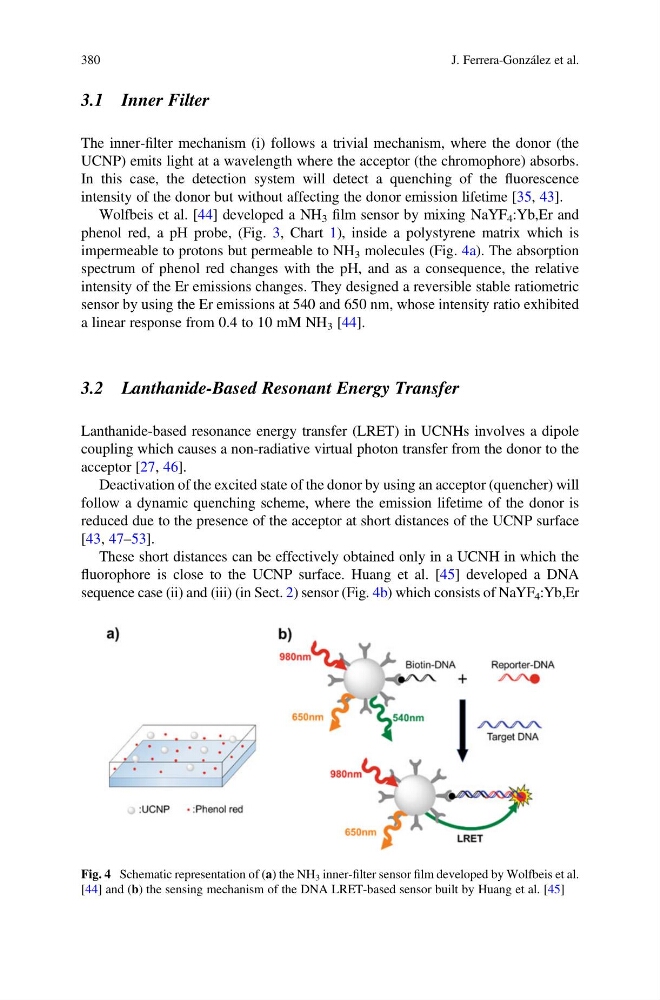
Wolfbeis et al. [44] developed a NH 3 film sensor by mixing NaYF 4 :Yb,Er and
phenol red, a pH probe, (Fig. 3, Chart 1), inside a polystyrene matrix which is
impermeable to protons but permeable to NH 3 molecules (Fig. 4a). The absorption
spectrum of phenol red changes with the pH, and as a consequence, the relative
intensity of the Er emissions changes. They designed a reversible stable ratiometric
sensor by using the Er emissions at 540 and 650 nm, whose intensity ratio exhibited
a linear response from 0.4 to 10 mM NH 3 [44].
3.2 Lanthanide-Based Resonant Energy Transfer
Lanthanide-based resonance energy transfer (LRET) in UCNHs involves a dipole
coupling which causes a non-radiative virtual photon transfer from the donor to the
acceptor [27, 46].
Deactivation of the excited state of the donor by using an acceptor (quencher) will
follow a dynamic quenching scheme, where the emission lifetime of the donor is
reduced due to the presence of the acceptor at short distances of the UCNP surface
[43, 47–53].
These short distances can be effectively obtained only in a UCNH in which the
fluorophore is close to the UCNP surface. Huang et al. [45] developed a DNA
sequence case (ii) and (iii) (in Sect. 2) sensor (Fig. 4b) which consists of NaYF 4 :Yb,Er
Fig. 4 Schematic representation of (a) the NH 3 inner-filter sensor film developed by Wolfbeis et al.
[44] and (b) the sensing mechanism of the DNA LRET-based sensor built by Huang et al. [45]
380
J. Ferrera-González et al.
The inner-filter mechanism (i) follows a trivial mechanism, where the donor (the
UCNP) emits light at a wavelength where the acceptor (the chromophore) absorbs.
In this case, the detection system will detect a quenching of the fluorescence
intensity of the donor but without affecting the donor emission lifetime [35, 43].
Wolfbeis et al. [44] developed a NH 3 film sensor by mixing NaYF 4 :Yb,Er and
phenol red, a pH probe, (Fig. 3, Chart 1), inside a polystyrene matrix which is
impermeable to protons but permeable to NH 3 molecules (Fig. 4a). The absorption
spectrum of phenol red changes with the pH, and as a consequence, the relative
intensity of the Er emissions changes. They designed a reversible stable ratiometric
sensor by using the Er emissions at 540 and 650 nm, whose intensity ratio exhibited
a linear response from 0.4 to 10 mM NH 3 [44].
3.2 Lanthanide-Based Resonant Energy Transfer
Lanthanide-based resonance energy transfer (LRET) in UCNHs involves a dipole
coupling which causes a non-radiative virtual photon transfer from the donor to the
acceptor [27, 46].
Deactivation of the excited state of the donor by using an acceptor (quencher) will
follow a dynamic quenching scheme, where the emission lifetime of the donor is
reduced due to the presence of the acceptor at short distances of the UCNP surface
[43, 47–53].
These short distances can be effectively obtained only in a UCNH in which the
fluorophore is close to the UCNP surface. Huang et al. [45] developed a DNA
sequence case (ii) and (iii) (in Sect. 2) sensor (Fig. 4b) which consists of NaYF 4 :Yb,Er
Fig. 4 Schematic representation of (a) the NH 3 inner-filter sensor film developed by Wolfbeis et al.
[44] and (b) the sensing mechanism of the DNA LRET-based sensor built by Huang et al. [45]
380
J. Ferrera-González et al.