

means that two MV
2+ must share part of the volume of a u.c., but how? The puzzle
was solved by applying Rietveld refinement of X-ray data and molecular modeling.
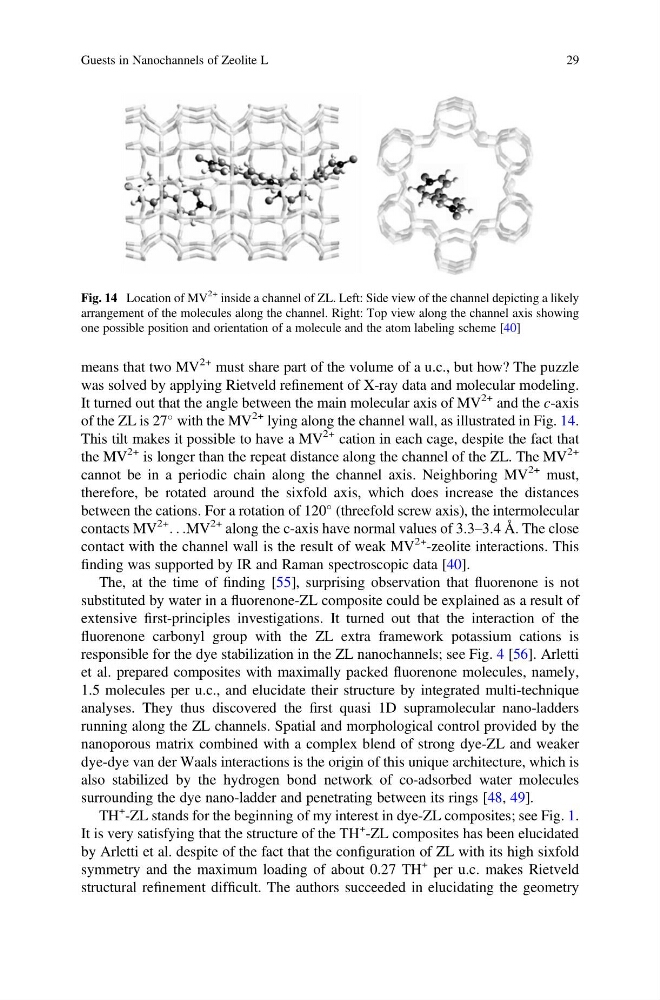
It turned out that the angle between the main molecular axis of MV
2+ and the c-axis
of the ZL is 27
with the MV
2+ lying along the channel wall, as illustrated in Fig. 14.
This tilt makes it possible to have a MV
2+ cation in each cage, despite the fact that
the MV
2+ is longer than the repeat distance along the channel of the ZL. The MV
2+
cannot be in a periodic chain along the channel axis. Neighboring MV
2+ must,
therefore, be rotated around the sixfold axis, which does increase the distances
between the cations. For a rotation of 120
(threefold screw axis), the intermolecular
contacts MV
2+
. . .MV
2+ along the c-axis have normal values of 3.3–3.4 Å. The close
contact with the channel wall is the result of weak MV
2+ -zeolite interactions. This
finding was supported by IR and Raman spectroscopic data [40].
The, at the time of finding [55], surprising observation that fluorenone is not
substituted by water in a fluorenone-ZL composite could be explained as a result of
extensive first-principles investigations. It turned out that the interaction of the
fluorenone carbonyl group with the ZL extra framework potassium cations is
responsible for the dye stabilization in the ZL nanochannels; see Fig. 4 [56]. Arletti
et al. prepared composites with maximally packed fluorenone molecules, namely,
1.5 molecules per u.c., and elucidate their structure by integrated multi-technique
analyses. They thus discovered the first quasi 1D supramolecular nano-ladders
running along the ZL channels. Spatial and morphological control provided by the
nanoporous matrix combined with a complex blend of strong dye-ZL and weaker
dye-dye van der Waals interactions is the origin of this unique architecture, which is
also stabilized by the hydrogen bond network of co-adsorbed water molecules
surrounding the dye nano-ladder and penetrating between its rings [48, 49].
TH
+
-ZL stands for the beginning of my interest in dye-ZL composites; see Fig. 1.
It is very satisfying that the structure of the TH
+
-ZL composites has been elucidated
by Arletti et al. despite of the fact that the configuration of ZL with its high sixfold
symmetry and the maximum loading of about 0.27 TH
+ per u.c. makes Rietveld
structural refinement difficult. The authors succeeded in elucidating the geometry
Fig. 14 Location of MV
2+ inside a channel of ZL. Left: Side view of the channel depicting a likely
arrangement of the molecules along the channel. Right: Top view along the channel axis showing
one possible position and orientation of a molecule and the atom labeling scheme [40]
Guests in Nanochannels of Zeolite L
29
2+ must share part of the volume of a u.c., but how? The puzzle
was solved by applying Rietveld refinement of X-ray data and molecular modeling.
It turned out that the angle between the main molecular axis of MV
2+ and the c-axis
of the ZL is 27
with the MV
2+ lying along the channel wall, as illustrated in Fig. 14.
This tilt makes it possible to have a MV
2+ cation in each cage, despite the fact that
the MV
2+ is longer than the repeat distance along the channel of the ZL. The MV
2+
cannot be in a periodic chain along the channel axis. Neighboring MV
2+ must,
therefore, be rotated around the sixfold axis, which does increase the distances
between the cations. For a rotation of 120
(threefold screw axis), the intermolecular
contacts MV
2+
. . .MV
2+ along the c-axis have normal values of 3.3–3.4 Å. The close
contact with the channel wall is the result of weak MV
2+ -zeolite interactions. This
finding was supported by IR and Raman spectroscopic data [40].
The, at the time of finding [55], surprising observation that fluorenone is not
substituted by water in a fluorenone-ZL composite could be explained as a result of
extensive first-principles investigations. It turned out that the interaction of the
fluorenone carbonyl group with the ZL extra framework potassium cations is
responsible for the dye stabilization in the ZL nanochannels; see Fig. 4 [56]. Arletti
et al. prepared composites with maximally packed fluorenone molecules, namely,
1.5 molecules per u.c., and elucidate their structure by integrated multi-technique
analyses. They thus discovered the first quasi 1D supramolecular nano-ladders
running along the ZL channels. Spatial and morphological control provided by the
nanoporous matrix combined with a complex blend of strong dye-ZL and weaker
dye-dye van der Waals interactions is the origin of this unique architecture, which is
also stabilized by the hydrogen bond network of co-adsorbed water molecules
surrounding the dye nano-ladder and penetrating between its rings [48, 49].
TH
+
-ZL stands for the beginning of my interest in dye-ZL composites; see Fig. 1.
It is very satisfying that the structure of the TH
+
-ZL composites has been elucidated
by Arletti et al. despite of the fact that the configuration of ZL with its high sixfold
symmetry and the maximum loading of about 0.27 TH
+ per u.c. makes Rietveld
structural refinement difficult. The authors succeeded in elucidating the geometry
Fig. 14 Location of MV
2+ inside a channel of ZL. Left: Side view of the channel depicting a likely
arrangement of the molecules along the channel. Right: Top view along the channel axis showing
one possible position and orientation of a molecule and the atom labeling scheme [40]
Guests in Nanochannels of Zeolite L
29