

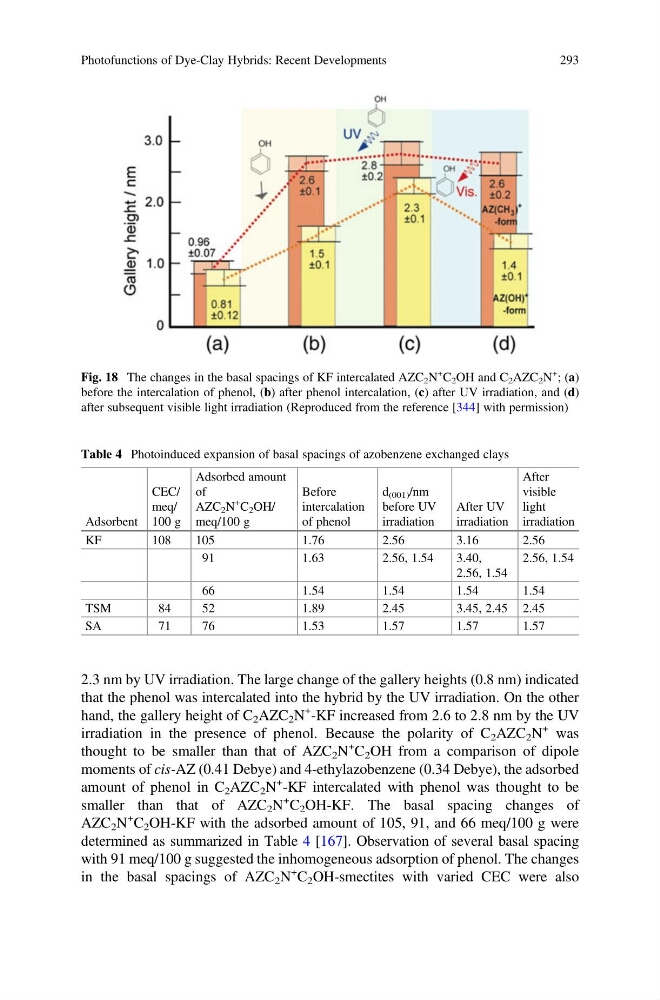
2.3 nm by UV irradiation. The large change of the gallery heights (0.8 nm) indicated
that the phenol was intercalated into the hybrid by the UV irradiation. On the other
hand, the gallery height of C 2 AZC 2 N
+
-KF increased from 2.6 to 2.8 nm by the UV
irradiation in the presence of phenol. Because the polarity of C 2 AZC 2 N
+ was
thought to be smaller than that of AZC 2 N
+
C 2 OH from a comparison of dipole
moments of cis-AZ (0.41 Debye) and 4-ethylazobenzene (0.34 Debye), the adsorbed
amount of phenol in C 2 AZC 2 N
+
-KF intercalated with phenol was thought to be
smaller than that of AZC 2 N
+ C 2 OH-KF. The basal spacing changes of
AZC 2 N
+
C 2 OH-KF with the adsorbed amount of 105, 91, and 66 meq/100 g were
determined as summarized in Table 4 [167]. Observation of several basal spacing
with 91 meq/100 g suggested the inhomogeneous adsorption of phenol. The changes
in the basal spacings of AZC 2 N
+
C 2 OH-smectites with varied CEC were also
Fig. 18 The changes in the basal spacings of KF intercalated AZC 2 N
+ C 2 OH and C 2 AZC 2 N
+ ; (a)
before the intercalation of phenol, (b) after phenol intercalation, (c) after UV irradiation, and (d)
after subsequent visible light irradiation (Reproduced from the reference [344] with permission)
Table 4 Photoinduced expansion of basal spacings of azobenzene exchanged clays
Adsorbent
CEC/
meq/
100 g
Adsorbed amount
of
AZC 2 N
+ C 2 OH/
meq/100 g
Before
intercalation
of phenol
d (001) /nm
before UV
irradiation
After UV
irradiation
After
visible
light
irradiation
KF
108
105
1.76
2.56
3.16
2.56
91
1.63
2.56, 1.54
3.40,
2.56, 1.54
2.56, 1.54
66
1.54
1.54
1.54
1.54
TSM
84
52
1.89
2.45
3.45, 2.45 2.45
SA
71
76
1.53
1.57
1.57
1.57
Photofunctions of Dye-Clay Hybrids: Recent Developments
293
that the phenol was intercalated into the hybrid by the UV irradiation. On the other
hand, the gallery height of C 2 AZC 2 N
+
-KF increased from 2.6 to 2.8 nm by the UV
irradiation in the presence of phenol. Because the polarity of C 2 AZC 2 N
+ was
thought to be smaller than that of AZC 2 N
+
C 2 OH from a comparison of dipole
moments of cis-AZ (0.41 Debye) and 4-ethylazobenzene (0.34 Debye), the adsorbed
amount of phenol in C 2 AZC 2 N
+
-KF intercalated with phenol was thought to be
smaller than that of AZC 2 N
+ C 2 OH-KF. The basal spacing changes of
AZC 2 N
+
C 2 OH-KF with the adsorbed amount of 105, 91, and 66 meq/100 g were
determined as summarized in Table 4 [167]. Observation of several basal spacing
with 91 meq/100 g suggested the inhomogeneous adsorption of phenol. The changes
in the basal spacings of AZC 2 N
+
C 2 OH-smectites with varied CEC were also
Fig. 18 The changes in the basal spacings of KF intercalated AZC 2 N
+ C 2 OH and C 2 AZC 2 N
+ ; (a)
before the intercalation of phenol, (b) after phenol intercalation, (c) after UV irradiation, and (d)
after subsequent visible light irradiation (Reproduced from the reference [344] with permission)
Table 4 Photoinduced expansion of basal spacings of azobenzene exchanged clays
Adsorbent
CEC/
meq/
100 g
Adsorbed amount
of
AZC 2 N
+ C 2 OH/
meq/100 g
Before
intercalation
of phenol
d (001) /nm
before UV
irradiation
After UV
irradiation
After
visible
light
irradiation
KF
108
105
1.76
2.56
3.16
2.56
91
1.63
2.56, 1.54
3.40,
2.56, 1.54
2.56, 1.54
66
1.54
1.54
1.54
1.54
TSM
84
52
1.89
2.45
3.45, 2.45 2.45
SA
71
76
1.53
1.57
1.57
1.57
Photofunctions of Dye-Clay Hybrids: Recent Developments
293