

5.3.3 Photoswitching of Magnetism
Photoswitching of magnetism of layered double hydroxides (LDHs) was reported by
intercalation of photochromic compounds of spiropyrans [431–435], azobenzenes
[436, 437], and diarylethenes [438–440]. Two main contributions of intralayer
superexchange interactions between metal cations and interlayer dipole interactions
between the LDH layers were claimed to control the magnetism of the LDHs
[441]. Because the photochromic compounds change shapes, sizes, and polarities
by irradiation, the photochromic compounds affected the magnetism of the LDHsdye hybrids.
Magnetism of layered (C 3 H 7 ) 4 N[Fe
II Fe
III (C 2 O 2 S 2 ) 3 ] was explained by charge
transfer at 120 and 6.5 K between Fe
II and Fe
III [432, 442, 443]. The phase transition
at 120 K was attributed to the charge transfer between Fe
II (spin angular momentum
S ¼ 1/2) and Fe
III (S ¼ 2) (the authors named high-temperature phase) to form the
state with Fe
III (S ¼ 5/2) and Fe
II (S ¼ 0) (low-temperature phase). The layered
(C 3 H 7 ) 4 N[Fe
II Fe
III
(C 2 O 2 S 2 ) 3 ] showed ferromagnetism below 6.5 K due to the
charge transfer between the Fe
III (S ¼ 5/2) and the Fe
II (S ¼ 0). A hybrid of
[Fe
II Fe
III
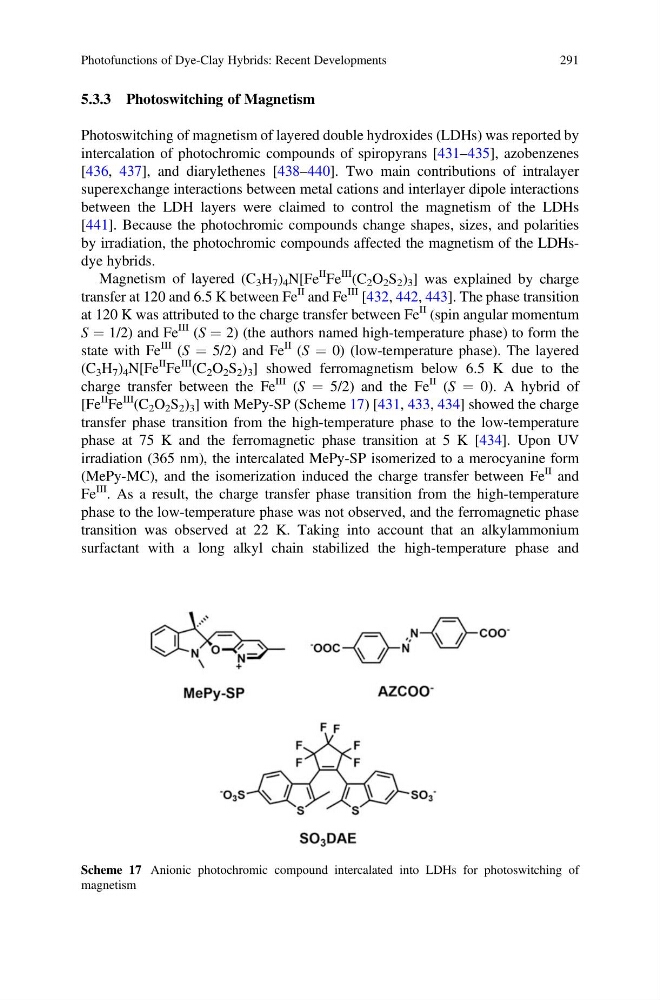
(C 2 O 2 S 2 ) 3 ] with MePy-SP (Scheme 17) [431, 433, 434] showed the charge
transfer phase transition from the high-temperature phase to the low-temperature
phase at 75 K and the ferromagnetic phase transition at 5 K [434]. Upon UV
irradiation (365 nm), the intercalated MePy-SP isomerized to a merocyanine form
(MePy-MC), and the isomerization induced the charge transfer between Fe
II and
Fe
III . As a result, the charge transfer phase transition from the high-temperature
phase to the low-temperature phase was not observed, and the ferromagnetic phase
transition was observed at 22 K. Taking into account that an alkylammonium
surfactant with a long alkyl chain stabilized the high-temperature phase and
Scheme 17 Anionic photochromic compound intercalated into LDHs for photoswitching of
magnetism
Photofunctions of Dye-Clay Hybrids: Recent Developments
291
Photoswitching of magnetism of layered double hydroxides (LDHs) was reported by
intercalation of photochromic compounds of spiropyrans [431–435], azobenzenes
[436, 437], and diarylethenes [438–440]. Two main contributions of intralayer
superexchange interactions between metal cations and interlayer dipole interactions
between the LDH layers were claimed to control the magnetism of the LDHs
[441]. Because the photochromic compounds change shapes, sizes, and polarities
by irradiation, the photochromic compounds affected the magnetism of the LDHsdye hybrids.
Magnetism of layered (C 3 H 7 ) 4 N[Fe
II Fe
III (C 2 O 2 S 2 ) 3 ] was explained by charge
transfer at 120 and 6.5 K between Fe
II and Fe
III [432, 442, 443]. The phase transition
at 120 K was attributed to the charge transfer between Fe
II (spin angular momentum
S ¼ 1/2) and Fe
III (S ¼ 2) (the authors named high-temperature phase) to form the
state with Fe
III (S ¼ 5/2) and Fe
II (S ¼ 0) (low-temperature phase). The layered
(C 3 H 7 ) 4 N[Fe
II Fe
III
(C 2 O 2 S 2 ) 3 ] showed ferromagnetism below 6.5 K due to the
charge transfer between the Fe
III (S ¼ 5/2) and the Fe
II (S ¼ 0). A hybrid of
[Fe
II Fe
III
(C 2 O 2 S 2 ) 3 ] with MePy-SP (Scheme 17) [431, 433, 434] showed the charge
transfer phase transition from the high-temperature phase to the low-temperature
phase at 75 K and the ferromagnetic phase transition at 5 K [434]. Upon UV
irradiation (365 nm), the intercalated MePy-SP isomerized to a merocyanine form
(MePy-MC), and the isomerization induced the charge transfer between Fe
II and
Fe
III . As a result, the charge transfer phase transition from the high-temperature
phase to the low-temperature phase was not observed, and the ferromagnetic phase
transition was observed at 22 K. Taking into account that an alkylammonium
surfactant with a long alkyl chain stabilized the high-temperature phase and
Scheme 17 Anionic photochromic compound intercalated into LDHs for photoswitching of
magnetism
Photofunctions of Dye-Clay Hybrids: Recent Developments
291