

they are photoactive. In some cases, their insulating properties play an essential role
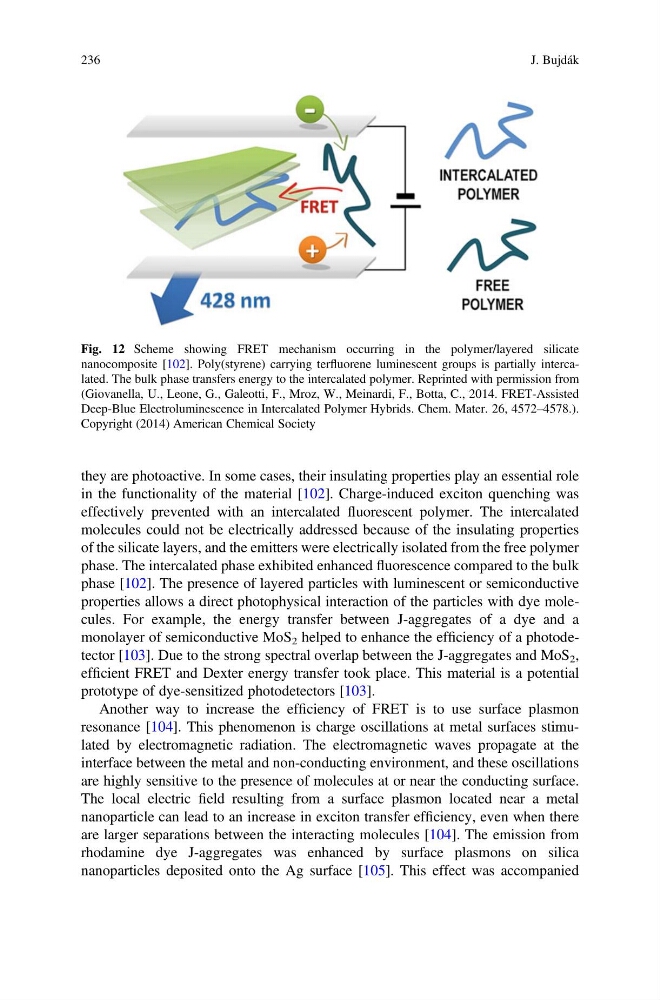
in the functionality of the material [102]. Charge-induced exciton quenching was
effectively prevented with an intercalated fluorescent polymer. The intercalated
molecules could not be electrically addressed because of the insulating properties
of the silicate layers, and the emitters were electrically isolated from the free polymer
phase. The intercalated phase exhibited enhanced fluorescence compared to the bulk
phase [102]. The presence of layered particles with luminescent or semiconductive
properties allows a direct photophysical interaction of the particles with dye molecules. For example, the energy transfer between J-aggregates of a dye and a
monolayer of semiconductive MoS 2 helped to enhance the efficiency of a photodetector [103]. Due to the strong spectral overlap between the J-aggregates and MoS 2 ,
efficient FRET and Dexter energy transfer took place. This material is a potential
prototype of dye-sensitized photodetectors [103].
Another way to increase the efficiency of FRET is to use surface plasmon
resonance [104]. This phenomenon is charge oscillations at metal surfaces stimulated by electromagnetic radiation. The electromagnetic waves propagate at the
interface between the metal and non-conducting environment, and these oscillations
are highly sensitive to the presence of molecules at or near the conducting surface.
The local electric field resulting from a surface plasmon located near a metal
nanoparticle can lead to an increase in exciton transfer efficiency, even when there
are larger separations between the interacting molecules [104]. The emission from
rhodamine dye J-aggregates was enhanced by surface plasmons on silica
nanoparticles deposited onto the Ag surface [105]. This effect was accompanied
Fig. 12 Scheme showing FRET mechanism occurring in the polymer/layered silicate
nanocomposite [102]. Poly(styrene) carrying terfluorene luminescent groups is partially intercalated. The bulk phase transfers energy to the intercalated polymer. Reprinted with permission from
(Giovanella, U., Leone, G., Galeotti, F., Mroz, W., Meinardi, F., Botta, C., 2014. FRET-Assisted
Deep-Blue Electroluminescence in Intercalated Polymer Hybrids. Chem. Mater. 26, 4572–4578.).
Copyright (2014) American Chemical Society
236
J. Bujdák
in the functionality of the material [102]. Charge-induced exciton quenching was
effectively prevented with an intercalated fluorescent polymer. The intercalated
molecules could not be electrically addressed because of the insulating properties
of the silicate layers, and the emitters were electrically isolated from the free polymer
phase. The intercalated phase exhibited enhanced fluorescence compared to the bulk
phase [102]. The presence of layered particles with luminescent or semiconductive
properties allows a direct photophysical interaction of the particles with dye molecules. For example, the energy transfer between J-aggregates of a dye and a
monolayer of semiconductive MoS 2 helped to enhance the efficiency of a photodetector [103]. Due to the strong spectral overlap between the J-aggregates and MoS 2 ,
efficient FRET and Dexter energy transfer took place. This material is a potential
prototype of dye-sensitized photodetectors [103].
Another way to increase the efficiency of FRET is to use surface plasmon
resonance [104]. This phenomenon is charge oscillations at metal surfaces stimulated by electromagnetic radiation. The electromagnetic waves propagate at the
interface between the metal and non-conducting environment, and these oscillations
are highly sensitive to the presence of molecules at or near the conducting surface.
The local electric field resulting from a surface plasmon located near a metal
nanoparticle can lead to an increase in exciton transfer efficiency, even when there
are larger separations between the interacting molecules [104]. The emission from
rhodamine dye J-aggregates was enhanced by surface plasmons on silica
nanoparticles deposited onto the Ag surface [105]. This effect was accompanied
Fig. 12 Scheme showing FRET mechanism occurring in the polymer/layered silicate
nanocomposite [102]. Poly(styrene) carrying terfluorene luminescent groups is partially intercalated. The bulk phase transfers energy to the intercalated polymer. Reprinted with permission from
(Giovanella, U., Leone, G., Galeotti, F., Mroz, W., Meinardi, F., Botta, C., 2014. FRET-Assisted
Deep-Blue Electroluminescence in Intercalated Polymer Hybrids. Chem. Mater. 26, 4572–4578.).
Copyright (2014) American Chemical Society
236
J. Bujdák