

the LB films. Some of them exhibited FRET [27, 32, 33, 42, 100]. An example is LB
films comprised of N, N
0 -dioctadecyl-thiacyanine and octadecyl-RB in the presence
of Lap. The dye molecules formed J-aggregates which were active in FRET
[33]. The properties of LB films were improved compared to the hybrid dispersions
or films of the same systems, in which the hydrophobic dyes had a stronger tendency
to aggregate, forming H- and J-type assemblies with lower photoactivities
[33]. FRET was effectively used to track changes occurring during the deposition
of the LbL films based on the layers of silicate particles with adsorbed cationic laser
dyes and polyelectrolyte [40] as already described in Sect. 4.2.6.
4.2.10 Structural Changes in Dye Molecules and FRET
Changing the FRET efficiency can be achieved by an induced change of the integral
overlap. It can be done by changing the conditions, notably pH, photochromically, or
by interacting with an analyte. One possibility is to change the integral overlap by
shifting the wavelength of the absorbed light. Alternatively, the change in the
integral overlap may be modulated by changing the molar absorption coefficient
without any significant displacements of the absorption bands. The use of
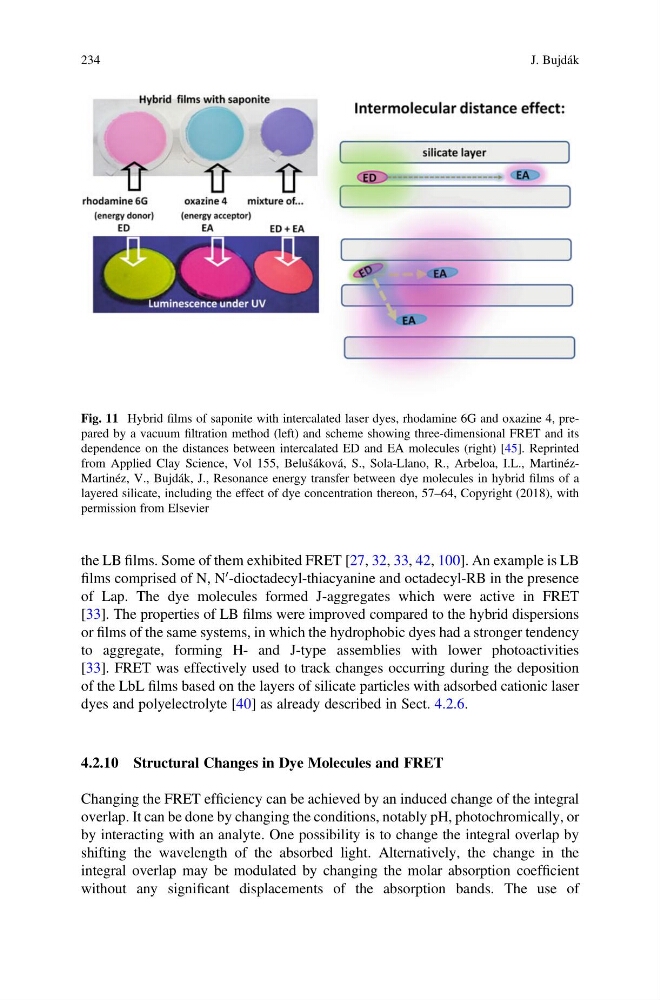
Fig. 11 Hybrid films of saponite with intercalated laser dyes, rhodamine 6G and oxazine 4, prepared by a vacuum filtration method (left) and scheme showing three-dimensional FRET and its
dependence on the distances between intercalated ED and EA molecules (right) [45]. Reprinted
from Applied Clay Science, Vol 155, Belušáková, S., Sola-Llano, R., Arbeloa, I.L., MartinézMartinéz, V., Bujdák, J., Resonance energy transfer between dye molecules in hybrid films of a
layered silicate, including the effect of dye concentration thereon, 57–64, Copyright (2018), with
permission from Elsevier
234
J. Bujdák
films comprised of N, N
0 -dioctadecyl-thiacyanine and octadecyl-RB in the presence
of Lap. The dye molecules formed J-aggregates which were active in FRET
[33]. The properties of LB films were improved compared to the hybrid dispersions
or films of the same systems, in which the hydrophobic dyes had a stronger tendency
to aggregate, forming H- and J-type assemblies with lower photoactivities
[33]. FRET was effectively used to track changes occurring during the deposition
of the LbL films based on the layers of silicate particles with adsorbed cationic laser
dyes and polyelectrolyte [40] as already described in Sect. 4.2.6.
4.2.10 Structural Changes in Dye Molecules and FRET
Changing the FRET efficiency can be achieved by an induced change of the integral
overlap. It can be done by changing the conditions, notably pH, photochromically, or
by interacting with an analyte. One possibility is to change the integral overlap by
shifting the wavelength of the absorbed light. Alternatively, the change in the
integral overlap may be modulated by changing the molar absorption coefficient
without any significant displacements of the absorption bands. The use of
Fig. 11 Hybrid films of saponite with intercalated laser dyes, rhodamine 6G and oxazine 4, prepared by a vacuum filtration method (left) and scheme showing three-dimensional FRET and its
dependence on the distances between intercalated ED and EA molecules (right) [45]. Reprinted
from Applied Clay Science, Vol 155, Belušáková, S., Sola-Llano, R., Arbeloa, I.L., MartinézMartinéz, V., Bujdák, J., Resonance energy transfer between dye molecules in hybrid films of a
layered silicate, including the effect of dye concentration thereon, 57–64, Copyright (2018), with
permission from Elsevier
234
J. Bujdák