

4.2.4 Complexes with Neutral Dye Molecules
Systems based on uncharged organic dye molecules are very rare. One simple reason
is the relatively low solubility of this type of compounds, especially in polar solvents
that are compatible with nanoparticle systems. Another major reason for the application of this type of compounds being problematic is the relatively weak adsorption
of neutral molecules to the polar surfaces of nanoparticles compared to the stronger
electrostatic binding of ionic dyes. And last but not least, the formation of molecular
aggregates and the so-called phenomenon of metachromasia, which frequently leads
to the disappearance of a dye’s photoactivity, occurs more easily in systems with
uncharged molecules. Although ionic dyes also exhibit molecular aggregation, the
degree of the aggregation can be at least partially reduced by electrostatic repulsion
between ions of the same charge and by the hydration of the ions. With ionic dyes,
the dye aggregation can be suppressed more easily than with neutral molecules.
Nevertheless, the successful application of neutral dye molecules has also been
realized. The solubilization of otherwise insoluble dyes was achieved in the presence
of layered templates, such as Sap, which led to the enhancement of their
photoactivity [65]. There are a few papers reporting FRET for systems with neutral
dye molecules and layered inorganic templates. For example, FRET was studied
with systems based on pyrene and acriflavine, the former dye component was in a
neutral form. FRET efficiency doubled in the presence of Lap compared to the mixed
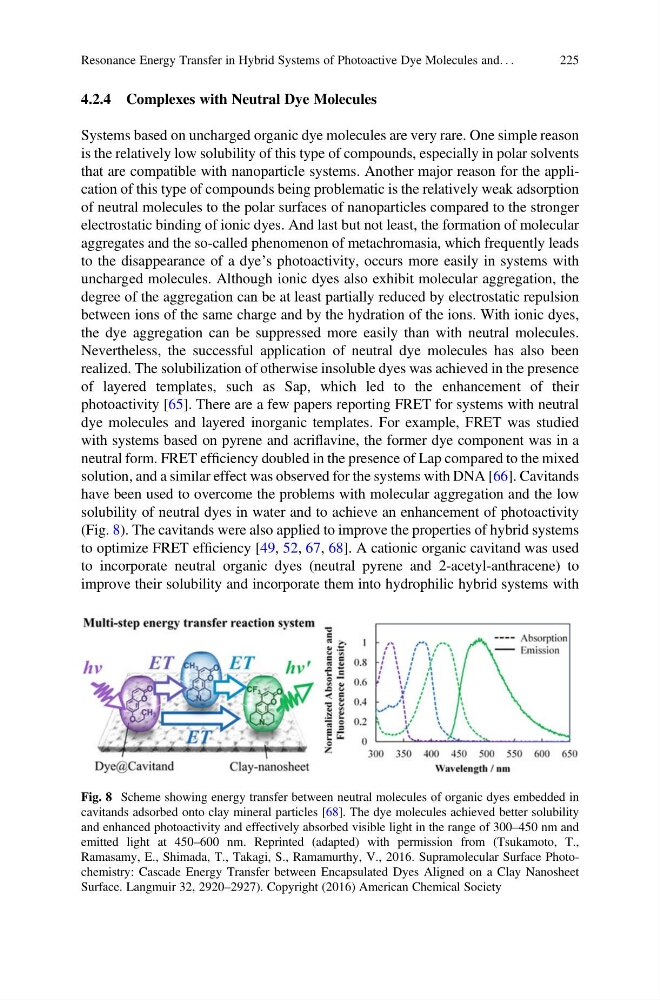
solution, and a similar effect was observed for the systems with DNA [66]. Cavitands
have been used to overcome the problems with molecular aggregation and the low
solubility of neutral dyes in water and to achieve an enhancement of photoactivity
(Fig. 8). The cavitands were also applied to improve the properties of hybrid systems
to optimize FRET efficiency [49, 52, 67, 68]. A cationic organic cavitand was used
to incorporate neutral organic dyes (neutral pyrene and 2-acetyl-anthracene) to
improve their solubility and incorporate them into hydrophilic hybrid systems with
Fig. 8 Scheme showing energy transfer between neutral molecules of organic dyes embedded in
cavitands adsorbed onto clay mineral particles [68]. The dye molecules achieved better solubility
and enhanced photoactivity and effectively absorbed visible light in the range of 300–450 nm and
emitted light at 450–600 nm. Reprinted (adapted) with permission from (Tsukamoto, T.,
Ramasamy, E., Shimada, T., Takagi, S., Ramamurthy, V., 2016. Supramolecular Surface Photochemistry: Cascade Energy Transfer between Encapsulated Dyes Aligned on a Clay Nanosheet
Surface. Langmuir 32, 2920–2927). Copyright (2016) American Chemical Society
Resonance Energy Transfer in Hybrid Systems of Photoactive Dye Molecules and. . .
225
Systems based on uncharged organic dye molecules are very rare. One simple reason
is the relatively low solubility of this type of compounds, especially in polar solvents
that are compatible with nanoparticle systems. Another major reason for the application of this type of compounds being problematic is the relatively weak adsorption
of neutral molecules to the polar surfaces of nanoparticles compared to the stronger
electrostatic binding of ionic dyes. And last but not least, the formation of molecular
aggregates and the so-called phenomenon of metachromasia, which frequently leads
to the disappearance of a dye’s photoactivity, occurs more easily in systems with
uncharged molecules. Although ionic dyes also exhibit molecular aggregation, the
degree of the aggregation can be at least partially reduced by electrostatic repulsion
between ions of the same charge and by the hydration of the ions. With ionic dyes,
the dye aggregation can be suppressed more easily than with neutral molecules.
Nevertheless, the successful application of neutral dye molecules has also been
realized. The solubilization of otherwise insoluble dyes was achieved in the presence
of layered templates, such as Sap, which led to the enhancement of their
photoactivity [65]. There are a few papers reporting FRET for systems with neutral
dye molecules and layered inorganic templates. For example, FRET was studied
with systems based on pyrene and acriflavine, the former dye component was in a
neutral form. FRET efficiency doubled in the presence of Lap compared to the mixed
solution, and a similar effect was observed for the systems with DNA [66]. Cavitands
have been used to overcome the problems with molecular aggregation and the low
solubility of neutral dyes in water and to achieve an enhancement of photoactivity
(Fig. 8). The cavitands were also applied to improve the properties of hybrid systems
to optimize FRET efficiency [49, 52, 67, 68]. A cationic organic cavitand was used
to incorporate neutral organic dyes (neutral pyrene and 2-acetyl-anthracene) to
improve their solubility and incorporate them into hydrophilic hybrid systems with
Fig. 8 Scheme showing energy transfer between neutral molecules of organic dyes embedded in
cavitands adsorbed onto clay mineral particles [68]. The dye molecules achieved better solubility
and enhanced photoactivity and effectively absorbed visible light in the range of 300–450 nm and
emitted light at 450–600 nm. Reprinted (adapted) with permission from (Tsukamoto, T.,
Ramasamy, E., Shimada, T., Takagi, S., Ramamurthy, V., 2016. Supramolecular Surface Photochemistry: Cascade Energy Transfer between Encapsulated Dyes Aligned on a Clay Nanosheet
Surface. Langmuir 32, 2920–2927). Copyright (2016) American Chemical Society
Resonance Energy Transfer in Hybrid Systems of Photoactive Dye Molecules and. . .
225