

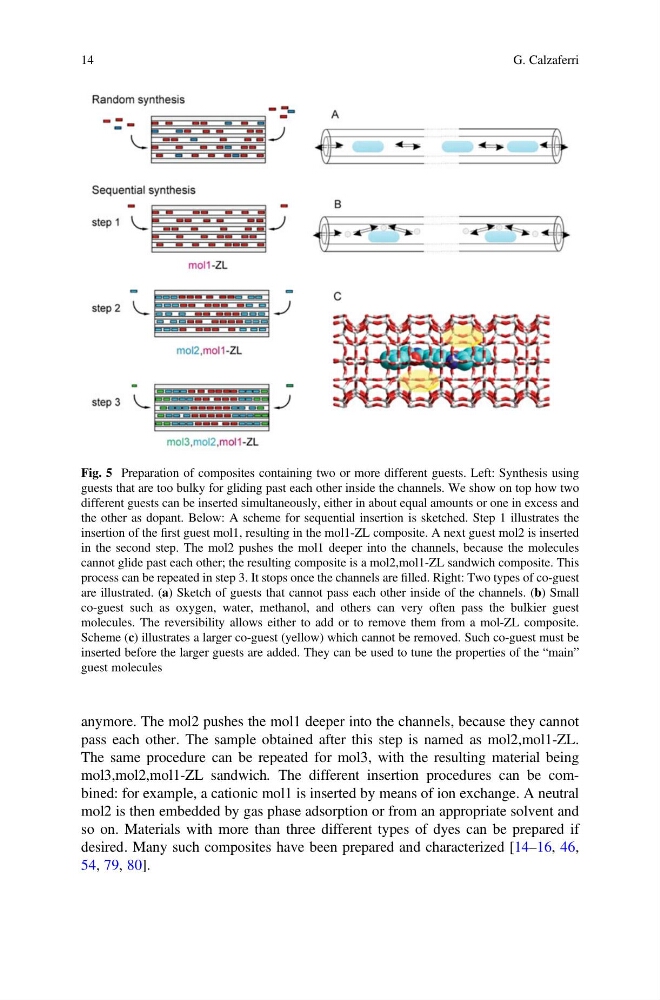
anymore. The mol2 pushes the mol1 deeper into the channels, because they cannot
pass each other. The sample obtained after this step is named as mol2,mol1-ZL.
The same procedure can be repeated for mol3, with the resulting material being
mol3,mol2,mol1-ZL sandwich. The different insertion procedures can be combined: for example, a cationic mol1 is inserted by means of ion exchange. A neutral
mol2 is then embedded by gas phase adsorption or from an appropriate solvent and
so on. Materials with more than three different types of dyes can be prepared if
desired. Many such composites have been prepared and characterized [14–16, 46,
54, 79, 80].
Fig. 5 Preparation of composites containing two or more different guests. Left: Synthesis using
guests that are too bulky for gliding past each other inside the channels. We show on top how two
different guests can be inserted simultaneously, either in about equal amounts or one in excess and
the other as dopant. Below: A scheme for sequential insertion is sketched. Step 1 illustrates the
insertion of the first guest mol1, resulting in the mol1-ZL composite. A next guest mol2 is inserted
in the second step. The mol2 pushes the mol1 deeper into the channels, because the molecules
cannot glide past each other; the resulting composite is a mol2,mol1-ZL sandwich composite. This
process can be repeated in step 3. It stops once the channels are filled. Right: Two types of co-guest
are illustrated. (a) Sketch of guests that cannot pass each other inside of the channels. (b) Small
co-guest such as oxygen, water, methanol, and others can very often pass the bulkier guest
molecules. The reversibility allows either to add or to remove them from a mol-ZL composite.
Scheme (c) illustrates a larger co-guest (yellow) which cannot be removed. Such co-guest must be
inserted before the larger guests are added. They can be used to tune the properties of the “main”
guest molecules
14
G. Calzaferri
pass each other. The sample obtained after this step is named as mol2,mol1-ZL.
The same procedure can be repeated for mol3, with the resulting material being
mol3,mol2,mol1-ZL sandwich. The different insertion procedures can be combined: for example, a cationic mol1 is inserted by means of ion exchange. A neutral
mol2 is then embedded by gas phase adsorption or from an appropriate solvent and
so on. Materials with more than three different types of dyes can be prepared if
desired. Many such composites have been prepared and characterized [14–16, 46,
54, 79, 80].
Fig. 5 Preparation of composites containing two or more different guests. Left: Synthesis using
guests that are too bulky for gliding past each other inside the channels. We show on top how two
different guests can be inserted simultaneously, either in about equal amounts or one in excess and
the other as dopant. Below: A scheme for sequential insertion is sketched. Step 1 illustrates the
insertion of the first guest mol1, resulting in the mol1-ZL composite. A next guest mol2 is inserted
in the second step. The mol2 pushes the mol1 deeper into the channels, because the molecules
cannot glide past each other; the resulting composite is a mol2,mol1-ZL sandwich composite. This
process can be repeated in step 3. It stops once the channels are filled. Right: Two types of co-guest
are illustrated. (a) Sketch of guests that cannot pass each other inside of the channels. (b) Small
co-guest such as oxygen, water, methanol, and others can very often pass the bulkier guest
molecules. The reversibility allows either to add or to remove them from a mol-ZL composite.
Scheme (c) illustrates a larger co-guest (yellow) which cannot be removed. Such co-guest must be
inserted before the larger guests are added. They can be used to tune the properties of the “main”
guest molecules
14
G. Calzaferri