

at which no significant molecular aggregation and quenching occurs. As shown in
Fig. 2, the occurrence of the neighboring molecules in the range of high FRET
efficiency is highly unlikely at this concentration. Combining Eqs. (8) and (13), one
can calculate the values of the FRET efficiency similarly to the way it has been
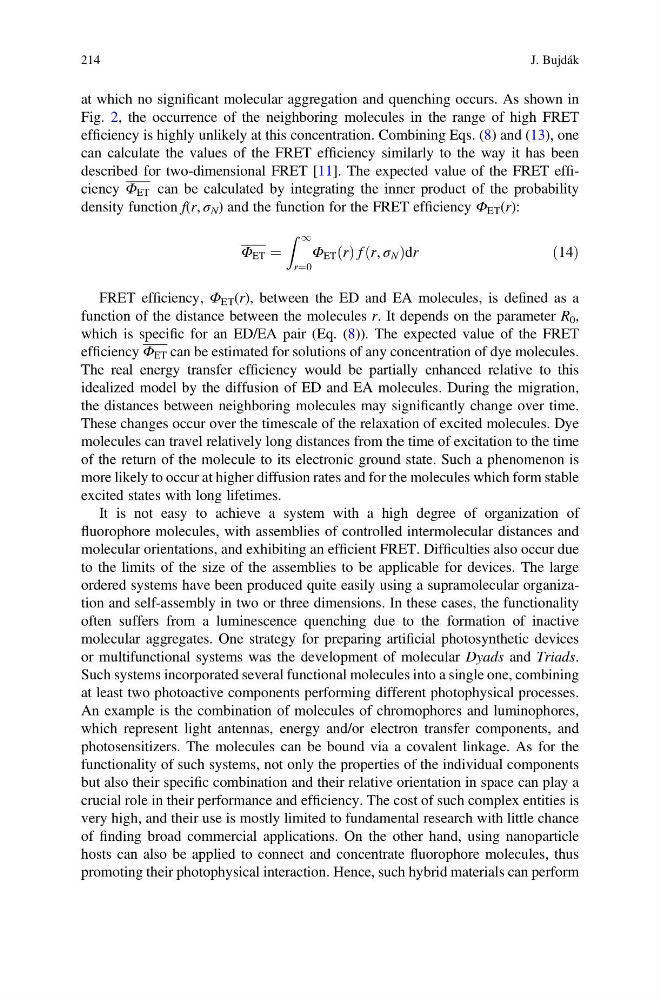
described for two-dimensional FRET [11]. The expected value of the FRET efficiency Φ ET can be calculated by integrating the inner product of the probability
density function f(r, σ N ) and the function for the FRET efficiency Φ ET (r):
Φ ET ¼
Z 1
r¼0
Φ ET r
ð Þ f r, σ N
ð
Þdr
ð14Þ
FRET efficiency, Φ ET (r), between the ED and EA molecules, is defined as a
function of the distance between the molecules r. It depends on the parameter R 0 ,
which is specific for an ED/EA pair (Eq. (8)). The expected value of the FRET
efficiency Φ ET can be estimated for solutions of any concentration of dye molecules.
The real energy transfer efficiency would be partially enhanced relative to this
idealized model by the diffusion of ED and EA molecules. During the migration,
the distances between neighboring molecules may significantly change over time.
These changes occur over the timescale of the relaxation of excited molecules. Dye
molecules can travel relatively long distances from the time of excitation to the time
of the return of the molecule to its electronic ground state. Such a phenomenon is
more likely to occur at higher diffusion rates and for the molecules which form stable
excited states with long lifetimes.
It is not easy to achieve a system with a high degree of organization of
fluorophore molecules, with assemblies of controlled intermolecular distances and
molecular orientations, and exhibiting an efficient FRET. Difficulties also occur due
to the limits of the size of the assemblies to be applicable for devices. The large
ordered systems have been produced quite easily using a supramolecular organization and self-assembly in two or three dimensions. In these cases, the functionality
often suffers from a luminescence quenching due to the formation of inactive
molecular aggregates. One strategy for preparing artificial photosynthetic devices
or multifunctional systems was the development of molecular Dyads and Triads.
Such systems incorporated several functional molecules into a single one, combining
at least two photoactive components performing different photophysical processes.
An example is the combination of molecules of chromophores and luminophores,
which represent light antennas, energy and/or electron transfer components, and
photosensitizers. The molecules can be bound via a covalent linkage. As for the
functionality of such systems, not only the properties of the individual components
but also their specific combination and their relative orientation in space can play a
crucial role in their performance and efficiency. The cost of such complex entities is
very high, and their use is mostly limited to fundamental research with little chance
of finding broad commercial applications. On the other hand, using nanoparticle
hosts can also be applied to connect and concentrate fluorophore molecules, thus
promoting their photophysical interaction. Hence, such hybrid materials can perform
214
J. Bujdák
Fig. 2, the occurrence of the neighboring molecules in the range of high FRET
efficiency is highly unlikely at this concentration. Combining Eqs. (8) and (13), one
can calculate the values of the FRET efficiency similarly to the way it has been
described for two-dimensional FRET [11]. The expected value of the FRET efficiency Φ ET can be calculated by integrating the inner product of the probability
density function f(r, σ N ) and the function for the FRET efficiency Φ ET (r):
Φ ET ¼
Z 1
r¼0
Φ ET r
ð Þ f r, σ N
ð
Þdr
ð14Þ
FRET efficiency, Φ ET (r), between the ED and EA molecules, is defined as a
function of the distance between the molecules r. It depends on the parameter R 0 ,
which is specific for an ED/EA pair (Eq. (8)). The expected value of the FRET
efficiency Φ ET can be estimated for solutions of any concentration of dye molecules.
The real energy transfer efficiency would be partially enhanced relative to this
idealized model by the diffusion of ED and EA molecules. During the migration,
the distances between neighboring molecules may significantly change over time.
These changes occur over the timescale of the relaxation of excited molecules. Dye
molecules can travel relatively long distances from the time of excitation to the time
of the return of the molecule to its electronic ground state. Such a phenomenon is
more likely to occur at higher diffusion rates and for the molecules which form stable
excited states with long lifetimes.
It is not easy to achieve a system with a high degree of organization of
fluorophore molecules, with assemblies of controlled intermolecular distances and
molecular orientations, and exhibiting an efficient FRET. Difficulties also occur due
to the limits of the size of the assemblies to be applicable for devices. The large
ordered systems have been produced quite easily using a supramolecular organization and self-assembly in two or three dimensions. In these cases, the functionality
often suffers from a luminescence quenching due to the formation of inactive
molecular aggregates. One strategy for preparing artificial photosynthetic devices
or multifunctional systems was the development of molecular Dyads and Triads.
Such systems incorporated several functional molecules into a single one, combining
at least two photoactive components performing different photophysical processes.
An example is the combination of molecules of chromophores and luminophores,
which represent light antennas, energy and/or electron transfer components, and
photosensitizers. The molecules can be bound via a covalent linkage. As for the
functionality of such systems, not only the properties of the individual components
but also their specific combination and their relative orientation in space can play a
crucial role in their performance and efficiency. The cost of such complex entities is
very high, and their use is mostly limited to fundamental research with little chance
of finding broad commercial applications. On the other hand, using nanoparticle
hosts can also be applied to connect and concentrate fluorophore molecules, thus
promoting their photophysical interaction. Hence, such hybrid materials can perform
214
J. Bujdák