

those exhibiting coordination to K
+
. This understanding represents a general
principle [56].
3.1 Ship-in-a-Bottle Synthesis
In situ formation of species within the channels of ZL is possible by adsorbing
suitable precursors that can be transformed into the final guest. Complexes have been
synthesized inside the channels of ZL by means of the “ship-in-a-bottle” synthesis,
pioneered by Lunsford et al. in the early 1980s [57]. This synthesis principle has
been used successfully for the preparation of many host-guest composites [58–
60]. The ship-in-a-bottle procedure has been widely used for the preparation of
catalytically active metal and bimetallic clusters in ZL, such as Pt, PtSn, PtCo, Ru,
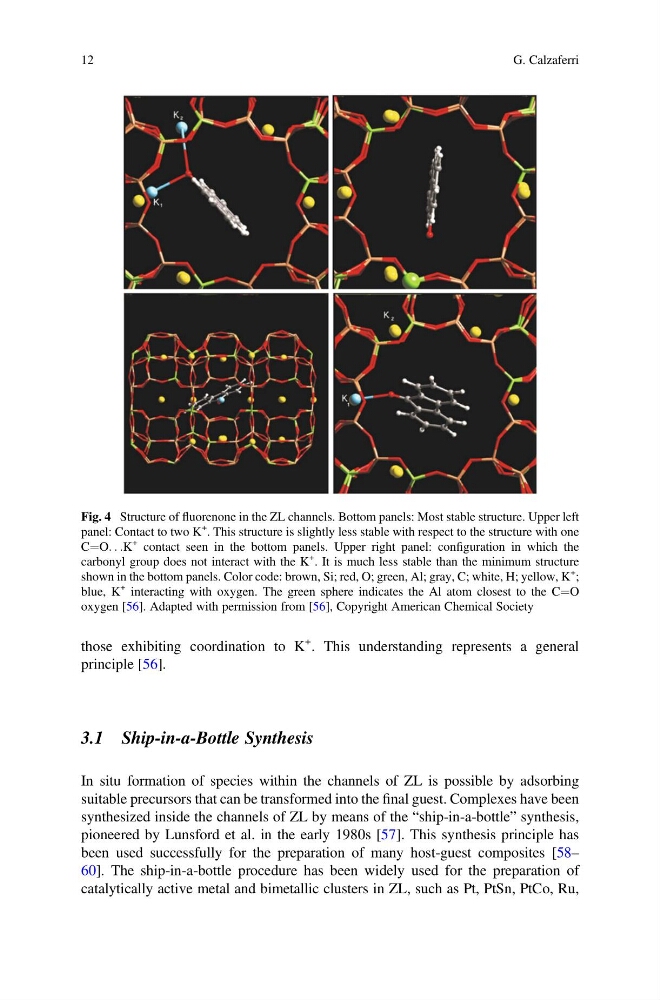
Fig. 4 Structure of fluorenone in the ZL channels. Bottom panels: Most stable structure. Upper left
panel: Contact to two K
+ . This structure is slightly less stable with respect to the structure with one
C¼O. . .K
+ contact seen in the bottom panels. Upper right panel: configuration in which the
carbonyl group does not interact with the K
+ . It is much less stable than the minimum structure
shown in the bottom panels. Color code: brown, Si; red, O; green, Al; gray, C; white, H; yellow, K
+ ;
blue, K
+ interacting with oxygen. The green sphere indicates the Al atom closest to the C¼O
oxygen [56]. Adapted with permission from [56], Copyright American Chemical Society
12
G. Calzaferri
+
. This understanding represents a general
principle [56].
3.1 Ship-in-a-Bottle Synthesis
In situ formation of species within the channels of ZL is possible by adsorbing
suitable precursors that can be transformed into the final guest. Complexes have been
synthesized inside the channels of ZL by means of the “ship-in-a-bottle” synthesis,
pioneered by Lunsford et al. in the early 1980s [57]. This synthesis principle has
been used successfully for the preparation of many host-guest composites [58–
60]. The ship-in-a-bottle procedure has been widely used for the preparation of
catalytically active metal and bimetallic clusters in ZL, such as Pt, PtSn, PtCo, Ru,
Fig. 4 Structure of fluorenone in the ZL channels. Bottom panels: Most stable structure. Upper left
panel: Contact to two K
+ . This structure is slightly less stable with respect to the structure with one
C¼O. . .K
+ contact seen in the bottom panels. Upper right panel: configuration in which the
carbonyl group does not interact with the K
+ . It is much less stable than the minimum structure
shown in the bottom panels. Color code: brown, Si; red, O; green, Al; gray, C; white, H; yellow, K
+ ;
blue, K
+ interacting with oxygen. The green sphere indicates the Al atom closest to the C¼O
oxygen [56]. Adapted with permission from [56], Copyright American Chemical Society
12
G. Calzaferri