

segregation and aggregation that induce changes in photochemical properties. In
recent decades, the intrinsic photochemical properties of molecules on layered
materials were clarified by the progress in techniques to prepare complexes between
molecules and layered materials. These examples will be described in this chapter.
Keywords Chromism · Emission · Fluorescence · Layered materials · Synthetic
clay · Transition probability
Abbreviations
p-TMPyP Tetrakis(N-methylpyridinium-4-yl)porphyrin
AFM
Atomic force microscopy
AIE
Aggregation-induced emission
CEC
Cation exchange capacity
DMF
Dimethylformamide
SSA
Saponite
S-FIE
Surface-fixation induced emission
TPAB
1,3,5-Tris[(N-pyridinium)aniline-4-yl]-benzene
XRD
X-ray diffraction
1 Emission of Dyes
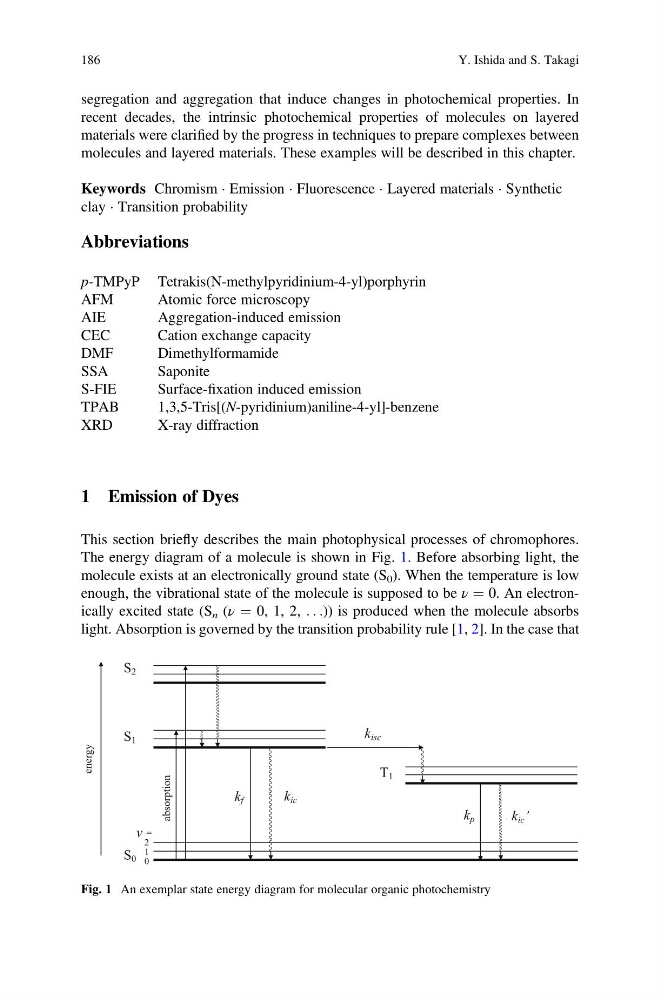
This section briefly describes the main photophysical processes of chromophores.
The energy diagram of a molecule is shown in Fig. 1. Before absorbing light, the
molecule exists at an electronically ground state (S 0 ). When the temperature is low
enough, the vibrational state of the molecule is supposed to be ν ¼ 0. An electronically excited state (S n (ν ¼ 0, 1, 2, . . .)) is produced when the molecule absorbs
light. Absorption is governed by the transition probability rule [1, 2]. In the case that
S 0
S 1
S 2
T 1
absorption
k
v
f
k nr
k isc
k p
k nr ’
energy
=
2
1
0
k ic
k ic ’
Fig. 1 An exemplar state energy diagram for molecular organic photochemistry
186
Y. Ishida and S. Takagi
recent decades, the intrinsic photochemical properties of molecules on layered
materials were clarified by the progress in techniques to prepare complexes between
molecules and layered materials. These examples will be described in this chapter.
Keywords Chromism · Emission · Fluorescence · Layered materials · Synthetic
clay · Transition probability
Abbreviations
p-TMPyP Tetrakis(N-methylpyridinium-4-yl)porphyrin
AFM
Atomic force microscopy
AIE
Aggregation-induced emission
CEC
Cation exchange capacity
DMF
Dimethylformamide
SSA
Saponite
S-FIE
Surface-fixation induced emission
TPAB
1,3,5-Tris[(N-pyridinium)aniline-4-yl]-benzene
XRD
X-ray diffraction
1 Emission of Dyes
This section briefly describes the main photophysical processes of chromophores.
The energy diagram of a molecule is shown in Fig. 1. Before absorbing light, the
molecule exists at an electronically ground state (S 0 ). When the temperature is low
enough, the vibrational state of the molecule is supposed to be ν ¼ 0. An electronically excited state (S n (ν ¼ 0, 1, 2, . . .)) is produced when the molecule absorbs
light. Absorption is governed by the transition probability rule [1, 2]. In the case that
S 0
S 1
S 2
T 1
absorption
k
v
f
k nr
k isc
k p
k nr ’
energy
=
2
1
0
k ic
k ic ’
Fig. 1 An exemplar state energy diagram for molecular organic photochemistry
186
Y. Ishida and S. Takagi