

p ¼
number of occupied sites
total number of sites
:
ð3Þ
The symbol n s represents the number of u.c. occupied by a guest. It can, for
example, be equal to 1, 2, or 3, but n s is not necessarily an integer. The loading
p ranges from 0 for an empty ZL to 1 for a fully loaded one. The concentration c(p)
of a guest-ZL composite can be expressed as a function of p by means of Eq. (4):
[14]
c p
ð Þ ¼ 0:752
p
n S
mol
L
:
ð4Þ
This means, for example, that the maximum concentration of a guest that
occupies 2 u.c. amounts to 0.376 mol/L. Many samples with high loading have
been prepared. The MV
2+ -ZL was probably the first composite reported with such a
high loading [40]. Entropy decrease accompanying the buildup of such highly
ordered composites has been analyzed [20, 41, 42]. The insertion kinetics leading
to homogeneous filling could nicely be monitored using the two cationic dyes Py
+
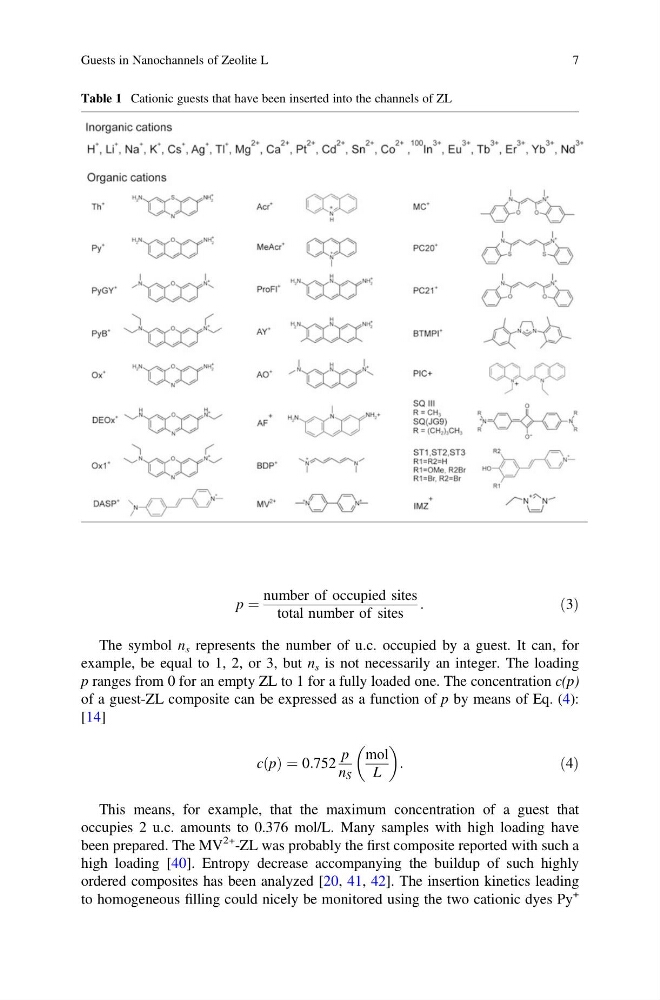
Table 1 Cationic guests that have been inserted into the channels of ZL
Guests in Nanochannels of Zeolite L
7
number of occupied sites
total number of sites
:
ð3Þ
The symbol n s represents the number of u.c. occupied by a guest. It can, for
example, be equal to 1, 2, or 3, but n s is not necessarily an integer. The loading
p ranges from 0 for an empty ZL to 1 for a fully loaded one. The concentration c(p)
of a guest-ZL composite can be expressed as a function of p by means of Eq. (4):
[14]
c p
ð Þ ¼ 0:752
p
n S
mol
L
:
ð4Þ
This means, for example, that the maximum concentration of a guest that
occupies 2 u.c. amounts to 0.376 mol/L. Many samples with high loading have
been prepared. The MV
2+ -ZL was probably the first composite reported with such a
high loading [40]. Entropy decrease accompanying the buildup of such highly
ordered composites has been analyzed [20, 41, 42]. The insertion kinetics leading
to homogeneous filling could nicely be monitored using the two cationic dyes Py
+
Table 1 Cationic guests that have been inserted into the channels of ZL
Guests in Nanochannels of Zeolite L
7