

high thermal stability of the embedded photochromic guest. Indeed, this class of
photochromic hybrid materials offers a great potential to study thermally stable
photoswitches inside MOFs both in bulk form and as thin films.
2.4 Spiropyrans in MOFs
2.4.1 Bulk Materials
Diarylethenes and dithienylethenes are one example of photochromic dyes with
clearly separated absorption bands. Significant spectral changes are also observed
for spiropyrans upon UV light irradiation: While the open spiropyran (SP) form does
not show an absorption band in the visible region and is mostly colorless, the
corresponding merocyanine (MC) possesses a strong absorption band and is, therefore, deeply colored [26, 27]. Interestingly, the absorption properties of the excited
MC are highly dependent on the surrounding medium [21, 150, 151], which is
referred to as solvatochromism [48] (thoroughly described in Sect. 1.2). The
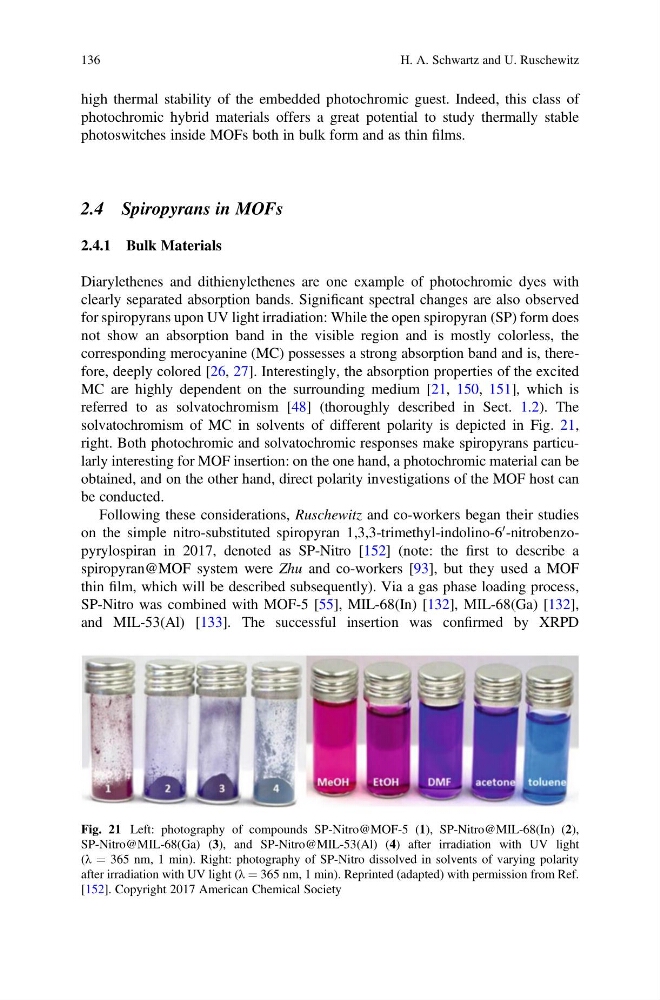
solvatochromism of MC in solvents of different polarity is depicted in Fig. 21,
right. Both photochromic and solvatochromic responses make spiropyrans particularly interesting for MOF insertion: on the one hand, a photochromic material can be
obtained, and on the other hand, direct polarity investigations of the MOF host can
be conducted.
Following these considerations, Ruschewitz and co-workers began their studies
on the simple nitro-substituted spiropyran 1,3,3-trimethyl-indolino-6
0 -nitrobenzopyrylospiran in 2017, denoted as SP-Nitro [152] (note: the first to describe a
spiropyran@MOF system were Zhu and co-workers [93], but they used a MOF
thin film, which will be described subsequently). Via a gas phase loading process,
SP-Nitro was combined with MOF-5 [55], MIL-68(In) [132], MIL-68(Ga) [132],
and MIL-53(Al) [133]. The successful insertion was confirmed by XRPD
Fig. 21 Left: photography of compounds SP-Nitro@MOF-5 (1), SP-Nitro@MIL-68(In) (2),
SP-Nitro@MIL-68(Ga) (3), and SP-Nitro@MIL-53(Al) (4) after irradiation with UV light
(λ ¼ 365 nm, 1 min). Right: photography of SP-Nitro dissolved in solvents of varying polarity
after irradiation with UV light (λ ¼ 365 nm, 1 min). Reprinted (adapted) with permission from Ref.
[152]. Copyright 2017 American Chemical Society
136
H. A. Schwartz and U. Ruschewitz
photochromic hybrid materials offers a great potential to study thermally stable
photoswitches inside MOFs both in bulk form and as thin films.
2.4 Spiropyrans in MOFs
2.4.1 Bulk Materials
Diarylethenes and dithienylethenes are one example of photochromic dyes with
clearly separated absorption bands. Significant spectral changes are also observed
for spiropyrans upon UV light irradiation: While the open spiropyran (SP) form does
not show an absorption band in the visible region and is mostly colorless, the
corresponding merocyanine (MC) possesses a strong absorption band and is, therefore, deeply colored [26, 27]. Interestingly, the absorption properties of the excited
MC are highly dependent on the surrounding medium [21, 150, 151], which is
referred to as solvatochromism [48] (thoroughly described in Sect. 1.2). The
solvatochromism of MC in solvents of different polarity is depicted in Fig. 21,
right. Both photochromic and solvatochromic responses make spiropyrans particularly interesting for MOF insertion: on the one hand, a photochromic material can be
obtained, and on the other hand, direct polarity investigations of the MOF host can
be conducted.
Following these considerations, Ruschewitz and co-workers began their studies
on the simple nitro-substituted spiropyran 1,3,3-trimethyl-indolino-6
0 -nitrobenzopyrylospiran in 2017, denoted as SP-Nitro [152] (note: the first to describe a
spiropyran@MOF system were Zhu and co-workers [93], but they used a MOF
thin film, which will be described subsequently). Via a gas phase loading process,
SP-Nitro was combined with MOF-5 [55], MIL-68(In) [132], MIL-68(Ga) [132],
and MIL-53(Al) [133]. The successful insertion was confirmed by XRPD
Fig. 21 Left: photography of compounds SP-Nitro@MOF-5 (1), SP-Nitro@MIL-68(In) (2),
SP-Nitro@MIL-68(Ga) (3), and SP-Nitro@MIL-53(Al) (4) after irradiation with UV light
(λ ¼ 365 nm, 1 min). Right: photography of SP-Nitro dissolved in solvents of varying polarity
after irradiation with UV light (λ ¼ 365 nm, 1 min). Reprinted (adapted) with permission from Ref.
[152]. Copyright 2017 American Chemical Society
136
H. A. Schwartz and U. Ruschewitz