

approaches are presented, which have continued to develop up to the most recent
work and, thus, led to a significantly better understanding of the resulting optical
properties of these switch@MOF materials. However, even today not all aspects are
understood. These limitations will be discussed in the conclusion section.
2 Switch@MOF Systems
Various switch@MOF systems with fascinating properties were synthesized. As
photoactive part different photochromic dyes have been incorporated into both bulk
materials and thin films. In the following, the resulting composites will be presented,
always starting with bulk materials followed by thin films.
2.1 Stilbenes in MOFs
2.1.1 Bulk Material
The first switching system consisting of a photochromic dye and a metal-organic
framework was described by Fujita and co-workers in 2010 [125]. They used a
porous coordination network (PCN; this is an alternative term for MOF) built up
from the tris(4-pyridyl)triazine ligand and ZnI 2 . The as synthesized network
[{(ZnI 2 ) 3 (C 18 H 12 N 6 ) 2 } Â (C 6 H 5 NO 2 )] n was soaked into a solution containing Zstilbene in cyclohexane. Initially, the pale PCN crystals turned bright yellow, which
already indicated the successful embedment of the dye. By elemental analyses, the
authors confirmed the inclusion of one molecule Z-stilbene per formula unit of the
PCN. Additionally, diffuse reflectance UV/vis spectroscopy verified the successful
inclusion, since a new charge-transfer (CT) band at approximately 450 nm was
observed, which the authors attributed to the proximity of the guest molecule with
the PCN ligand inside the network.
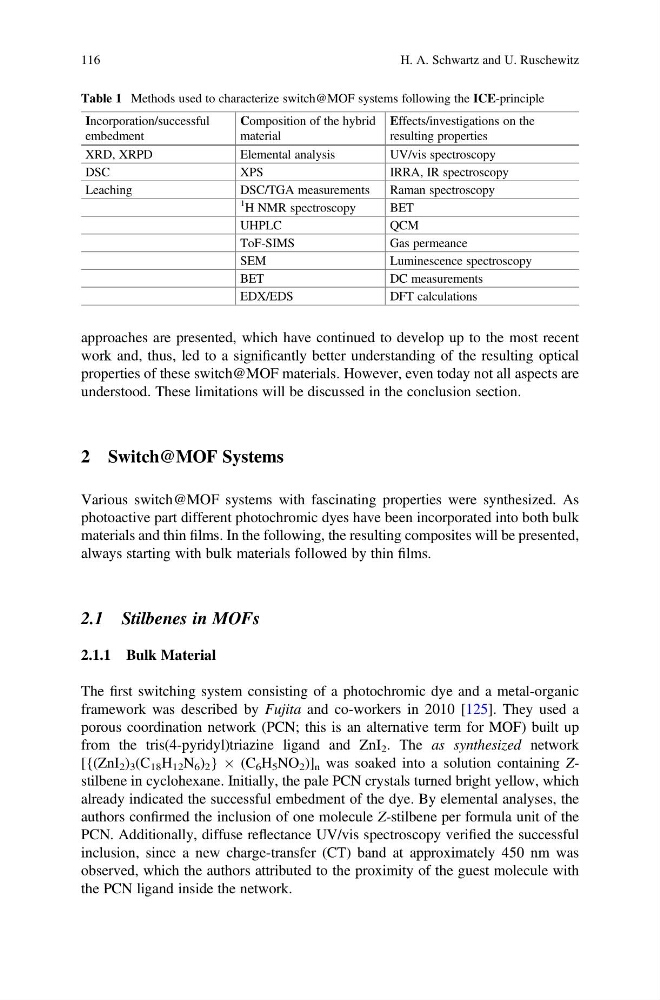
Table 1 Methods used to characterize switch@MOF systems following the ICE-principle
Incorporation/successful
embedment
Composition of the hybrid
material
Effects/investigations on the
resulting properties
XRD, XRPD
Elemental analysis
UV/vis spectroscopy
DSC
XPS
IRRA, IR spectroscopy
Leaching
DSC/TGA measurements
Raman spectroscopy
1
H NMR spectroscopy
BET
UHPLC
QCM
ToF-SIMS
Gas permeance
SEM
Luminescence spectroscopy
BET
DC measurements
EDX/EDS
DFT calculations
116
H. A. Schwartz and U. Ruschewitz
work and, thus, led to a significantly better understanding of the resulting optical
properties of these switch@MOF materials. However, even today not all aspects are
understood. These limitations will be discussed in the conclusion section.
2 Switch@MOF Systems
Various switch@MOF systems with fascinating properties were synthesized. As
photoactive part different photochromic dyes have been incorporated into both bulk
materials and thin films. In the following, the resulting composites will be presented,
always starting with bulk materials followed by thin films.
2.1 Stilbenes in MOFs
2.1.1 Bulk Material
The first switching system consisting of a photochromic dye and a metal-organic
framework was described by Fujita and co-workers in 2010 [125]. They used a
porous coordination network (PCN; this is an alternative term for MOF) built up
from the tris(4-pyridyl)triazine ligand and ZnI 2 . The as synthesized network
[{(ZnI 2 ) 3 (C 18 H 12 N 6 ) 2 } Â (C 6 H 5 NO 2 )] n was soaked into a solution containing Zstilbene in cyclohexane. Initially, the pale PCN crystals turned bright yellow, which
already indicated the successful embedment of the dye. By elemental analyses, the
authors confirmed the inclusion of one molecule Z-stilbene per formula unit of the
PCN. Additionally, diffuse reflectance UV/vis spectroscopy verified the successful
inclusion, since a new charge-transfer (CT) band at approximately 450 nm was
observed, which the authors attributed to the proximity of the guest molecule with
the PCN ligand inside the network.
Table 1 Methods used to characterize switch@MOF systems following the ICE-principle
Incorporation/successful
embedment
Composition of the hybrid
material
Effects/investigations on the
resulting properties
XRD, XRPD
Elemental analysis
UV/vis spectroscopy
DSC
XPS
IRRA, IR spectroscopy
Leaching
DSC/TGA measurements
Raman spectroscopy
1
H NMR spectroscopy
BET
UHPLC
QCM
ToF-SIMS
Gas permeance
SEM
Luminescence spectroscopy
BET
DC measurements
EDX/EDS
DFT calculations
116
H. A. Schwartz and U. Ruschewitz