

Photochromism is known for both inorganic and organic compounds. In the
following, we will set our focus on organic photoswitches. For organic compounds,
the photoresponse depends on the nature of the photochromic molecule. Different
kinds of structural changes occur and may vary from simple isomerization processes
to transfer reactions and bond breaking. For that reason, these photoswitches are
divided into different types with respect to their photoresponse. The two relevant
types for this review with exemplary representatives are discussed in the following.
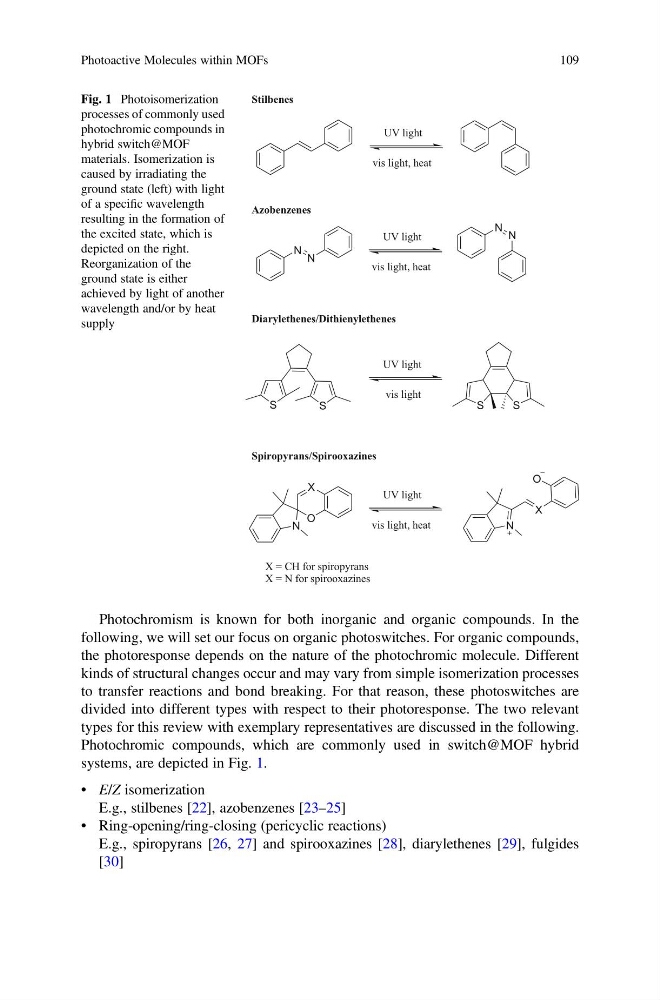
Photochromic compounds, which are commonly used in switch@MOF hybrid
systems, are depicted in Fig. 1.
• E/Z isomerization
E.g., stilbenes [22], azobenzenes [23–25]
• Ring-opening/ring-closing (pericyclic reactions)
E.g., spiropyrans [26, 27] and spirooxazines [28], diarylethenes [29], fulgides
[30]
N N
N N
UV light
vis light, heat
Stilbenes
Azobenzenes
Diarylethenes/Dithienylethenes
S
S
S
S
Spiropyrans/Spirooxazines
N
O
X
N
X
O
X = CH for spiropyrans
X = N for spirooxazines
UV light
vis light, heat
UV light
vis light, heat
UV light
vis light
Fig. 1 Photoisomerization
processes of commonly used
photochromic compounds in
hybrid switch@MOF
materials. Isomerization is
caused by irradiating the
ground state (left) with light
of a specific wavelength
resulting in the formation of
the excited state, which is
depicted on the right.
Reorganization of the
ground state is either
achieved by light of another
wavelength and/or by heat
supply
Photoactive Molecules within MOFs
109
following, we will set our focus on organic photoswitches. For organic compounds,
the photoresponse depends on the nature of the photochromic molecule. Different
kinds of structural changes occur and may vary from simple isomerization processes
to transfer reactions and bond breaking. For that reason, these photoswitches are
divided into different types with respect to their photoresponse. The two relevant
types for this review with exemplary representatives are discussed in the following.
Photochromic compounds, which are commonly used in switch@MOF hybrid
systems, are depicted in Fig. 1.
• E/Z isomerization
E.g., stilbenes [22], azobenzenes [23–25]
• Ring-opening/ring-closing (pericyclic reactions)
E.g., spiropyrans [26, 27] and spirooxazines [28], diarylethenes [29], fulgides
[30]
N N
N N
UV light
vis light, heat
Stilbenes
Azobenzenes
Diarylethenes/Dithienylethenes
S
S
S
S
Spiropyrans/Spirooxazines
N
O
X
N
X
O
X = CH for spiropyrans
X = N for spirooxazines
UV light
vis light, heat
UV light
vis light, heat
UV light
vis light
Fig. 1 Photoisomerization
processes of commonly used
photochromic compounds in
hybrid switch@MOF
materials. Isomerization is
caused by irradiating the
ground state (left) with light
of a specific wavelength
resulting in the formation of
the excited state, which is
depicted on the right.
Reorganization of the
ground state is either
achieved by light of another
wavelength and/or by heat
supply
Photoactive Molecules within MOFs
109