

Pb-LTA samples displayed an intense deep-blue emission with external quantum
efficiencies up to 69%, where a tetrahedral lead cluster (Pb4) with unusually short
Pb À Pb distances and hydroxyl ligands was identified as responsible for the
luminescence properties. An alternative approach to incorporate luminescent species
into zeolite frameworks was reported by Ruivo and collaborators, where Na 2 SO 4 ,
NaCl, and LTA zeolite precursors were ball-milled and treated at high temperatures
under a reductive atmosphere [121]. The samples displayed a transformation from
LTA to SOD (sodalite) framework combined with the confinement of orange
luminescent sulfide species, tentatively related to S
À2 and S 4
À2 emitting centers,
extending the myriad of opportunities to chalcogenide species. Later on, the incorporation of silver cations into luminescent sulfur-zeolites resulted in the fabrication
of white emitting silver-sulfur zeolites, displaying a remarkable color tunability
[79]. This report opened up several avenues to fabricate luminescent hybrid species
(metal/chalcogenide) within the molecularly-size cavities of zeolites. Continuing
with the strategy to confine luminescent inorganic hybrid materials in zeolites, recent
reports have pointed toward the use of zeolites as stabilizing scaffolds for the
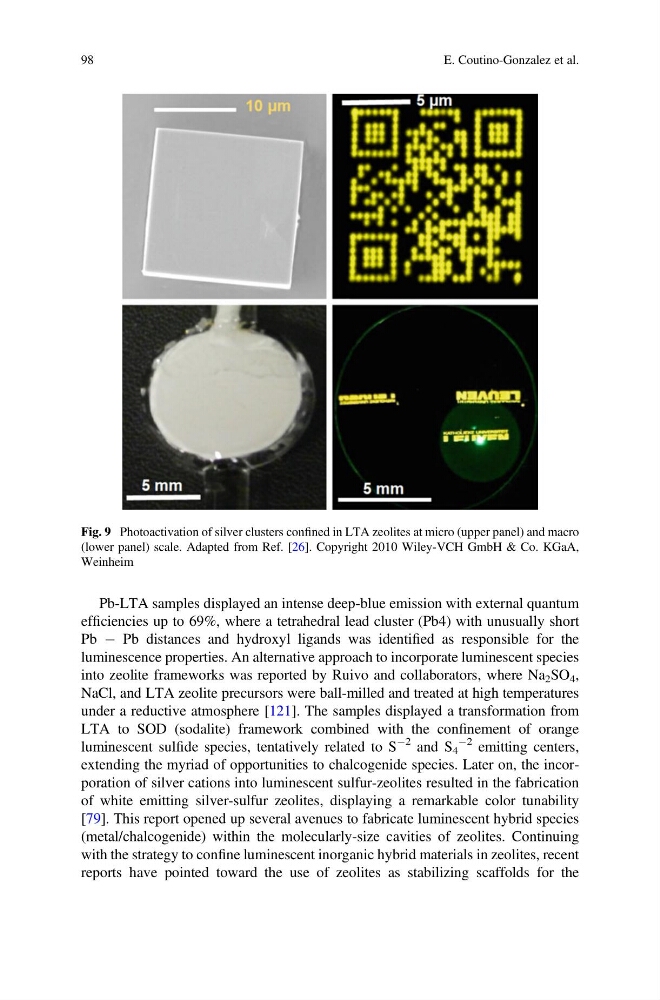
Fig. 9 Photoactivation of silver clusters confined in LTA zeolites at micro (upper panel) and macro
(lower panel) scale. Adapted from Ref. [26]. Copyright 2010 Wiley-VCH GmbH & Co. KGaA,
Weinheim
98
E. Coutino-Gonzalez et al.
efficiencies up to 69%, where a tetrahedral lead cluster (Pb4) with unusually short
Pb À Pb distances and hydroxyl ligands was identified as responsible for the
luminescence properties. An alternative approach to incorporate luminescent species
into zeolite frameworks was reported by Ruivo and collaborators, where Na 2 SO 4 ,
NaCl, and LTA zeolite precursors were ball-milled and treated at high temperatures
under a reductive atmosphere [121]. The samples displayed a transformation from
LTA to SOD (sodalite) framework combined with the confinement of orange
luminescent sulfide species, tentatively related to S
À2 and S 4
À2 emitting centers,
extending the myriad of opportunities to chalcogenide species. Later on, the incorporation of silver cations into luminescent sulfur-zeolites resulted in the fabrication
of white emitting silver-sulfur zeolites, displaying a remarkable color tunability
[79]. This report opened up several avenues to fabricate luminescent hybrid species
(metal/chalcogenide) within the molecularly-size cavities of zeolites. Continuing
with the strategy to confine luminescent inorganic hybrid materials in zeolites, recent
reports have pointed toward the use of zeolites as stabilizing scaffolds for the
Fig. 9 Photoactivation of silver clusters confined in LTA zeolites at micro (upper panel) and macro
(lower panel) scale. Adapted from Ref. [26]. Copyright 2010 Wiley-VCH GmbH & Co. KGaA,
Weinheim
98
E. Coutino-Gonzalez et al.