

important applications for protein separation with real-life examples and the comparison with immunoaffinity chromatography. In spite of well-advanced demonstrations and the extraordinary potential developments, a significant optimization work
is still due to deserve large-scale applications with all necessary validations.
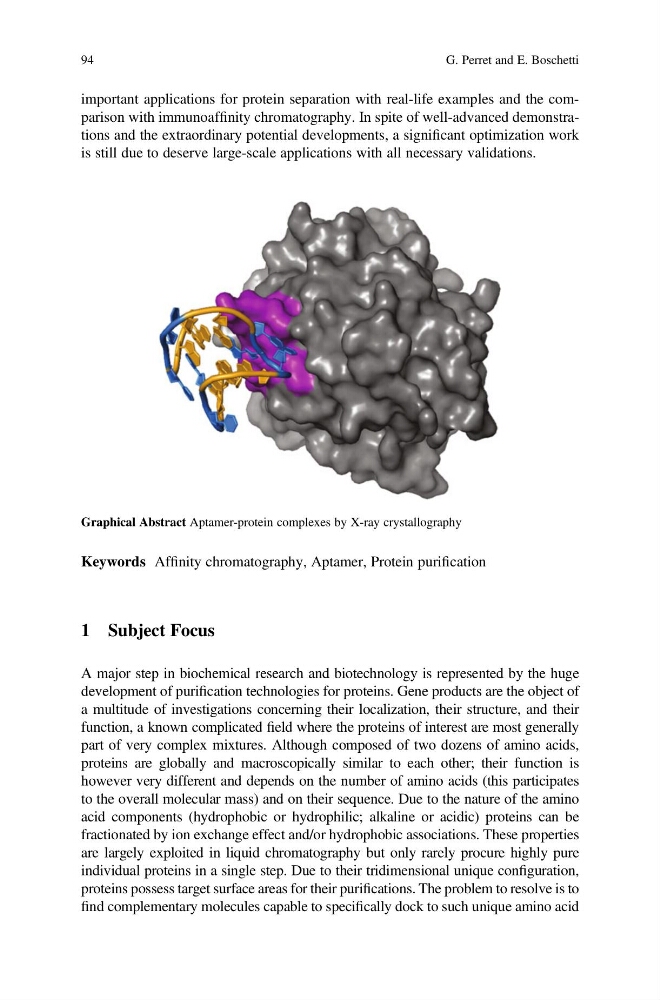
Graphical Abstract Aptamer-protein complexes by X-ray crystallography
Keywords Affinity chromatography, Aptamer, Protein purification
1 Subject Focus
A major step in biochemical research and biotechnology is represented by the huge
development of purification technologies for proteins. Gene products are the object of
a multitude of investigations concerning their localization, their structure, and their
function, a known complicated field where the proteins of interest are most generally
part of very complex mixtures. Although composed of two dozens of amino acids,
proteins are globally and macroscopically similar to each other; their function is
however very different and depends on the number of amino acids (this participates
to the overall molecular mass) and on their sequence. Due to the nature of the amino
acid components (hydrophobic or hydrophilic; alkaline or acidic) proteins can be
fractionated by ion exchange effect and/or hydrophobic associations. These properties
are largely exploited in liquid chromatography but only rarely procure highly pure
individual proteins in a single step. Due to their tridimensional unique configuration,
proteins possess target surface areas for their purifications. The problem to resolve is to
find complementary molecules capable to specifically dock to such unique amino acid
94
G. Perret and E. Boschetti
is still due to deserve large-scale applications with all necessary validations.
Graphical Abstract Aptamer-protein complexes by X-ray crystallography
Keywords Affinity chromatography, Aptamer, Protein purification
1 Subject Focus
A major step in biochemical research and biotechnology is represented by the huge
development of purification technologies for proteins. Gene products are the object of
a multitude of investigations concerning their localization, their structure, and their
function, a known complicated field where the proteins of interest are most generally
part of very complex mixtures. Although composed of two dozens of amino acids,
proteins are globally and macroscopically similar to each other; their function is
however very different and depends on the number of amino acids (this participates
to the overall molecular mass) and on their sequence. Due to the nature of the amino
acid components (hydrophobic or hydrophilic; alkaline or acidic) proteins can be
fractionated by ion exchange effect and/or hydrophobic associations. These properties
are largely exploited in liquid chromatography but only rarely procure highly pure
individual proteins in a single step. Due to their tridimensional unique configuration,
proteins possess target surface areas for their purifications. The problem to resolve is to
find complementary molecules capable to specifically dock to such unique amino acid
94
G. Perret and E. Boschetti