

5 Benefits and Challenges of Impedimetric Aptasensors
In the first sections of this chapter, we reviewed aptamer-based impedimetric biosensors with respect to their application in biotechnology. An advantage of electrochemical biosensors is their high sensitivity and in combination with aptamers and
surface design by using, e.g., nanocomposites or other nanostructures, the detection
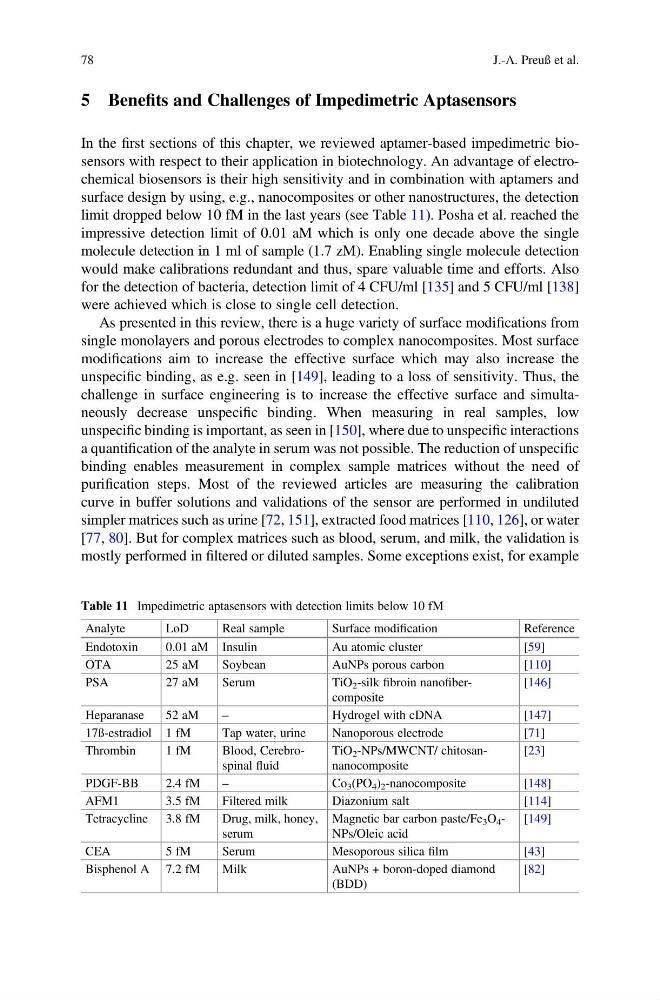
limit dropped below 10 fM in the last years (see Table 11). Posha et al. reached the
impressive detection limit of 0.01 aM which is only one decade above the single
molecule detection in 1 ml of sample (1.7 zM). Enabling single molecule detection
would make calibrations redundant and thus, spare valuable time and efforts. Also
for the detection of bacteria, detection limit of 4 CFU/ml [135] and 5 CFU/ml [138]
were achieved which is close to single cell detection.
As presented in this review, there is a huge variety of surface modifications from
single monolayers and porous electrodes to complex nanocomposites. Most surface
modifications aim to increase the effective surface which may also increase the
unspecific binding, as e.g. seen in [149], leading to a loss of sensitivity. Thus, the
challenge in surface engineering is to increase the effective surface and simultaneously decrease unspecific binding. When measuring in real samples, low
unspecific binding is important, as seen in [150], where due to unspecific interactions
a quantification of the analyte in serum was not possible. The reduction of unspecific
binding enables measurement in complex sample matrices without the need of
purification steps. Most of the reviewed articles are measuring the calibration
curve in buffer solutions and validations of the sensor are performed in undiluted
simpler matrices such as urine [72, 151], extracted food matrices [110, 126], or water
[77, 80]. But for complex matrices such as blood, serum, and milk, the validation is
mostly performed in filtered or diluted samples. Some exceptions exist, for example
Table 11 Impedimetric aptasensors with detection limits below 10 fM
Analyte
LoD
Real sample
Surface modification
Reference
Endotoxin
0.01 aM Insulin
Au atomic cluster
[59]
OTA
25 aM
Soybean
AuNPs porous carbon
[110]
PSA
27 aM
Serum
TiO 2 -silk fibroin nanofibercomposite
[146]
Heparanase
52 aM
–
Hydrogel with cDNA
[147]
17ß-estradiol 1 fM
Tap water, urine
Nanoporous electrode
[71]
Thrombin
1 fM
Blood, Cerebrospinal fluid
TiO 2 -NPs/MWCNT/ chitosannanocomposite
[23]
PDGF-BB
2.4 fM
–
Co 3 (PO 4 ) 2 -nanocomposite
[148]
AFM1
3.5 fM
Filtered milk
Diazonium salt
[114]
Tetracycline 3.8 fM
Drug, milk, honey,
serum
Magnetic bar carbon paste/Fe 3 O 4 -
NPs/Oleic acid
[149]
CEA
5 fM
Serum
Mesoporous silica film
[43]
Bisphenol A 7.2 fM
Milk
AuNPs + boron-doped diamond
(BDD)
[82]
78
J.-A. Preuß et al.
In the first sections of this chapter, we reviewed aptamer-based impedimetric biosensors with respect to their application in biotechnology. An advantage of electrochemical biosensors is their high sensitivity and in combination with aptamers and
surface design by using, e.g., nanocomposites or other nanostructures, the detection
limit dropped below 10 fM in the last years (see Table 11). Posha et al. reached the
impressive detection limit of 0.01 aM which is only one decade above the single
molecule detection in 1 ml of sample (1.7 zM). Enabling single molecule detection
would make calibrations redundant and thus, spare valuable time and efforts. Also
for the detection of bacteria, detection limit of 4 CFU/ml [135] and 5 CFU/ml [138]
were achieved which is close to single cell detection.
As presented in this review, there is a huge variety of surface modifications from
single monolayers and porous electrodes to complex nanocomposites. Most surface
modifications aim to increase the effective surface which may also increase the
unspecific binding, as e.g. seen in [149], leading to a loss of sensitivity. Thus, the
challenge in surface engineering is to increase the effective surface and simultaneously decrease unspecific binding. When measuring in real samples, low
unspecific binding is important, as seen in [150], where due to unspecific interactions
a quantification of the analyte in serum was not possible. The reduction of unspecific
binding enables measurement in complex sample matrices without the need of
purification steps. Most of the reviewed articles are measuring the calibration
curve in buffer solutions and validations of the sensor are performed in undiluted
simpler matrices such as urine [72, 151], extracted food matrices [110, 126], or water
[77, 80]. But for complex matrices such as blood, serum, and milk, the validation is
mostly performed in filtered or diluted samples. Some exceptions exist, for example
Table 11 Impedimetric aptasensors with detection limits below 10 fM
Analyte
LoD
Real sample
Surface modification
Reference
Endotoxin
0.01 aM Insulin
Au atomic cluster
[59]
OTA
25 aM
Soybean
AuNPs porous carbon
[110]
PSA
27 aM
Serum
TiO 2 -silk fibroin nanofibercomposite
[146]
Heparanase
52 aM
–
Hydrogel with cDNA
[147]
17ß-estradiol 1 fM
Tap water, urine
Nanoporous electrode
[71]
Thrombin
1 fM
Blood, Cerebrospinal fluid
TiO 2 -NPs/MWCNT/ chitosannanocomposite
[23]
PDGF-BB
2.4 fM
–
Co 3 (PO 4 ) 2 -nanocomposite
[148]
AFM1
3.5 fM
Filtered milk
Diazonium salt
[114]
Tetracycline 3.8 fM
Drug, milk, honey,
serum
Magnetic bar carbon paste/Fe 3 O 4 -
NPs/Oleic acid
[149]
CEA
5 fM
Serum
Mesoporous silica film
[43]
Bisphenol A 7.2 fM
Milk
AuNPs + boron-doped diamond
(BDD)
[82]
78
J.-A. Preuß et al.