

solution with 1 mM [Fe(CN) 6 ]
3À/4À . Although the author enabled a wide concentration range, it is two magnitudes below the legislative limits and thus a dilution step
is required. The concentration range achieved by Castillo et al. of 0.04–40 ng/ml is
better suited for direct detection [105]. However, dilution of the sample can increase
the signal-to-noise ratio as the matrix is diluted as well. The authors were able to
regenerate the aptasensor up to 10 times without significant signal loss.
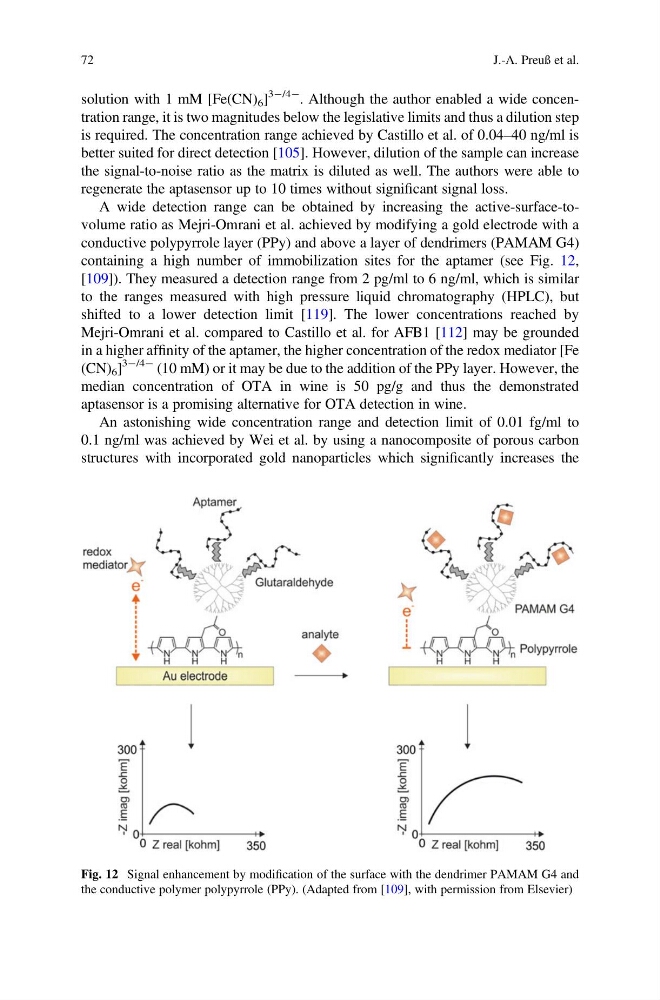
A wide detection range can be obtained by increasing the active-surface-tovolume ratio as Mejri-Omrani et al. achieved by modifying a gold electrode with a
conductive polypyrrole layer (PPy) and above a layer of dendrimers (PAMAM G4)
containing a high number of immobilization sites for the aptamer (see Fig. 12,
[109]). They measured a detection range from 2 pg/ml to 6 ng/ml, which is similar
to the ranges measured with high pressure liquid chromatography (HPLC), but
shifted to a lower detection limit [119]. The lower concentrations reached by
Mejri-Omrani et al. compared to Castillo et al. for AFB1 [112] may be grounded
in a higher affinity of the aptamer, the higher concentration of the redox mediator [Fe
(CN) 6 ]
3À/4À (10 mM) or it may be due to the addition of the PPy layer. However, the
median concentration of OTA in wine is 50 pg/g and thus the demonstrated
aptasensor is a promising alternative for OTA detection in wine.
An astonishing wide concentration range and detection limit of 0.01 fg/ml to
0.1 ng/ml was achieved by Wei et al. by using a nanocomposite of porous carbon
structures with incorporated gold nanoparticles which significantly increases the
Fig. 12 Signal enhancement by modification of the surface with the dendrimer PAMAM G4 and
the conductive polymer polypyrrole (PPy). (Adapted from [109], with permission from Elsevier)
72
J.-A. Preuß et al.
3À/4À . Although the author enabled a wide concentration range, it is two magnitudes below the legislative limits and thus a dilution step
is required. The concentration range achieved by Castillo et al. of 0.04–40 ng/ml is
better suited for direct detection [105]. However, dilution of the sample can increase
the signal-to-noise ratio as the matrix is diluted as well. The authors were able to
regenerate the aptasensor up to 10 times without significant signal loss.
A wide detection range can be obtained by increasing the active-surface-tovolume ratio as Mejri-Omrani et al. achieved by modifying a gold electrode with a
conductive polypyrrole layer (PPy) and above a layer of dendrimers (PAMAM G4)
containing a high number of immobilization sites for the aptamer (see Fig. 12,
[109]). They measured a detection range from 2 pg/ml to 6 ng/ml, which is similar
to the ranges measured with high pressure liquid chromatography (HPLC), but
shifted to a lower detection limit [119]. The lower concentrations reached by
Mejri-Omrani et al. compared to Castillo et al. for AFB1 [112] may be grounded
in a higher affinity of the aptamer, the higher concentration of the redox mediator [Fe
(CN) 6 ]
3À/4À (10 mM) or it may be due to the addition of the PPy layer. However, the
median concentration of OTA in wine is 50 pg/g and thus the demonstrated
aptasensor is a promising alternative for OTA detection in wine.
An astonishing wide concentration range and detection limit of 0.01 fg/ml to
0.1 ng/ml was achieved by Wei et al. by using a nanocomposite of porous carbon
structures with incorporated gold nanoparticles which significantly increases the
Fig. 12 Signal enhancement by modification of the surface with the dendrimer PAMAM G4 and
the conductive polymer polypyrrole (PPy). (Adapted from [109], with permission from Elsevier)
72
J.-A. Preuß et al.