

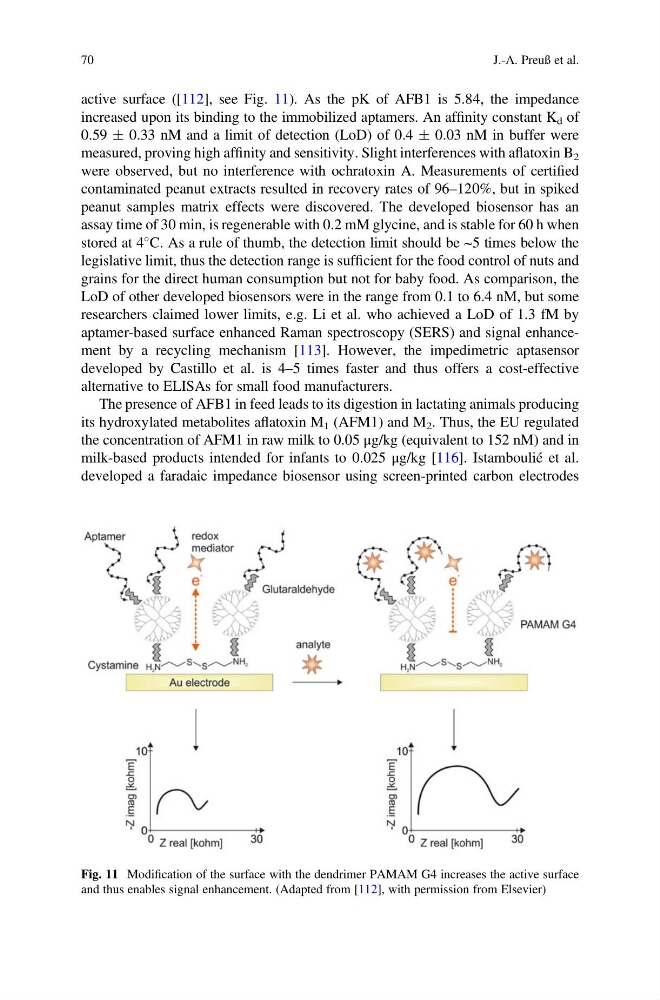
active surface ([112], see Fig. 11). As the pK of AFB1 is 5.84, the impedance
increased upon its binding to the immobilized aptamers. An affinity constant K d of
0.59 Æ 0.33 nM and a limit of detection (LoD) of 0.4 Æ 0.03 nM in buffer were
measured, proving high affinity and sensitivity. Slight interferences with aflatoxin B 2
were observed, but no interference with ochratoxin A. Measurements of certified
contaminated peanut extracts resulted in recovery rates of 96–120%, but in spiked
peanut samples matrix effects were discovered. The developed biosensor has an
assay time of 30 min, is regenerable with 0.2 mM glycine, and is stable for 60 h when
stored at 4
C. As a rule of thumb, the detection limit should be ~5 times below the
legislative limit, thus the detection range is sufficient for the food control of nuts and
grains for the direct human consumption but not for baby food. As comparison, the
LoD of other developed biosensors were in the range from 0.1 to 6.4 nM, but some
researchers claimed lower limits, e.g. Li et al. who achieved a LoD of 1.3 fM by
aptamer-based surface enhanced Raman spectroscopy (SERS) and signal enhancement by a recycling mechanism [113]. However, the impedimetric aptasensor
developed by Castillo et al. is 4–5 times faster and thus offers a cost-effective
alternative to ELISAs for small food manufacturers.
The presence of AFB1 in feed leads to its digestion in lactating animals producing
its hydroxylated metabolites aflatoxin M 1 (AFM1) and M 2 . Thus, the EU regulated
the concentration of AFM1 in raw milk to 0.05 μg/kg (equivalent to 152 nM) and in
milk-based products intended for infants to 0.025 μg/kg [116]. Istamboulié et al.
developed a faradaic impedance biosensor using screen-printed carbon electrodes
Fig. 11 Modification of the surface with the dendrimer PAMAM G4 increases the active surface
and thus enables signal enhancement. (Adapted from [112], with permission from Elsevier)
70
J.-A. Preuß et al.
increased upon its binding to the immobilized aptamers. An affinity constant K d of
0.59 Æ 0.33 nM and a limit of detection (LoD) of 0.4 Æ 0.03 nM in buffer were
measured, proving high affinity and sensitivity. Slight interferences with aflatoxin B 2
were observed, but no interference with ochratoxin A. Measurements of certified
contaminated peanut extracts resulted in recovery rates of 96–120%, but in spiked
peanut samples matrix effects were discovered. The developed biosensor has an
assay time of 30 min, is regenerable with 0.2 mM glycine, and is stable for 60 h when
stored at 4
C. As a rule of thumb, the detection limit should be ~5 times below the
legislative limit, thus the detection range is sufficient for the food control of nuts and
grains for the direct human consumption but not for baby food. As comparison, the
LoD of other developed biosensors were in the range from 0.1 to 6.4 nM, but some
researchers claimed lower limits, e.g. Li et al. who achieved a LoD of 1.3 fM by
aptamer-based surface enhanced Raman spectroscopy (SERS) and signal enhancement by a recycling mechanism [113]. However, the impedimetric aptasensor
developed by Castillo et al. is 4–5 times faster and thus offers a cost-effective
alternative to ELISAs for small food manufacturers.
The presence of AFB1 in feed leads to its digestion in lactating animals producing
its hydroxylated metabolites aflatoxin M 1 (AFM1) and M 2 . Thus, the EU regulated
the concentration of AFM1 in raw milk to 0.05 μg/kg (equivalent to 152 nM) and in
milk-based products intended for infants to 0.025 μg/kg [116]. Istamboulié et al.
developed a faradaic impedance biosensor using screen-printed carbon electrodes
Fig. 11 Modification of the surface with the dendrimer PAMAM G4 increases the active surface
and thus enables signal enhancement. (Adapted from [112], with permission from Elsevier)
70
J.-A. Preuß et al.