

10
13 aptamer molecules per cm
2 ) due to its lower molecular mass compared to
antibodies [62]. However, for some targets (e.g. lysozyme) no measurement in a
medically relevant matrix is reported.
With regard to point-of-care tests, EIS might not be the method of choice since
high-priced potentiostats are required and are not suitable for in-field diagnostics
(malaria or virus detection). Nonetheless, organizations, which are able to cover the
investment costs (e.g., cancer medicine or food industry), might benefit from it by
reducing current costs and time. Thus, the important aspects to be clarified are costs
per unit, proof of standardized mass production, and tests of stability. The common
strategy of self-assembled monolayer formation which requires several hours might
be a limiting factor of fabrication and commercialization.
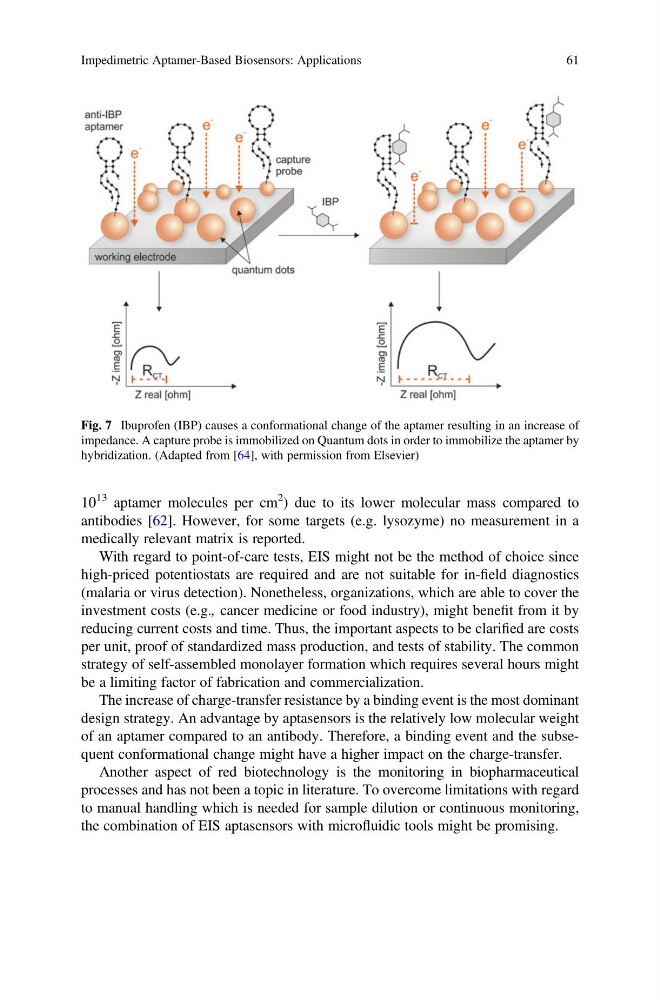
The increase of charge-transfer resistance by a binding event is the most dominant
design strategy. An advantage by aptasensors is the relatively low molecular weight
of an aptamer compared to an antibody. Therefore, a binding event and the subsequent conformational change might have a higher impact on the charge-transfer.
Another aspect of red biotechnology is the monitoring in biopharmaceutical
processes and has not been a topic in literature. To overcome limitations with regard
to manual handling which is needed for sample dilution or continuous monitoring,
the combination of EIS aptasensors with microfluidic tools might be promising.
Fig. 7 Ibuprofen (IBP) causes a conformational change of the aptamer resulting in an increase of
impedance. A capture probe is immobilized on Quantum dots in order to immobilize the aptamer by
hybridization. (Adapted from [64], with permission from Elsevier)
Impedimetric Aptamer-Based Biosensors: Applications
61
13 aptamer molecules per cm
2 ) due to its lower molecular mass compared to
antibodies [62]. However, for some targets (e.g. lysozyme) no measurement in a
medically relevant matrix is reported.
With regard to point-of-care tests, EIS might not be the method of choice since
high-priced potentiostats are required and are not suitable for in-field diagnostics
(malaria or virus detection). Nonetheless, organizations, which are able to cover the
investment costs (e.g., cancer medicine or food industry), might benefit from it by
reducing current costs and time. Thus, the important aspects to be clarified are costs
per unit, proof of standardized mass production, and tests of stability. The common
strategy of self-assembled monolayer formation which requires several hours might
be a limiting factor of fabrication and commercialization.
The increase of charge-transfer resistance by a binding event is the most dominant
design strategy. An advantage by aptasensors is the relatively low molecular weight
of an aptamer compared to an antibody. Therefore, a binding event and the subsequent conformational change might have a higher impact on the charge-transfer.
Another aspect of red biotechnology is the monitoring in biopharmaceutical
processes and has not been a topic in literature. To overcome limitations with regard
to manual handling which is needed for sample dilution or continuous monitoring,
the combination of EIS aptasensors with microfluidic tools might be promising.
Fig. 7 Ibuprofen (IBP) causes a conformational change of the aptamer resulting in an increase of
impedance. A capture probe is immobilized on Quantum dots in order to immobilize the aptamer by
hybridization. (Adapted from [64], with permission from Elsevier)
Impedimetric Aptamer-Based Biosensors: Applications
61