

2.3 Other Use Cases
This paragraph gives a short overview about targets which points beyond the classic
diagnostics as a major field of red biotechnology. Since red biotechnology deals with
biotechnology in health care related applications in general, the analytics for diverse
non-protein or non-cell targets such as drugs are required in order to ensure safe
production of pharmaceuticals, drug monitoring, or forensic analytics.
The pyrogenic endotoxin, also called lipopolysaccharide (LPS), causes an
immune response including fever or septic shock. Therefore, the removal of endotoxins is of great interest for the drug industry concerning potential contamination of
pharmaceutical products.
Endotoxins originate from the outer membrane of gram-negative bacteria and are
released after cell death and are chemically stable even with regard to sterilization
[57, 58]. Thus, the drug industry needs to meet legal limits with regard to endotoxin
concentration which lies at approximately 20 pM for drug distribution [59].
The most popular endotoxin detection method is the Limulus amebocyte lysate
(LAL) test which utilizes the unique coagulation based on an endotoxin induced
enzyme cascade in the Limulus blood. Chromogenic and turbidimetric assays are
available [57]. The need for more rapid testing and the increased need for pharmaceutical contamination detection require more sustainable alternatives than the
horseshoe crab based LAL test.
Several impedimetric aptasensors have been developed for the detection of
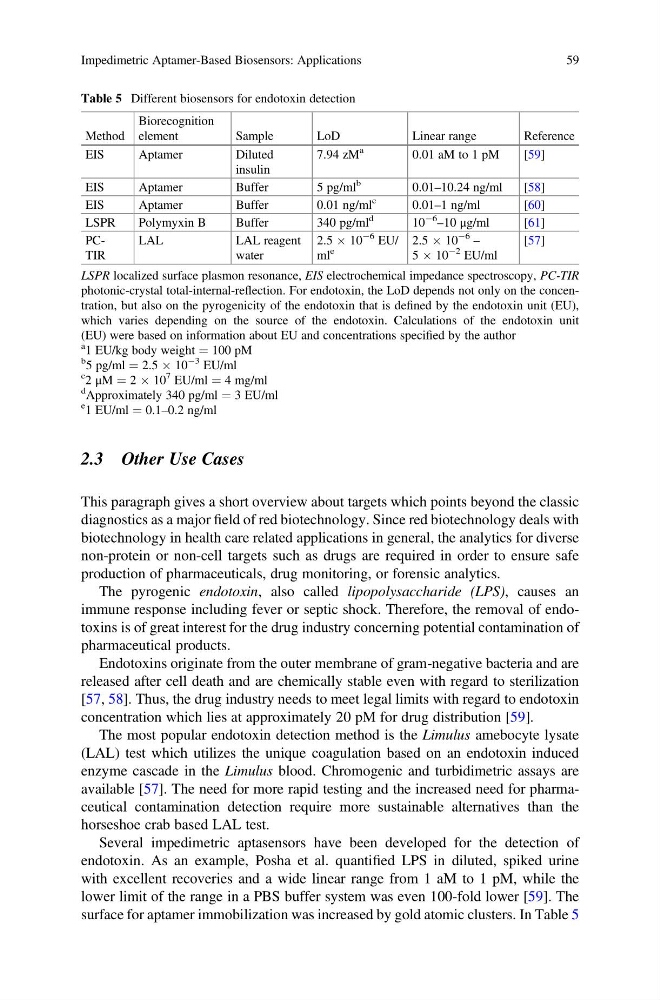
endotoxin. As an example, Posha et al. quantified LPS in diluted, spiked urine
with excellent recoveries and a wide linear range from 1 aM to 1 pM, while the
lower limit of the range in a PBS buffer system was even 100-fold lower [59]. The
surface for aptamer immobilization was increased by gold atomic clusters. In Table 5
Table 5 Different biosensors for endotoxin detection
Method
Biorecognition
element
Sample
LoD
Linear range
Reference
EIS
Aptamer
Diluted
insulin
7.94 zM
a
0.01 aM to 1 pM
[59]
EIS
Aptamer
Buffer
5 pg/ml
b
0.01–10.24 ng/ml
[58]
EIS
Aptamer
Buffer
0.01 ng/ml
c
0.01–1 ng/ml
[60]
LSPR
Polymyxin B
Buffer
340 pg/ml
d
10
À6
–10 μg/ml
[61]
PCTIR
LAL
LAL reagent
water
2.5 Â 10
À6 EU/
ml
e
2.5 Â 10
À6 –
5 Â 10
À2 EU/ml
[57]
LSPR localized surface plasmon resonance, EIS electrochemical impedance spectroscopy, PC-TIR
photonic-crystal total-internal-reflection. For endotoxin, the LoD depends not only on the concentration, but also on the pyrogenicity of the endotoxin that is defined by the endotoxin unit (EU),
which varies depending on the source of the endotoxin. Calculations of the endotoxin unit
(EU) were based on information about EU and concentrations specified by the author
a 1 EU/kg body weight ¼ 100 pM
b
5 pg/ml ¼ 2.5 Â 10
À3 EU/ml
c 2 μM ¼ 2 Â 10
7 EU/ml ¼ 4 mg/ml
d
Approximately 340 pg/ml ¼ 3 EU/ml
e 1 EU/ml ¼ 0.1–0.2 ng/ml
Impedimetric Aptamer-Based Biosensors: Applications
59
This paragraph gives a short overview about targets which points beyond the classic
diagnostics as a major field of red biotechnology. Since red biotechnology deals with
biotechnology in health care related applications in general, the analytics for diverse
non-protein or non-cell targets such as drugs are required in order to ensure safe
production of pharmaceuticals, drug monitoring, or forensic analytics.
The pyrogenic endotoxin, also called lipopolysaccharide (LPS), causes an
immune response including fever or septic shock. Therefore, the removal of endotoxins is of great interest for the drug industry concerning potential contamination of
pharmaceutical products.
Endotoxins originate from the outer membrane of gram-negative bacteria and are
released after cell death and are chemically stable even with regard to sterilization
[57, 58]. Thus, the drug industry needs to meet legal limits with regard to endotoxin
concentration which lies at approximately 20 pM for drug distribution [59].
The most popular endotoxin detection method is the Limulus amebocyte lysate
(LAL) test which utilizes the unique coagulation based on an endotoxin induced
enzyme cascade in the Limulus blood. Chromogenic and turbidimetric assays are
available [57]. The need for more rapid testing and the increased need for pharmaceutical contamination detection require more sustainable alternatives than the
horseshoe crab based LAL test.
Several impedimetric aptasensors have been developed for the detection of
endotoxin. As an example, Posha et al. quantified LPS in diluted, spiked urine
with excellent recoveries and a wide linear range from 1 aM to 1 pM, while the
lower limit of the range in a PBS buffer system was even 100-fold lower [59]. The
surface for aptamer immobilization was increased by gold atomic clusters. In Table 5
Table 5 Different biosensors for endotoxin detection
Method
Biorecognition
element
Sample
LoD
Linear range
Reference
EIS
Aptamer
Diluted
insulin
7.94 zM
a
0.01 aM to 1 pM
[59]
EIS
Aptamer
Buffer
5 pg/ml
b
0.01–10.24 ng/ml
[58]
EIS
Aptamer
Buffer
0.01 ng/ml
c
0.01–1 ng/ml
[60]
LSPR
Polymyxin B
Buffer
340 pg/ml
d
10
À6
–10 μg/ml
[61]
PCTIR
LAL
LAL reagent
water
2.5 Â 10
À6 EU/
ml
e
2.5 Â 10
À6 –
5 Â 10
À2 EU/ml
[57]
LSPR localized surface plasmon resonance, EIS electrochemical impedance spectroscopy, PC-TIR
photonic-crystal total-internal-reflection. For endotoxin, the LoD depends not only on the concentration, but also on the pyrogenicity of the endotoxin that is defined by the endotoxin unit (EU),
which varies depending on the source of the endotoxin. Calculations of the endotoxin unit
(EU) were based on information about EU and concentrations specified by the author
a 1 EU/kg body weight ¼ 100 pM
b
5 pg/ml ¼ 2.5 Â 10
À3 EU/ml
c 2 μM ¼ 2 Â 10
7 EU/ml ¼ 4 mg/ml
d
Approximately 340 pg/ml ¼ 3 EU/ml
e 1 EU/ml ¼ 0.1–0.2 ng/ml
Impedimetric Aptamer-Based Biosensors: Applications
59