

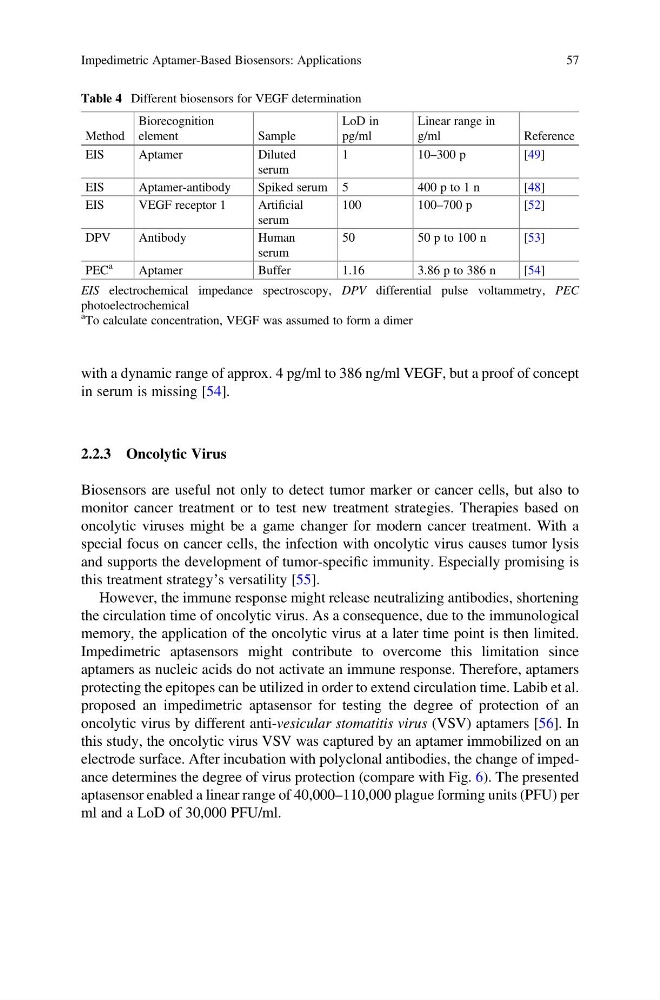
with a dynamic range of approx. 4 pg/ml to 386 ng/ml VEGF, but a proof of concept
in serum is missing [54].
2.2.3 Oncolytic Virus
Biosensors are useful not only to detect tumor marker or cancer cells, but also to
monitor cancer treatment or to test new treatment strategies. Therapies based on
oncolytic viruses might be a game changer for modern cancer treatment. With a
special focus on cancer cells, the infection with oncolytic virus causes tumor lysis
and supports the development of tumor-specific immunity. Especially promising is
this treatment strategy’s versatility [55].
However, the immune response might release neutralizing antibodies, shortening
the circulation time of oncolytic virus. As a consequence, due to the immunological
memory, the application of the oncolytic virus at a later time point is then limited.
Impedimetric aptasensors might contribute to overcome this limitation since
aptamers as nucleic acids do not activate an immune response. Therefore, aptamers
protecting the epitopes can be utilized in order to extend circulation time. Labib et al.
proposed an impedimetric aptasensor for testing the degree of protection of an
oncolytic virus by different anti-vesicular stomatitis virus (VSV) aptamers [56]. In
this study, the oncolytic virus VSV was captured by an aptamer immobilized on an
electrode surface. After incubation with polyclonal antibodies, the change of impedance determines the degree of virus protection (compare with Fig. 6). The presented
aptasensor enabled a linear range of 40,000–110,000 plague forming units (PFU) per
ml and a LoD of 30,000 PFU/ml.
Table 4 Different biosensors for VEGF determination
Method
Biorecognition
element
Sample
LoD in
pg/ml
Linear range in
g/ml
Reference
EIS
Aptamer
Diluted
serum
1
1 0 –300 p
[49]
EIS
Aptamer-antibody
Spiked serum 5
400 p to 1 n
[48]
EIS
VEGF receptor 1
Artificial
serum
100
100–700 p
[52]
DPV
Antibody
Human
serum
50
50 p to 100 n
[53]
PEC
a
Aptamer
Buffer
1.16
3.86 p to 386 n
[54]
EIS electrochemical impedance spectroscopy, DPV differential pulse voltammetry, PEC
photoelectrochemical
a To calculate concentration, VEGF was assumed to form a dimer
Impedimetric Aptamer-Based Biosensors: Applications
57
in serum is missing [54].
2.2.3 Oncolytic Virus
Biosensors are useful not only to detect tumor marker or cancer cells, but also to
monitor cancer treatment or to test new treatment strategies. Therapies based on
oncolytic viruses might be a game changer for modern cancer treatment. With a
special focus on cancer cells, the infection with oncolytic virus causes tumor lysis
and supports the development of tumor-specific immunity. Especially promising is
this treatment strategy’s versatility [55].
However, the immune response might release neutralizing antibodies, shortening
the circulation time of oncolytic virus. As a consequence, due to the immunological
memory, the application of the oncolytic virus at a later time point is then limited.
Impedimetric aptasensors might contribute to overcome this limitation since
aptamers as nucleic acids do not activate an immune response. Therefore, aptamers
protecting the epitopes can be utilized in order to extend circulation time. Labib et al.
proposed an impedimetric aptasensor for testing the degree of protection of an
oncolytic virus by different anti-vesicular stomatitis virus (VSV) aptamers [56]. In
this study, the oncolytic virus VSV was captured by an aptamer immobilized on an
electrode surface. After incubation with polyclonal antibodies, the change of impedance determines the degree of virus protection (compare with Fig. 6). The presented
aptasensor enabled a linear range of 40,000–110,000 plague forming units (PFU) per
ml and a LoD of 30,000 PFU/ml.
Table 4 Different biosensors for VEGF determination
Method
Biorecognition
element
Sample
LoD in
pg/ml
Linear range in
g/ml
Reference
EIS
Aptamer
Diluted
serum
1
1 0 –300 p
[49]
EIS
Aptamer-antibody
Spiked serum 5
400 p to 1 n
[48]
EIS
VEGF receptor 1
Artificial
serum
100
100–700 p
[52]
DPV
Antibody
Human
serum
50
50 p to 100 n
[53]
PEC
a
Aptamer
Buffer
1.16
3.86 p to 386 n
[54]
EIS electrochemical impedance spectroscopy, DPV differential pulse voltammetry, PEC
photoelectrochemical
a To calculate concentration, VEGF was assumed to form a dimer
Impedimetric Aptamer-Based Biosensors: Applications
57