

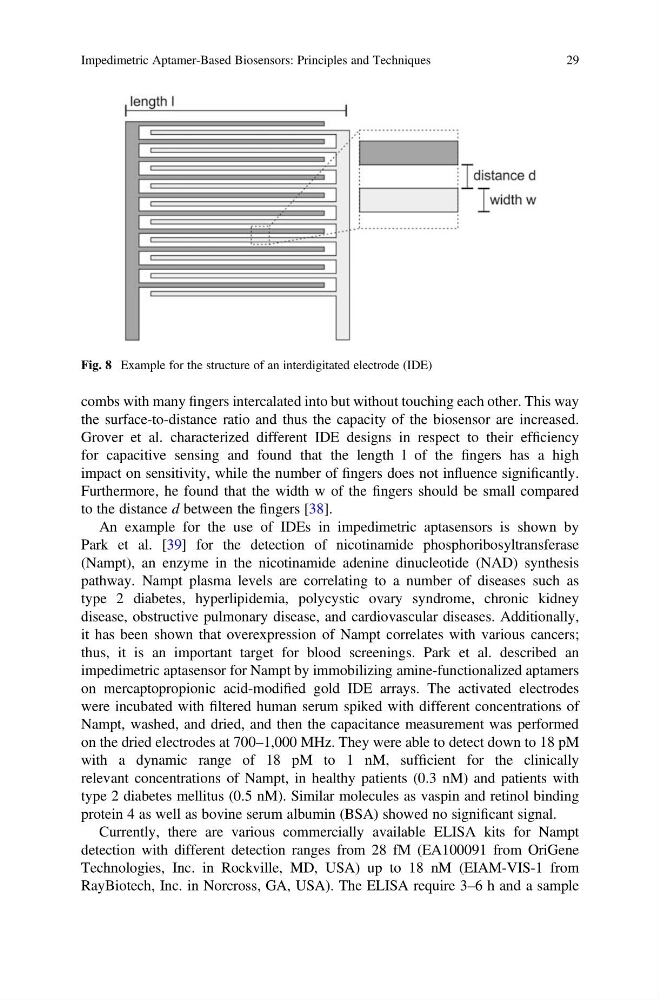
combs with many fingers intercalated into but without touching each other. This way
the surface-to-distance ratio and thus the capacity of the biosensor are increased.
Grover et al. characterized different IDE designs in respect to their efficiency
for capacitive sensing and found that the length l of the fingers has a high
impact on sensitivity, while the number of fingers does not influence significantly.
Furthermore, he found that the width w of the fingers should be small compared
to the distance d between the fingers [38].
An example for the use of IDEs in impedimetric aptasensors is shown by
Park et al. [39] for the detection of nicotinamide phosphoribosyltransferase
(Nampt), an enzyme in the nicotinamide adenine dinucleotide (NAD) synthesis
pathway. Nampt plasma levels are correlating to a number of diseases such as
type 2 diabetes, hyperlipidemia, polycystic ovary syndrome, chronic kidney
disease, obstructive pulmonary disease, and cardiovascular diseases. Additionally,
it has been shown that overexpression of Nampt correlates with various cancers;
thus, it is an important target for blood screenings. Park et al. described an
impedimetric aptasensor for Nampt by immobilizing amine-functionalized aptamers
on mercaptopropionic acid-modified gold IDE arrays. The activated electrodes
were incubated with filtered human serum spiked with different concentrations of
Nampt, washed, and dried, and then the capacitance measurement was performed
on the dried electrodes at 700–1,000 MHz. They were able to detect down to 18 pM
with a dynamic range of 18 pM to 1 nM, sufficient for the clinically
relevant concentrations of Nampt, in healthy patients (0.3 nM) and patients with
type 2 diabetes mellitus (0.5 nM). Similar molecules as vaspin and retinol binding
protein 4 as well as bovine serum albumin (BSA) showed no significant signal.
Currently, there are various commercially available ELISA kits for Nampt
detection with different detection ranges from 28 fM (EA100091 from OriGene
Technologies, Inc. in Rockville, MD, USA) up to 18 nM (EIAM-VIS-1 from
RayBiotech, Inc. in Norcross, GA, USA). The ELISA require 3–6 h and a sample
Fig. 8 Example for the structure of an interdigitated electrode (IDE)
Impedimetric Aptamer-Based Biosensors: Principles and Techniques
29
the surface-to-distance ratio and thus the capacity of the biosensor are increased.
Grover et al. characterized different IDE designs in respect to their efficiency
for capacitive sensing and found that the length l of the fingers has a high
impact on sensitivity, while the number of fingers does not influence significantly.
Furthermore, he found that the width w of the fingers should be small compared
to the distance d between the fingers [38].
An example for the use of IDEs in impedimetric aptasensors is shown by
Park et al. [39] for the detection of nicotinamide phosphoribosyltransferase
(Nampt), an enzyme in the nicotinamide adenine dinucleotide (NAD) synthesis
pathway. Nampt plasma levels are correlating to a number of diseases such as
type 2 diabetes, hyperlipidemia, polycystic ovary syndrome, chronic kidney
disease, obstructive pulmonary disease, and cardiovascular diseases. Additionally,
it has been shown that overexpression of Nampt correlates with various cancers;
thus, it is an important target for blood screenings. Park et al. described an
impedimetric aptasensor for Nampt by immobilizing amine-functionalized aptamers
on mercaptopropionic acid-modified gold IDE arrays. The activated electrodes
were incubated with filtered human serum spiked with different concentrations of
Nampt, washed, and dried, and then the capacitance measurement was performed
on the dried electrodes at 700–1,000 MHz. They were able to detect down to 18 pM
with a dynamic range of 18 pM to 1 nM, sufficient for the clinically
relevant concentrations of Nampt, in healthy patients (0.3 nM) and patients with
type 2 diabetes mellitus (0.5 nM). Similar molecules as vaspin and retinol binding
protein 4 as well as bovine serum albumin (BSA) showed no significant signal.
Currently, there are various commercially available ELISA kits for Nampt
detection with different detection ranges from 28 fM (EA100091 from OriGene
Technologies, Inc. in Rockville, MD, USA) up to 18 nM (EIAM-VIS-1 from
RayBiotech, Inc. in Norcross, GA, USA). The ELISA require 3–6 h and a sample
Fig. 8 Example for the structure of an interdigitated electrode (IDE)
Impedimetric Aptamer-Based Biosensors: Principles and Techniques
29