

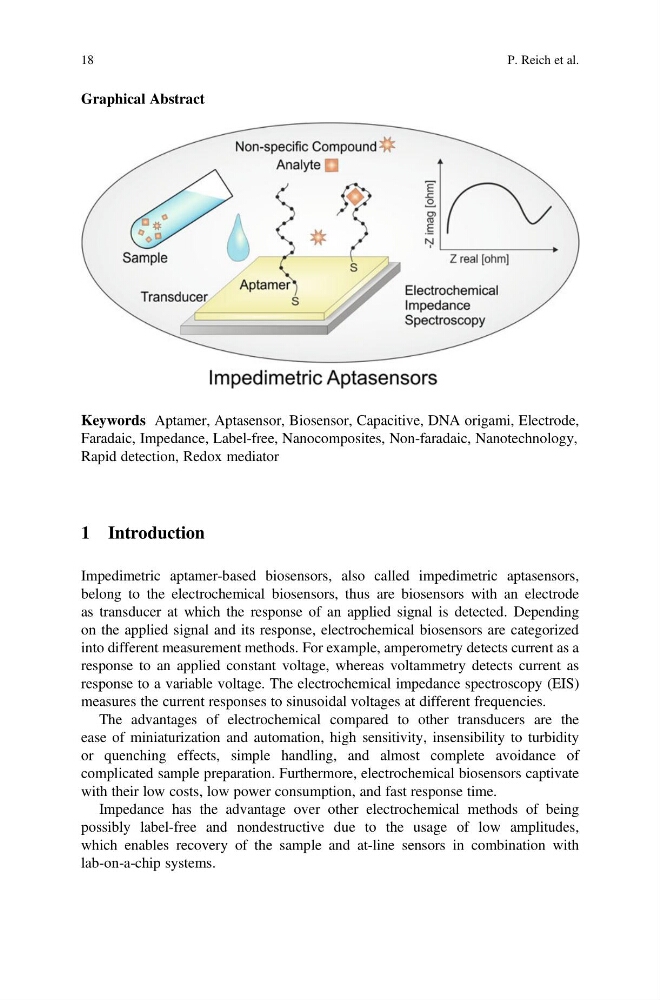
Graphical Abstract
Keywords Aptamer, Aptasensor, Biosensor, Capacitive, DNA origami, Electrode,
Faradaic, Impedance, Label-free, Nanocomposites, Non-faradaic, Nanotechnology,
Rapid detection, Redox mediator
1 Introduction
Impedimetric aptamer-based biosensors, also called impedimetric aptasensors,
belong to the electrochemical biosensors, thus are biosensors with an electrode
as transducer at which the response of an applied signal is detected. Depending
on the applied signal and its response, electrochemical biosensors are categorized
into different measurement methods. For example, amperometry detects current as a
response to an applied constant voltage, whereas voltammetry detects current as
response to a variable voltage. The electrochemical impedance spectroscopy (EIS)
measures the current responses to sinusoidal voltages at different frequencies.
The advantages of electrochemical compared to other transducers are the
ease of miniaturization and automation, high sensitivity, insensibility to turbidity
or quenching effects, simple handling, and almost complete avoidance of
complicated sample preparation. Furthermore, electrochemical biosensors captivate
with their low costs, low power consumption, and fast response time.
Impedance has the advantage over other electrochemical methods of being
possibly label-free and nondestructive due to the usage of low amplitudes,
which enables recovery of the sample and at-line sensors in combination with
lab-on-a-chip systems.
18
P. Reich et al.
Keywords Aptamer, Aptasensor, Biosensor, Capacitive, DNA origami, Electrode,
Faradaic, Impedance, Label-free, Nanocomposites, Non-faradaic, Nanotechnology,
Rapid detection, Redox mediator
1 Introduction
Impedimetric aptamer-based biosensors, also called impedimetric aptasensors,
belong to the electrochemical biosensors, thus are biosensors with an electrode
as transducer at which the response of an applied signal is detected. Depending
on the applied signal and its response, electrochemical biosensors are categorized
into different measurement methods. For example, amperometry detects current as a
response to an applied constant voltage, whereas voltammetry detects current as
response to a variable voltage. The electrochemical impedance spectroscopy (EIS)
measures the current responses to sinusoidal voltages at different frequencies.
The advantages of electrochemical compared to other transducers are the
ease of miniaturization and automation, high sensitivity, insensibility to turbidity
or quenching effects, simple handling, and almost complete avoidance of
complicated sample preparation. Furthermore, electrochemical biosensors captivate
with their low costs, low power consumption, and fast response time.
Impedance has the advantage over other electrochemical methods of being
possibly label-free and nondestructive due to the usage of low amplitudes,
which enables recovery of the sample and at-line sensors in combination with
lab-on-a-chip systems.
18
P. Reich et al.