

longer shelf life or special chemical properties and ability to be modified versus
protein-based antibodies. The following chapter reviews the essence of wellconceived TPPs especially with respect to aptamer targets for diagnostics and
illustrates several examples of commercial aptamer diagnostic success.
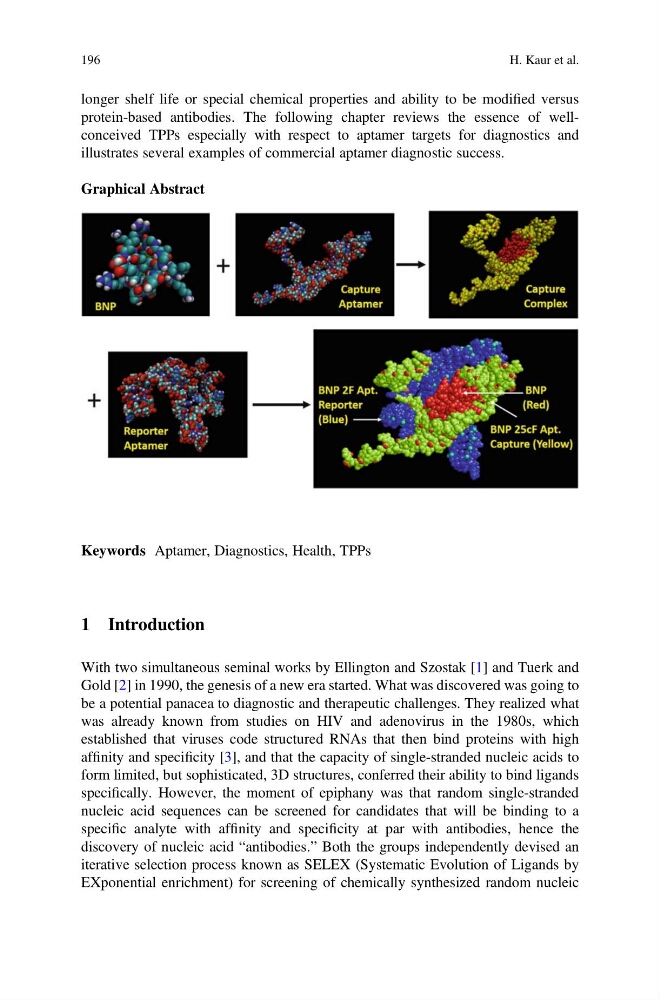
Graphical Abstract
Keywords Aptamer, Diagnostics, Health, TPPs
1 Introduction
With two simultaneous seminal works by Ellington and Szostak [1] and Tuerk and
Gold [2] in 1990, the genesis of a new era started. What was discovered was going to
be a potential panacea to diagnostic and therapeutic challenges. They realized what
was already known from studies on HIV and adenovirus in the 1980s, which
established that viruses code structured RNAs that then bind proteins with high
affinity and specificity [3], and that the capacity of single-stranded nucleic acids to
form limited, but sophisticated, 3D structures, conferred their ability to bind ligands
specifically. However, the moment of epiphany was that random single-stranded
nucleic acid sequences can be screened for candidates that will be binding to a
specific analyte with affinity and specificity at par with antibodies, hence the
discovery of nucleic acid “antibodies.” Both the groups independently devised an
iterative selection process known as SELEX (Systematic Evolution of Ligands by
EXponential enrichment) for screening of chemically synthesized random nucleic
196
H. Kaur et al.
protein-based antibodies. The following chapter reviews the essence of wellconceived TPPs especially with respect to aptamer targets for diagnostics and
illustrates several examples of commercial aptamer diagnostic success.
Graphical Abstract
Keywords Aptamer, Diagnostics, Health, TPPs
1 Introduction
With two simultaneous seminal works by Ellington and Szostak [1] and Tuerk and
Gold [2] in 1990, the genesis of a new era started. What was discovered was going to
be a potential panacea to diagnostic and therapeutic challenges. They realized what
was already known from studies on HIV and adenovirus in the 1980s, which
established that viruses code structured RNAs that then bind proteins with high
affinity and specificity [3], and that the capacity of single-stranded nucleic acids to
form limited, but sophisticated, 3D structures, conferred their ability to bind ligands
specifically. However, the moment of epiphany was that random single-stranded
nucleic acid sequences can be screened for candidates that will be binding to a
specific analyte with affinity and specificity at par with antibodies, hence the
discovery of nucleic acid “antibodies.” Both the groups independently devised an
iterative selection process known as SELEX (Systematic Evolution of Ligands by
EXponential enrichment) for screening of chemically synthesized random nucleic
196
H. Kaur et al.