

by irradiating with 532 nm light. The spatial proximity of the two aptamers is lost,
and thrombin cannot be effectively bound any longer, so the blood can clot again
[19]. However, light with a wavelength of 532 nm can only penetrate the skin to a
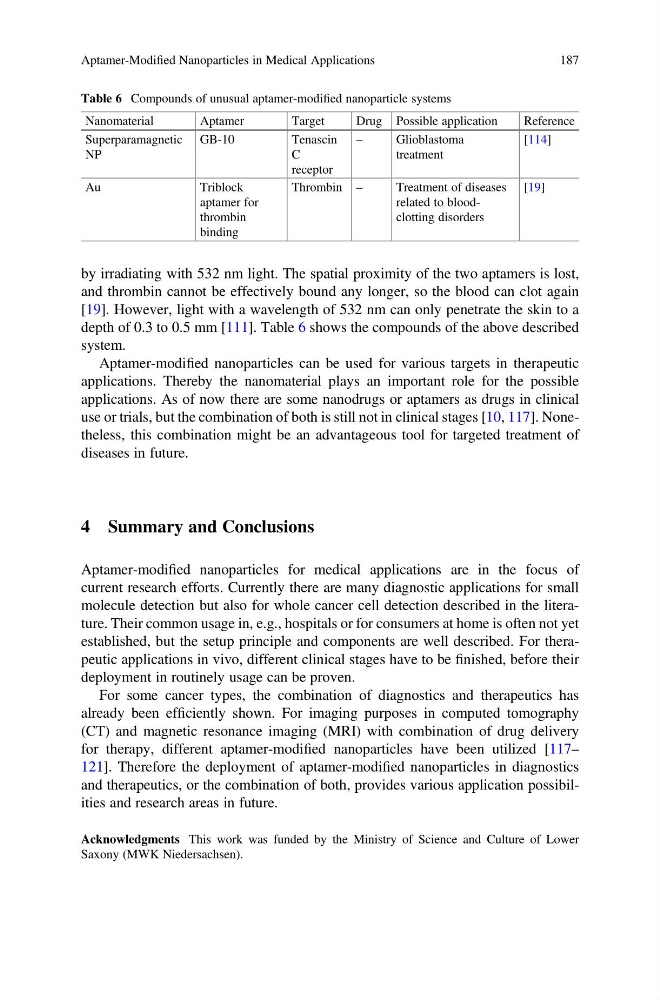
depth of 0.3 to 0.5 mm [111]. Table 6 shows the compounds of the above described
system.
Aptamer-modified nanoparticles can be used for various targets in therapeutic
applications. Thereby the nanomaterial plays an important role for the possible
applications. As of now there are some nanodrugs or aptamers as drugs in clinical
use or trials, but the combination of both is still not in clinical stages [10, 117]. Nonetheless, this combination might be an advantageous tool for targeted treatment of
diseases in future.
4 Summary and Conclusions
Aptamer-modified nanoparticles for medical applications are in the focus of
current research efforts. Currently there are many diagnostic applications for small
molecule detection but also for whole cancer cell detection described in the literature. Their common usage in, e.g., hospitals or for consumers at home is often not yet
established, but the setup principle and components are well described. For therapeutic applications in vivo, different clinical stages have to be finished, before their
deployment in routinely usage can be proven.
For some cancer types, the combination of diagnostics and therapeutics has
already been efficiently shown. For imaging purposes in computed tomography
(CT) and magnetic resonance imaging (MRI) with combination of drug delivery
for therapy, different aptamer-modified nanoparticles have been utilized [117–
121]. Therefore the deployment of aptamer-modified nanoparticles in diagnostics
and therapeutics, or the combination of both, provides various application possibilities and research areas in future.
Acknowledgments This work was funded by the Ministry of Science and Culture of Lower
Saxony (MWK Niedersachsen).
Table 6 Compounds of unusual aptamer-modified nanoparticle systems
Nanomaterial
Aptamer
Target
Drug Possible application
Reference
Superparamagnetic
NP
GB-10
Tenascin
C
receptor
–
Glioblastoma
treatment
[114]
Au
Triblock
aptamer for
thrombin
binding
Thrombin –
Treatment of diseases
related to bloodclotting disorders
[19]
Aptamer-Modified Nanoparticles in Medical Applications
187
and thrombin cannot be effectively bound any longer, so the blood can clot again
[19]. However, light with a wavelength of 532 nm can only penetrate the skin to a
depth of 0.3 to 0.5 mm [111]. Table 6 shows the compounds of the above described
system.
Aptamer-modified nanoparticles can be used for various targets in therapeutic
applications. Thereby the nanomaterial plays an important role for the possible
applications. As of now there are some nanodrugs or aptamers as drugs in clinical
use or trials, but the combination of both is still not in clinical stages [10, 117]. Nonetheless, this combination might be an advantageous tool for targeted treatment of
diseases in future.
4 Summary and Conclusions
Aptamer-modified nanoparticles for medical applications are in the focus of
current research efforts. Currently there are many diagnostic applications for small
molecule detection but also for whole cancer cell detection described in the literature. Their common usage in, e.g., hospitals or for consumers at home is often not yet
established, but the setup principle and components are well described. For therapeutic applications in vivo, different clinical stages have to be finished, before their
deployment in routinely usage can be proven.
For some cancer types, the combination of diagnostics and therapeutics has
already been efficiently shown. For imaging purposes in computed tomography
(CT) and magnetic resonance imaging (MRI) with combination of drug delivery
for therapy, different aptamer-modified nanoparticles have been utilized [117–
121]. Therefore the deployment of aptamer-modified nanoparticles in diagnostics
and therapeutics, or the combination of both, provides various application possibilities and research areas in future.
Acknowledgments This work was funded by the Ministry of Science and Culture of Lower
Saxony (MWK Niedersachsen).
Table 6 Compounds of unusual aptamer-modified nanoparticle systems
Nanomaterial
Aptamer
Target
Drug Possible application
Reference
Superparamagnetic
NP
GB-10
Tenascin
C
receptor
–
Glioblastoma
treatment
[114]
Au
Triblock
aptamer for
thrombin
binding
Thrombin –
Treatment of diseases
related to bloodclotting disorders
[19]
Aptamer-Modified Nanoparticles in Medical Applications
187