

3.2.1 Gold Nanoparticles for Photodynamic and Photothermal Therapy
Gold nanoparticles have a high plasmon resonance and low quantum yield; therefore
photon energy which is absorbed by AuNPs after irradiation is nearly completely
transformed into heat. This offers the opportunity for their usage for photothermal
therapy.
Additionally the generated heat can lead to a controlled release of drugs if the
AuNPs are used for drug delivery (see Fig. 8b) [7]. Nevertheless, not all tissues can
be reached by direct laser irradiation. For example, a laser with a wavelength of
532 nm, which was used by Luo et al. for controlled release of drugs from AuNPs,
can only penetrate the skin to a depth of 0.3 to 0.5 mm [7, 111]. However, by the use
of fiber optics, irradiation can reach nearly all targeted tissues in a minimal invasive
way [112].
3.2.2 Single-Walled Carbon Nanotubes (SWNT)
Besides gold nanoparticles also single-walled carbon nanotubes (SWNTs) can be
used for photodynamic therapy [8]. They consist of a cylinder out of a single
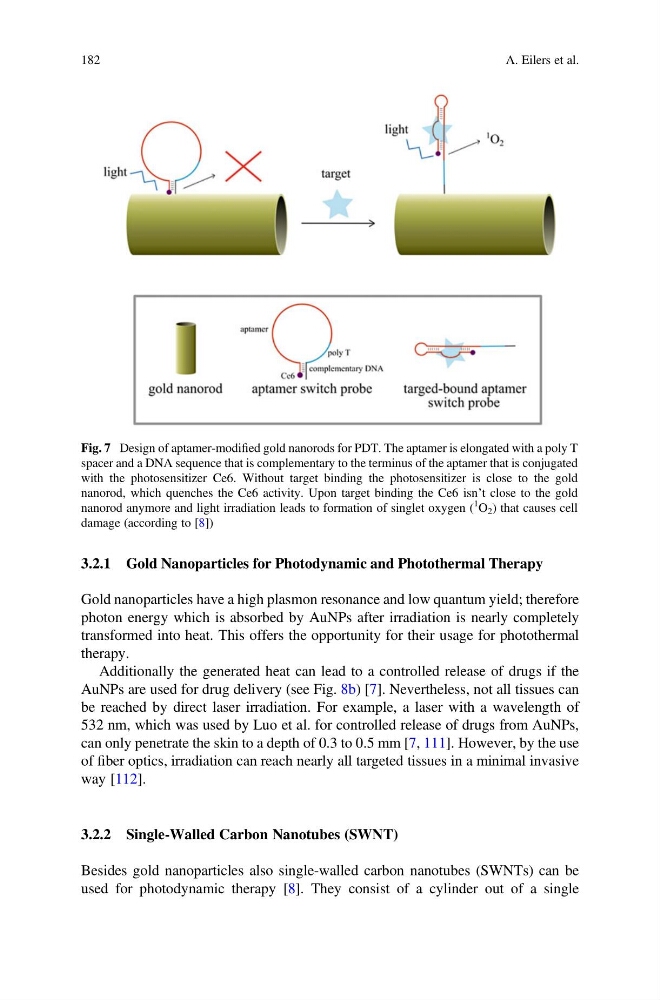
Fig. 7 Design of aptamer-modified gold nanorods for PDT. The aptamer is elongated with a poly T
spacer and a DNA sequence that is complementary to the terminus of the aptamer that is conjugated
with the photosensitizer Ce6. Without target binding the photosensitizer is close to the gold
nanorod, which quenches the Ce6 activity. Upon target binding the Ce6 isn’t close to the gold
nanorod anymore and light irradiation leads to formation of singlet oxygen (
1
O 2 ) that causes cell
damage (according to [8])
182
A. Eilers et al.
Gold nanoparticles have a high plasmon resonance and low quantum yield; therefore
photon energy which is absorbed by AuNPs after irradiation is nearly completely
transformed into heat. This offers the opportunity for their usage for photothermal
therapy.
Additionally the generated heat can lead to a controlled release of drugs if the
AuNPs are used for drug delivery (see Fig. 8b) [7]. Nevertheless, not all tissues can
be reached by direct laser irradiation. For example, a laser with a wavelength of
532 nm, which was used by Luo et al. for controlled release of drugs from AuNPs,
can only penetrate the skin to a depth of 0.3 to 0.5 mm [7, 111]. However, by the use
of fiber optics, irradiation can reach nearly all targeted tissues in a minimal invasive
way [112].
3.2.2 Single-Walled Carbon Nanotubes (SWNT)
Besides gold nanoparticles also single-walled carbon nanotubes (SWNTs) can be
used for photodynamic therapy [8]. They consist of a cylinder out of a single
Fig. 7 Design of aptamer-modified gold nanorods for PDT. The aptamer is elongated with a poly T
spacer and a DNA sequence that is complementary to the terminus of the aptamer that is conjugated
with the photosensitizer Ce6. Without target binding the photosensitizer is close to the gold
nanorod, which quenches the Ce6 activity. Upon target binding the Ce6 isn’t close to the gold
nanorod anymore and light irradiation leads to formation of singlet oxygen (
1
O 2 ) that causes cell
damage (according to [8])
182
A. Eilers et al.