

physisorption [29, 30]. Coating gold nanoparticles with a silica layer leads to free
hydroxyl groups on the surface, which can further be functionalized with aptamers
[31, 32]. Additionally “click” reactions of terminal alkynes and azides can be
performed. These “click” reactions utilize the Au-thiol bond, which can further be
used for modifying AuNPs with Polyethylene glycol (PEG) ligands
[33]. Non-modified aptamers get adsorbed as well, just with a weaker, electrostatic
interactions [34].
The assays use the ability of aptamers to specifically bind their target. Some
assays need an additional interaction partner, to generate signals. In case of small
molecule detection, oligonucleotides complementary to the aptamers are frequently
used. The assay setup can be a sandwich or a competitive assay; properties like size
and binding mechanism of the aptamer, target, and oligonucleotide are crucial for the
selected setup.
In this chapter, the most common assays using aptamer-modified AuNPs are
presented.
2.1.1 Lateral Flow Assays
Lateral flow assays (LFAs) are paper-based platforms for detection and sometimes
even quantification of an analyte. Many LFAs work with complex media, such as
blood, urine, saliva, or serum [35]. The most popular LFA is the pregnancy test,
invented in the 1970s [36], using urine or blood as sample probe. But there are
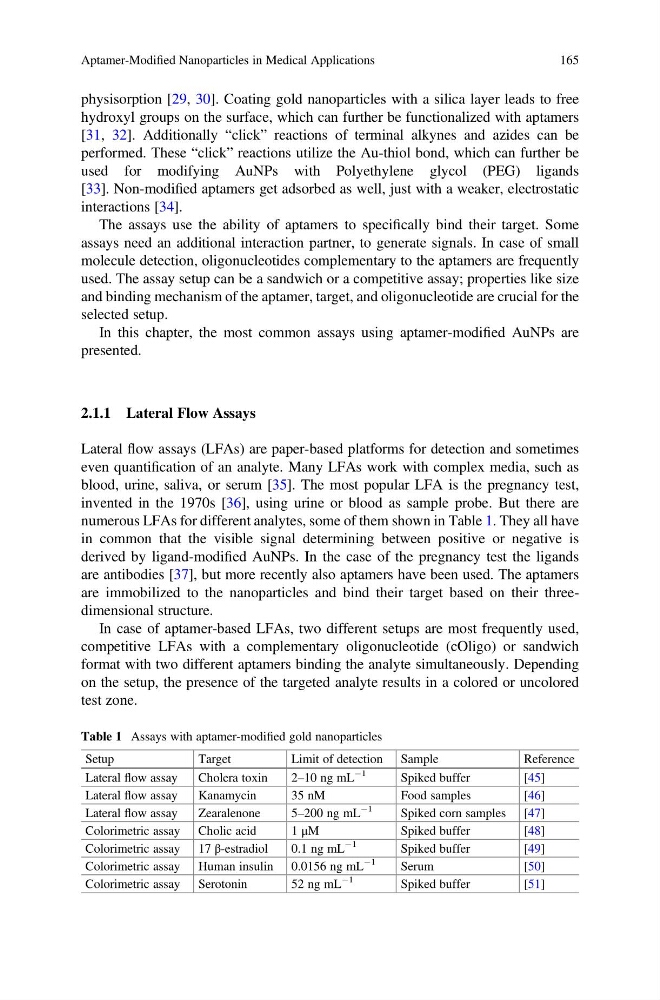
numerous LFAs for different analytes, some of them shown in Table 1. They all have
in common that the visible signal determining between positive or negative is
derived by ligand-modified AuNPs. In the case of the pregnancy test the ligands
are antibodies [37], but more recently also aptamers have been used. The aptamers
are immobilized to the nanoparticles and bind their target based on their threedimensional structure.
In case of aptamer-based LFAs, two different setups are most frequently used,
competitive LFAs with a complementary oligonucleotide (cOligo) or sandwich
format with two different aptamers binding the analyte simultaneously. Depending
on the setup, the presence of the targeted analyte results in a colored or uncolored
test zone.
Table 1 Assays with aptamer-modified gold nanoparticles
Setup
Target
Limit of detection Sample
Reference
Lateral flow assay
Cholera toxin
2–10 ng mL
À1
Spiked buffer
[45]
Lateral flow assay
Kanamycin
35 nM
Food samples
[46]
Lateral flow assay
Zearalenone
5–200 ng mL
À1
Spiked corn samples [47]
Colorimetric assay Cholic acid
1 μM
Spiked buffer
[48]
Colorimetric assay 17 β-estradiol
0.1 ng mL
À1
Spiked buffer
[49]
Colorimetric assay Human insulin 0.0156 ng mL
À1
Serum
[50]
Colorimetric assay Serotonin
52 ng mL
À1
Spiked buffer
[51]
Aptamer-Modified Nanoparticles in Medical Applications
165
hydroxyl groups on the surface, which can further be functionalized with aptamers
[31, 32]. Additionally “click” reactions of terminal alkynes and azides can be
performed. These “click” reactions utilize the Au-thiol bond, which can further be
used for modifying AuNPs with Polyethylene glycol (PEG) ligands
[33]. Non-modified aptamers get adsorbed as well, just with a weaker, electrostatic
interactions [34].
The assays use the ability of aptamers to specifically bind their target. Some
assays need an additional interaction partner, to generate signals. In case of small
molecule detection, oligonucleotides complementary to the aptamers are frequently
used. The assay setup can be a sandwich or a competitive assay; properties like size
and binding mechanism of the aptamer, target, and oligonucleotide are crucial for the
selected setup.
In this chapter, the most common assays using aptamer-modified AuNPs are
presented.
2.1.1 Lateral Flow Assays
Lateral flow assays (LFAs) are paper-based platforms for detection and sometimes
even quantification of an analyte. Many LFAs work with complex media, such as
blood, urine, saliva, or serum [35]. The most popular LFA is the pregnancy test,
invented in the 1970s [36], using urine or blood as sample probe. But there are
numerous LFAs for different analytes, some of them shown in Table 1. They all have
in common that the visible signal determining between positive or negative is
derived by ligand-modified AuNPs. In the case of the pregnancy test the ligands
are antibodies [37], but more recently also aptamers have been used. The aptamers
are immobilized to the nanoparticles and bind their target based on their threedimensional structure.
In case of aptamer-based LFAs, two different setups are most frequently used,
competitive LFAs with a complementary oligonucleotide (cOligo) or sandwich
format with two different aptamers binding the analyte simultaneously. Depending
on the setup, the presence of the targeted analyte results in a colored or uncolored
test zone.
Table 1 Assays with aptamer-modified gold nanoparticles
Setup
Target
Limit of detection Sample
Reference
Lateral flow assay
Cholera toxin
2–10 ng mL
À1
Spiked buffer
[45]
Lateral flow assay
Kanamycin
35 nM
Food samples
[46]
Lateral flow assay
Zearalenone
5–200 ng mL
À1
Spiked corn samples [47]
Colorimetric assay Cholic acid
1 μM
Spiked buffer
[48]
Colorimetric assay 17 β-estradiol
0.1 ng mL
À1
Spiked buffer
[49]
Colorimetric assay Human insulin 0.0156 ng mL
À1
Serum
[50]
Colorimetric assay Serotonin
52 ng mL
À1
Spiked buffer
[51]
Aptamer-Modified Nanoparticles in Medical Applications
165