

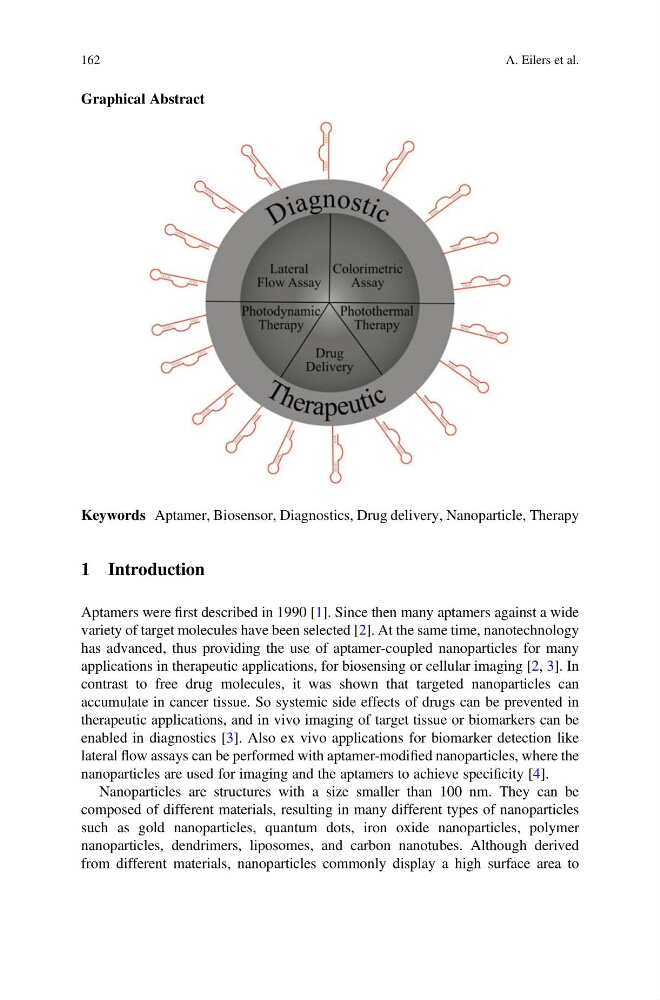
Graphical Abstract
Keywords Aptamer, Biosensor, Diagnostics, Drug delivery, Nanoparticle, Therapy
1 Introduction
Aptamers were first described in 1990 [1]. Since then many aptamers against a wide
variety of target molecules have been selected [2]. At the same time, nanotechnology
has advanced, thus providing the use of aptamer-coupled nanoparticles for many
applications in therapeutic applications, for biosensing or cellular imaging [2, 3]. In
contrast to free drug molecules, it was shown that targeted nanoparticles can
accumulate in cancer tissue. So systemic side effects of drugs can be prevented in
therapeutic applications, and in vivo imaging of target tissue or biomarkers can be
enabled in diagnostics [3]. Also ex vivo applications for biomarker detection like
lateral flow assays can be performed with aptamer-modified nanoparticles, where the
nanoparticles are used for imaging and the aptamers to achieve specificity [4].
Nanoparticles are structures with a size smaller than 100 nm. They can be
composed of different materials, resulting in many different types of nanoparticles
such as gold nanoparticles, quantum dots, iron oxide nanoparticles, polymer
nanoparticles, dendrimers, liposomes, and carbon nanotubes. Although derived
from different materials, nanoparticles commonly display a high surface area to
162
A. Eilers et al.
Keywords Aptamer, Biosensor, Diagnostics, Drug delivery, Nanoparticle, Therapy
1 Introduction
Aptamers were first described in 1990 [1]. Since then many aptamers against a wide
variety of target molecules have been selected [2]. At the same time, nanotechnology
has advanced, thus providing the use of aptamer-coupled nanoparticles for many
applications in therapeutic applications, for biosensing or cellular imaging [2, 3]. In
contrast to free drug molecules, it was shown that targeted nanoparticles can
accumulate in cancer tissue. So systemic side effects of drugs can be prevented in
therapeutic applications, and in vivo imaging of target tissue or biomarkers can be
enabled in diagnostics [3]. Also ex vivo applications for biomarker detection like
lateral flow assays can be performed with aptamer-modified nanoparticles, where the
nanoparticles are used for imaging and the aptamers to achieve specificity [4].
Nanoparticles are structures with a size smaller than 100 nm. They can be
composed of different materials, resulting in many different types of nanoparticles
such as gold nanoparticles, quantum dots, iron oxide nanoparticles, polymer
nanoparticles, dendrimers, liposomes, and carbon nanotubes. Although derived
from different materials, nanoparticles commonly display a high surface area to
162
A. Eilers et al.