

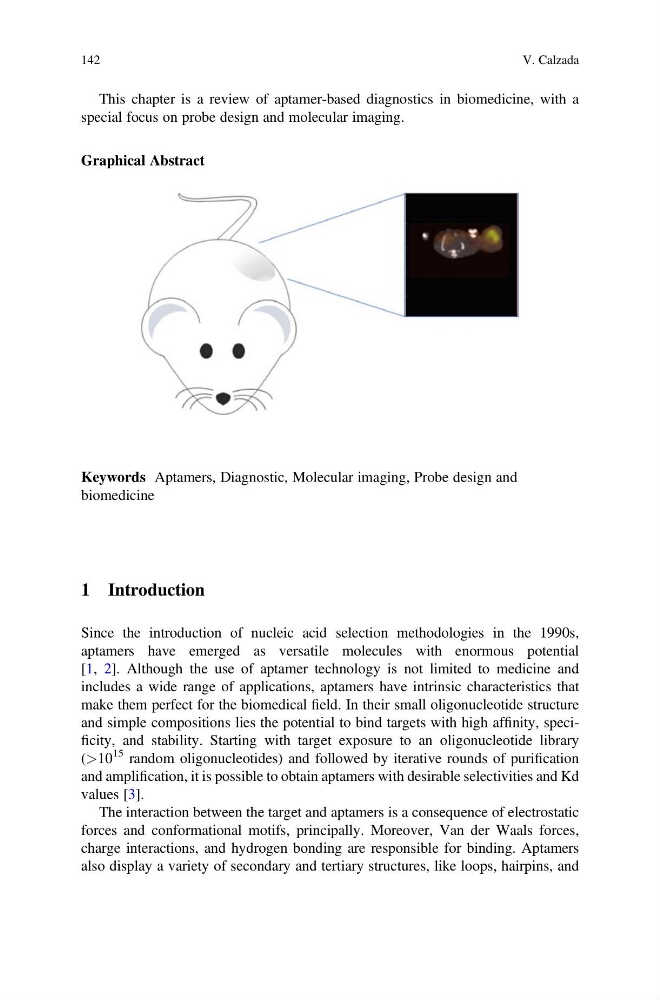
This chapter is a review of aptamer-based diagnostics in biomedicine, with a
special focus on probe design and molecular imaging.
Graphical Abstract
Keywords Aptamers, Diagnostic, Molecular imaging, Probe design and
biomedicine
1 Introduction
Since the introduction of nucleic acid selection methodologies in the 1990s,
aptamers have emerged as versatile molecules with enormous potential
[1, 2]. Although the use of aptamer technology is not limited to medicine and
includes a wide range of applications, aptamers have intrinsic characteristics that
make them perfect for the biomedical field. In their small oligonucleotide structure
and simple compositions lies the potential to bind targets with high affinity, specificity, and stability. Starting with target exposure to an oligonucleotide library
(>10
15 random oligonucleotides) and followed by iterative rounds of purification
and amplification, it is possible to obtain aptamers with desirable selectivities and Kd
values [3].
The interaction between the target and aptamers is a consequence of electrostatic
forces and conformational motifs, principally. Moreover, Van der Waals forces,
charge interactions, and hydrogen bonding are responsible for binding. Aptamers
also display a variety of secondary and tertiary structures, like loops, hairpins, and
142
V. Calzada
special focus on probe design and molecular imaging.
Graphical Abstract
Keywords Aptamers, Diagnostic, Molecular imaging, Probe design and
biomedicine
1 Introduction
Since the introduction of nucleic acid selection methodologies in the 1990s,
aptamers have emerged as versatile molecules with enormous potential
[1, 2]. Although the use of aptamer technology is not limited to medicine and
includes a wide range of applications, aptamers have intrinsic characteristics that
make them perfect for the biomedical field. In their small oligonucleotide structure
and simple compositions lies the potential to bind targets with high affinity, specificity, and stability. Starting with target exposure to an oligonucleotide library
(>10
15 random oligonucleotides) and followed by iterative rounds of purification
and amplification, it is possible to obtain aptamers with desirable selectivities and Kd
values [3].
The interaction between the target and aptamers is a consequence of electrostatic
forces and conformational motifs, principally. Moreover, Van der Waals forces,
charge interactions, and hydrogen bonding are responsible for binding. Aptamers
also display a variety of secondary and tertiary structures, like loops, hairpins, and
142
V. Calzada