

(as discussed in Sect. 3), but they could be stabilized by different chemical
means [110].
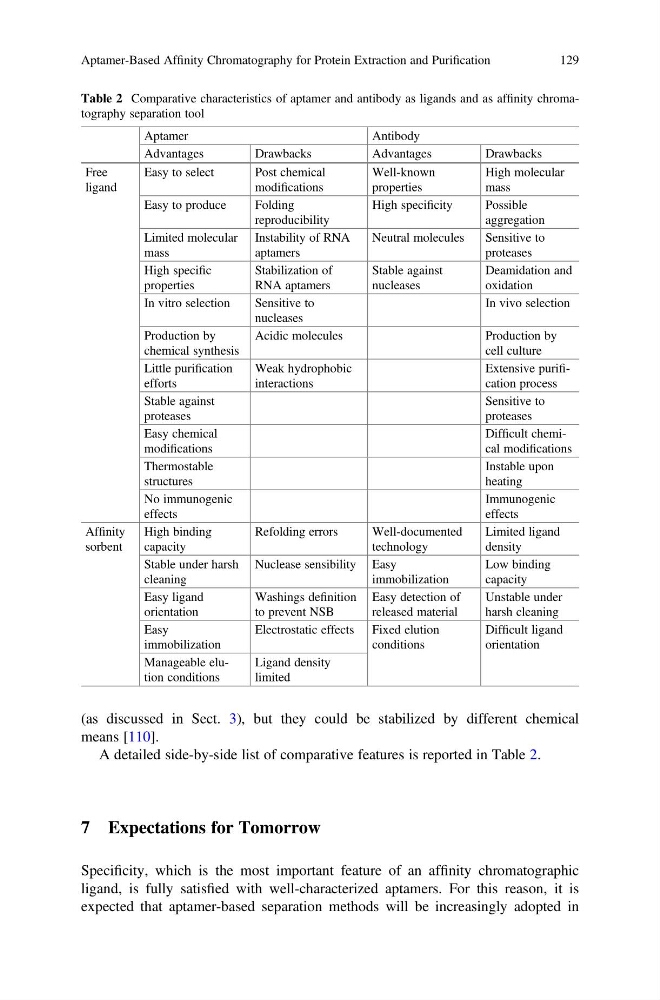
A detailed side-by-side list of comparative features is reported in Table 2.
7 Expectations for Tomorrow
Specificity, which is the most important feature of an affinity chromatographic
ligand, is fully satisfied with well-characterized aptamers. For this reason, it is
expected that aptamer-based separation methods will be increasingly adopted in
Table 2 Comparative characteristics of aptamer and antibody as ligands and as affinity chromatography separation tool
Aptamer
Antibody
Advantages
Drawbacks
Advantages
Drawbacks
Free
ligand
Easy to select
Post chemical
modifications
Well-known
properties
High molecular
mass
Easy to produce
Folding
reproducibility
High specificity
Possible
aggregation
Limited molecular
mass
Instability of RNA
aptamers
Neutral molecules
Sensitive to
proteases
High specific
properties
Stabilization of
RNA aptamers
Stable against
nucleases
Deamidation and
oxidation
In vitro selection
Sensitive to
nucleases
In vivo selection
Production by
chemical synthesis
Acidic molecules
Production by
cell culture
Little purification
efforts
Weak hydrophobic
interactions
Extensive purification process
Stable against
proteases
Sensitive to
proteases
Easy chemical
modifications
Difficult chemical modifications
Thermostable
structures
Instable upon
heating
No immunogenic
effects
Immunogenic
effects
Affinity
sorbent
High binding
capacity
Refolding errors
Well-documented
technology
Limited ligand
density
Stable under harsh
cleaning
Nuclease sensibility Easy
immobilization
Low binding
capacity
Easy ligand
orientation
Washings definition
to prevent NSB
Easy detection of
released material
Unstable under
harsh cleaning
Easy
immobilization
Electrostatic effects Fixed elution
conditions
Difficult ligand
orientation
Manageable elution conditions
Ligand density
limited
Aptamer-Based Affinity Chromatography for Protein Extraction and Purification
129
means [110].
A detailed side-by-side list of comparative features is reported in Table 2.
7 Expectations for Tomorrow
Specificity, which is the most important feature of an affinity chromatographic
ligand, is fully satisfied with well-characterized aptamers. For this reason, it is
expected that aptamer-based separation methods will be increasingly adopted in
Table 2 Comparative characteristics of aptamer and antibody as ligands and as affinity chromatography separation tool
Aptamer
Antibody
Advantages
Drawbacks
Advantages
Drawbacks
Free
ligand
Easy to select
Post chemical
modifications
Well-known
properties
High molecular
mass
Easy to produce
Folding
reproducibility
High specificity
Possible
aggregation
Limited molecular
mass
Instability of RNA
aptamers
Neutral molecules
Sensitive to
proteases
High specific
properties
Stabilization of
RNA aptamers
Stable against
nucleases
Deamidation and
oxidation
In vitro selection
Sensitive to
nucleases
In vivo selection
Production by
chemical synthesis
Acidic molecules
Production by
cell culture
Little purification
efforts
Weak hydrophobic
interactions
Extensive purification process
Stable against
proteases
Sensitive to
proteases
Easy chemical
modifications
Difficult chemical modifications
Thermostable
structures
Instable upon
heating
No immunogenic
effects
Immunogenic
effects
Affinity
sorbent
High binding
capacity
Refolding errors
Well-documented
technology
Limited ligand
density
Stable under harsh
cleaning
Nuclease sensibility Easy
immobilization
Low binding
capacity
Easy ligand
orientation
Washings definition
to prevent NSB
Easy detection of
released material
Unstable under
harsh cleaning
Easy
immobilization
Electrostatic effects Fixed elution
conditions
Difficult ligand
orientation
Manageable elution conditions
Ligand density
limited
Aptamer-Based Affinity Chromatography for Protein Extraction and Purification
129