

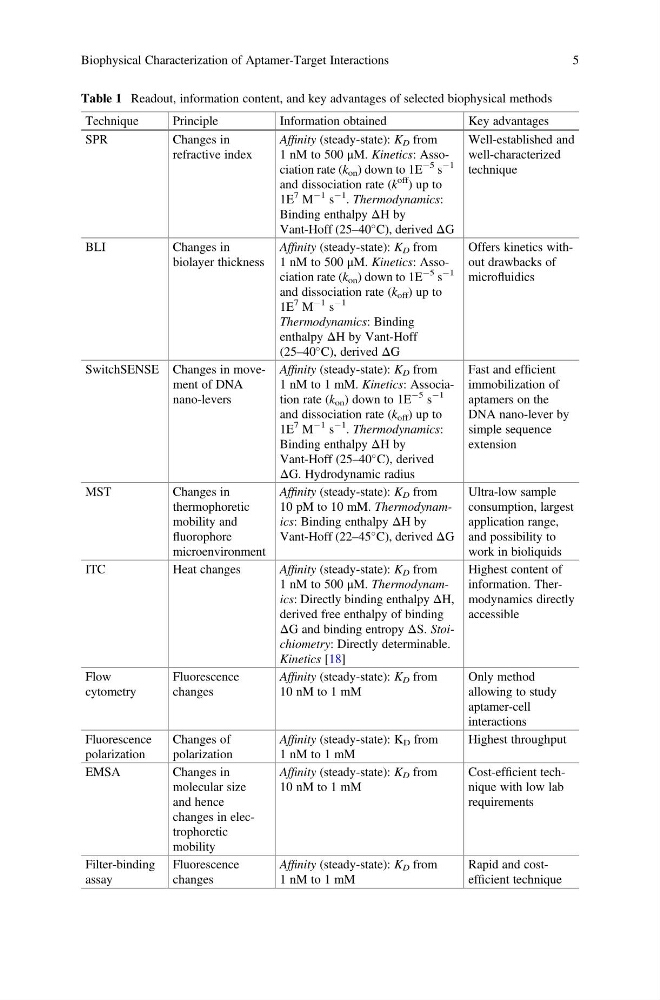
Table 1 Readout, information content, and key advantages of selected biophysical methods
Technique
Principle
Information obtained
Key advantages
SPR
Changes in
refractive index
Affinity (steady-state): K D from
1 nM to 500 μM. Kinetics: Association rate (k on ) down to 1E
À5 s
À1
and dissociation rate (k
off ) up to
1E
7 M
À1 s
À1
. Thermodynamics:
Binding enthalpy ΔH by
Vant-Hoff (25–40
C), derived ΔG
Well-established and
well-characterized
technique
BLI
Changes in
biolayer thickness
Affinity (steady-state): K D from
1 nM to 500 μM. Kinetics: Association rate (k on ) down to 1E
À5 s
À1
and dissociation rate (k off ) up to
1E
7 M
À1 s
À1
Thermodynamics: Binding
enthalpy ΔH by Vant-Hoff
(25–40
C), derived ΔG
Offers kinetics without drawbacks of
microfluidics
SwitchSENSE Changes in movement of DNA
nano-levers
Affinity (steady-state): K D from
1 nM to 1 mM. Kinetics: Association rate (k on ) down to 1E
À5 s
À1
and dissociation rate (k off ) up to
1E
7 M
À1 s
À1
. Thermodynamics:
Binding enthalpy ΔH by
Vant-Hoff (25–40
C), derived
ΔG. Hydrodynamic radius
Fast and efficient
immobilization of
aptamers on the
DNA nano-lever by
simple sequence
extension
MST
Changes in
thermophoretic
mobility and
fluorophore
microenvironment
Affinity (steady-state): K D from
10 pM to 10 mM. Thermodynamics: Binding enthalpy ΔH by
Vant-Hoff (22–45
C), derived ΔG
Ultra-low sample
consumption, largest
application range,
and possibility to
work in bioliquids
ITC
Heat changes
Affinity (steady-state): K D from
1 nM to 500 μM. Thermodynamics: Directly binding enthalpy ΔH,
derived free enthalpy of binding
ΔG and binding entropy ΔS. Stoichiometry: Directly determinable.
Kinetics [18]
Highest content of
information. Thermodynamics directly
accessible
Flow
cytometry
Fluorescence
changes
Affinity (steady-state): K D from
10 nM to 1 mM
Only method
allowing to study
aptamer-cell
interactions
Fluorescence
polarization
Changes of
polarization
Affinity (steady-state): K D from
1 nM to 1 mM
Highest throughput
EMSA
Changes in
molecular size
and hence
changes in electrophoretic
mobility
Affinity (steady-state): K D from
10 nM to 1 mM
Cost-efficient technique with low lab
requirements
Filter-binding
assay
Fluorescence
changes
Affinity (steady-state): K D from
1 nM to 1 mM
Rapid and costefficient technique
Biophysical Characterization of Aptamer-Target Interactions
5
Technique
Principle
Information obtained
Key advantages
SPR
Changes in
refractive index
Affinity (steady-state): K D from
1 nM to 500 μM. Kinetics: Association rate (k on ) down to 1E
À5 s
À1
and dissociation rate (k
off ) up to
1E
7 M
À1 s
À1
. Thermodynamics:
Binding enthalpy ΔH by
Vant-Hoff (25–40
C), derived ΔG
Well-established and
well-characterized
technique
BLI
Changes in
biolayer thickness
Affinity (steady-state): K D from
1 nM to 500 μM. Kinetics: Association rate (k on ) down to 1E
À5 s
À1
and dissociation rate (k off ) up to
1E
7 M
À1 s
À1
Thermodynamics: Binding
enthalpy ΔH by Vant-Hoff
(25–40
C), derived ΔG
Offers kinetics without drawbacks of
microfluidics
SwitchSENSE Changes in movement of DNA
nano-levers
Affinity (steady-state): K D from
1 nM to 1 mM. Kinetics: Association rate (k on ) down to 1E
À5 s
À1
and dissociation rate (k off ) up to
1E
7 M
À1 s
À1
. Thermodynamics:
Binding enthalpy ΔH by
Vant-Hoff (25–40
C), derived
ΔG. Hydrodynamic radius
Fast and efficient
immobilization of
aptamers on the
DNA nano-lever by
simple sequence
extension
MST
Changes in
thermophoretic
mobility and
fluorophore
microenvironment
Affinity (steady-state): K D from
10 pM to 10 mM. Thermodynamics: Binding enthalpy ΔH by
Vant-Hoff (22–45
C), derived ΔG
Ultra-low sample
consumption, largest
application range,
and possibility to
work in bioliquids
ITC
Heat changes
Affinity (steady-state): K D from
1 nM to 500 μM. Thermodynamics: Directly binding enthalpy ΔH,
derived free enthalpy of binding
ΔG and binding entropy ΔS. Stoichiometry: Directly determinable.
Kinetics [18]
Highest content of
information. Thermodynamics directly
accessible
Flow
cytometry
Fluorescence
changes
Affinity (steady-state): K D from
10 nM to 1 mM
Only method
allowing to study
aptamer-cell
interactions
Fluorescence
polarization
Changes of
polarization
Affinity (steady-state): K D from
1 nM to 1 mM
Highest throughput
EMSA
Changes in
molecular size
and hence
changes in electrophoretic
mobility
Affinity (steady-state): K D from
10 nM to 1 mM
Cost-efficient technique with low lab
requirements
Filter-binding
assay
Fluorescence
changes
Affinity (steady-state): K D from
1 nM to 1 mM
Rapid and costefficient technique
Biophysical Characterization of Aptamer-Target Interactions
5