

all subclasses of antibodies were present and their proportion was practically
unchanged. These aptamers were then used for the separation of monoclonal antibodies and compared side by side with current protein G purification processes. To
this end, a clear crude cell culture supernatant was directly loaded on both columns
and all foreign proteins washed out. In the case of protein G chromatography, the
elution was performed by 100 mM glycine-HCl pH 2.8 and for the aptamer column,
the monoclonal IgG desorption was performed using a neutral Tris-HCl buffer
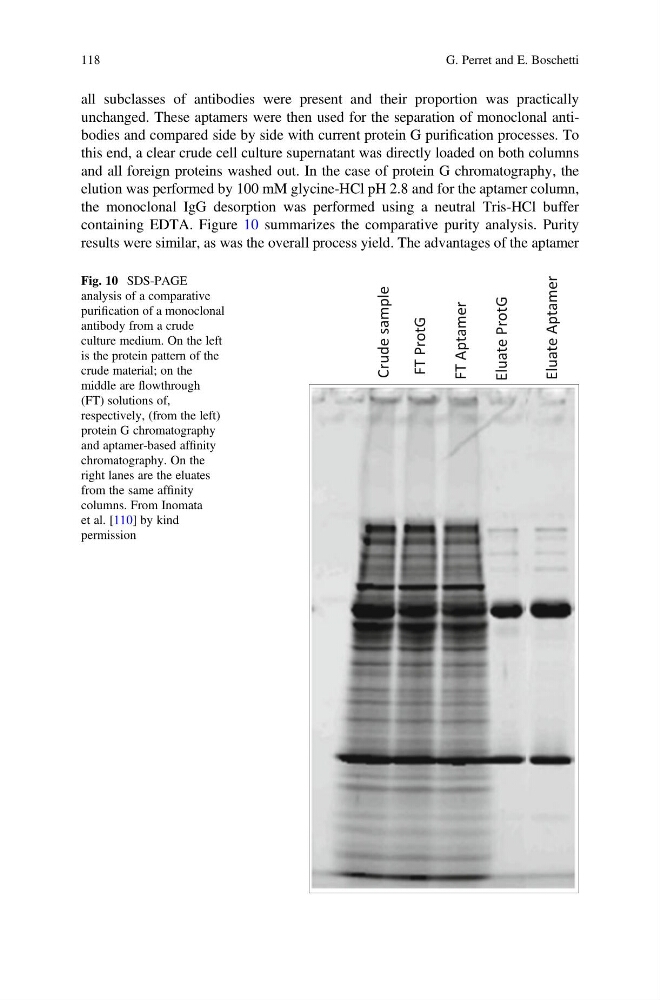
containing EDTA. Figure 10 summarizes the comparative purity analysis. Purity
results were similar, as was the overall process yield. The advantages of the aptamer
Crude sample
FT ProtG
FT Aptamer
Eluate ProtG
Eluate Aptamer
Fig. 10 SDS-PAGE
analysis of a comparative
purification of a monoclonal
antibody from a crude
culture medium. On the left
is the protein pattern of the
crude material; on the
middle are flowthrough
(FT) solutions of,
respectively, (from the left)
protein G chromatography
and aptamer-based affinity
chromatography. On the
right lanes are the eluates
from the same affinity
columns. From Inomata
et al. [110] by kind
permission
118
G. Perret and E. Boschetti
unchanged. These aptamers were then used for the separation of monoclonal antibodies and compared side by side with current protein G purification processes. To
this end, a clear crude cell culture supernatant was directly loaded on both columns
and all foreign proteins washed out. In the case of protein G chromatography, the
elution was performed by 100 mM glycine-HCl pH 2.8 and for the aptamer column,
the monoclonal IgG desorption was performed using a neutral Tris-HCl buffer
containing EDTA. Figure 10 summarizes the comparative purity analysis. Purity
results were similar, as was the overall process yield. The advantages of the aptamer
Crude sample
FT ProtG
FT Aptamer
Eluate ProtG
Eluate Aptamer
Fig. 10 SDS-PAGE
analysis of a comparative
purification of a monoclonal
antibody from a crude
culture medium. On the left
is the protein pattern of the
crude material; on the
middle are flowthrough
(FT) solutions of,
respectively, (from the left)
protein G chromatography
and aptamer-based affinity
chromatography. On the
right lanes are the eluates
from the same affinity
columns. From Inomata
et al. [110] by kind
permission
118
G. Perret and E. Boschetti