

proteins) [141]. Unfortunately, this charge inversion, favorable to a better contact
between the aptamer and the activated support, is not always compatible with the
conditions of the grafting reaction, since they frequently require alkaline pH values.
N-hydroxysuccinimide-activated supports are however relatively tolerant in terms of
pH, and they have been successfully used for aptamer coupling at pH below
6 [61]. Considering all these practical issues, a possible alternative to prevent the
electrostatic repulsion is to use pre-activated supports carrying a positive charge.
This is, for instance, the case for a commercially available NHS-activated sorbent
named Affi-Gel 11 that carries a positively charged amino group. Nevertheless, this
peculiar chemical structure may generate non-specific binding during the affinity
chromatography process as described [61].
It is to be added that thiol derivatives of aptamers can be directly grafted on gold
surfaces. This direct method is not applicable to preparative chromatographic supports, unless they are modified with colloidal gold particles. A necessary precaution
to be considered is to prevent the spontaneous formation of disulfur bridges between
Washing(s)
Target
protein
elution
Ligand
regeneration
Aptamer
selection
SELEX
Aptamer
synthesis
Aptamer
grafting
Target
Protein
capture
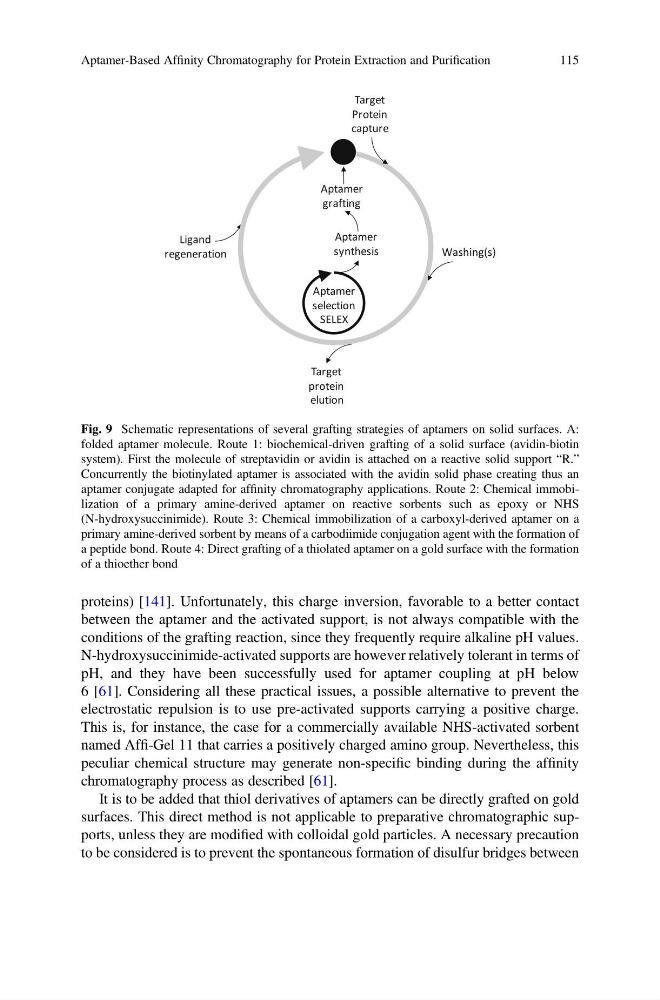
Fig. 9 Schematic representations of several grafting strategies of aptamers on solid surfaces. A:
folded aptamer molecule. Route 1: biochemical-driven grafting of a solid surface (avidin-biotin
system). First the molecule of streptavidin or avidin is attached on a reactive solid support “R.”
Concurrently the biotinylated aptamer is associated with the avidin solid phase creating thus an
aptamer conjugate adapted for affinity chromatography applications. Route 2: Chemical immobilization of a primary amine-derived aptamer on reactive sorbents such as epoxy or NHS
(N-hydroxysuccinimide). Route 3: Chemical immobilization of a carboxyl-derived aptamer on a
primary amine-derived sorbent by means of a carbodiimide conjugation agent with the formation of
a peptide bond. Route 4: Direct grafting of a thiolated aptamer on a gold surface with the formation
of a thioether bond
Aptamer-Based Affinity Chromatography for Protein Extraction and Purification
115
between the aptamer and the activated support, is not always compatible with the
conditions of the grafting reaction, since they frequently require alkaline pH values.
N-hydroxysuccinimide-activated supports are however relatively tolerant in terms of
pH, and they have been successfully used for aptamer coupling at pH below
6 [61]. Considering all these practical issues, a possible alternative to prevent the
electrostatic repulsion is to use pre-activated supports carrying a positive charge.
This is, for instance, the case for a commercially available NHS-activated sorbent
named Affi-Gel 11 that carries a positively charged amino group. Nevertheless, this
peculiar chemical structure may generate non-specific binding during the affinity
chromatography process as described [61].
It is to be added that thiol derivatives of aptamers can be directly grafted on gold
surfaces. This direct method is not applicable to preparative chromatographic supports, unless they are modified with colloidal gold particles. A necessary precaution
to be considered is to prevent the spontaneous formation of disulfur bridges between
Washing(s)
Target
protein
elution
Ligand
regeneration
Aptamer
selection
SELEX
Aptamer
synthesis
Aptamer
grafting
Target
Protein
capture
Fig. 9 Schematic representations of several grafting strategies of aptamers on solid surfaces. A:
folded aptamer molecule. Route 1: biochemical-driven grafting of a solid surface (avidin-biotin
system). First the molecule of streptavidin or avidin is attached on a reactive solid support “R.”
Concurrently the biotinylated aptamer is associated with the avidin solid phase creating thus an
aptamer conjugate adapted for affinity chromatography applications. Route 2: Chemical immobilization of a primary amine-derived aptamer on reactive sorbents such as epoxy or NHS
(N-hydroxysuccinimide). Route 3: Chemical immobilization of a carboxyl-derived aptamer on a
primary amine-derived sorbent by means of a carbodiimide conjugation agent with the formation of
a peptide bond. Route 4: Direct grafting of a thiolated aptamer on a gold surface with the formation
of a thioether bond
Aptamer-Based Affinity Chromatography for Protein Extraction and Purification
115