

3 The Advent of Aptamer Affinity Chromatography
Ligands
The advent of oligonucleotides as affinity chromatography ligands signals a singular
momentum in the technological developments of this separation technology. The
term aptamer was coined from two different words, the first from Latin “aptus”
designating something that fits and the second from the Greek word “mearos”
meaning a particle [57]. Thus “particle that fits” became “aptamer.” While the
affinity properties of these macromolecules appeared of interest from the beginning
of their discovery [58, 59], their application to affinity chromatography came later.
This happened with Romig et al. [60] when the authors described the use of an
aptamer against human L-selectin used for the purification of a L-selectin-Ig fusion
protein from a recombinant cell culture supernatant. For the first time, the demonstration was made that an aptamer affinity chromatography column was able to
increase the purification degree of about 1,500 times with a yield of 83%. Then, this
technology developed slowly up to recent papers underlining that protein purification is effectively facilitated by the use of aptamers [61, 62]. The evolution and the
most important purification examples are reported below in a subsequent section.
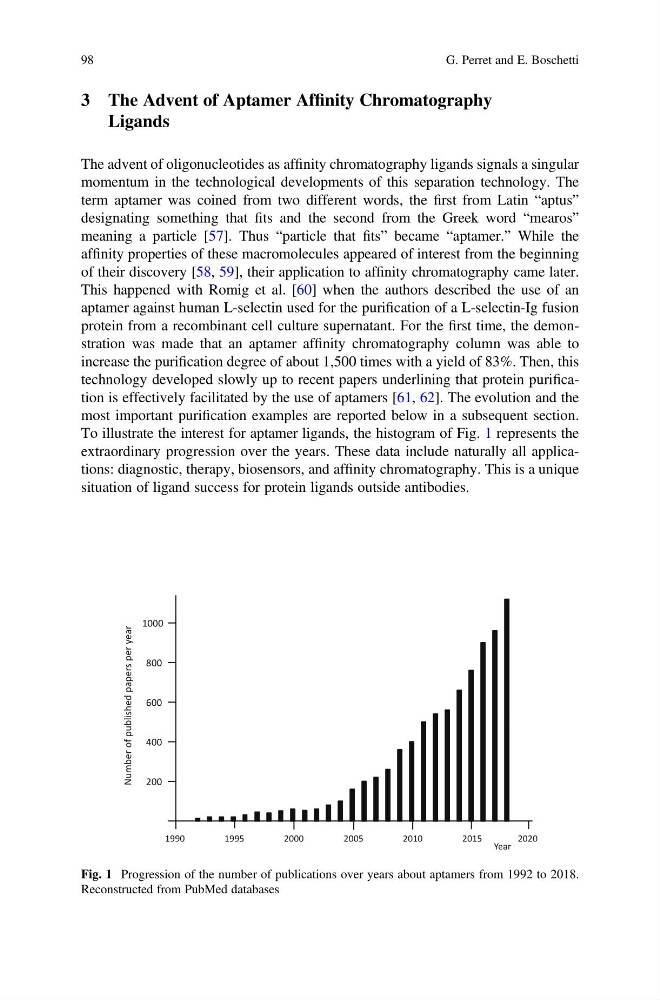
To illustrate the interest for aptamer ligands, the histogram of Fig. 1 represents the
extraordinary progression over the years. These data include naturally all applications: diagnostic, therapy, biosensors, and affinity chromatography. This is a unique
situation of ligand success for protein ligands outside antibodies.
2005
1990
2000
2020
1995
2015
2010
200
800
600
400
1000
Number of published papers per year
Year
Fig. 1 Progression of the number of publications over years about aptamers from 1992 to 2018.
Reconstructed from PubMed databases
98
G. Perret and E. Boschetti
Ligands
The advent of oligonucleotides as affinity chromatography ligands signals a singular
momentum in the technological developments of this separation technology. The
term aptamer was coined from two different words, the first from Latin “aptus”
designating something that fits and the second from the Greek word “mearos”
meaning a particle [57]. Thus “particle that fits” became “aptamer.” While the
affinity properties of these macromolecules appeared of interest from the beginning
of their discovery [58, 59], their application to affinity chromatography came later.
This happened with Romig et al. [60] when the authors described the use of an
aptamer against human L-selectin used for the purification of a L-selectin-Ig fusion
protein from a recombinant cell culture supernatant. For the first time, the demonstration was made that an aptamer affinity chromatography column was able to
increase the purification degree of about 1,500 times with a yield of 83%. Then, this
technology developed slowly up to recent papers underlining that protein purification is effectively facilitated by the use of aptamers [61, 62]. The evolution and the
most important purification examples are reported below in a subsequent section.
To illustrate the interest for aptamer ligands, the histogram of Fig. 1 represents the
extraordinary progression over the years. These data include naturally all applications: diagnostic, therapy, biosensors, and affinity chromatography. This is a unique
situation of ligand success for protein ligands outside antibodies.
2005
1990
2000
2020
1995
2015
2010
200
800
600
400
1000
Number of published papers per year
Year
Fig. 1 Progression of the number of publications over years about aptamers from 1992 to 2018.
Reconstructed from PubMed databases
98
G. Perret and E. Boschetti