

xylene Tol (pWWO) catabolic plasmid or partial degradative steps such as those for
naphthalene (NAH) to salicylate (SAL) and camphor (CAM). In addition, genes
involved in a catabolic pathway are frequently clustered together, facilitating correlation and transfer among microorganisms. Moreover, genes involved in the degradation of pesticides may evolve in different microorganisms followed by their
assembly on the same plasmid in a single organism through horizontal gene transfer.
There are now evidences indicating that transposable elements cause rearrangement
of genetic material and may be transferred between unrelated strains and ultimately
resulting in the construction of new degradative plasmids (Tan 1999).
The movement and rearrangement of sections of DNA through genetic recombination or transposition of DNA can modify the regulation and expression of catabolic genes. Success of a catabolic pathway depends upon its catabolic components
and regulatory elements particularly the promoters. Understanding of the behaviors
of such regulatory promoters in and off the field is the prerequisite for engineering of
the catabolic pathways for pesticide bioremediation. Genetic engineering techniques
have been used to construct plasmids that code for the catabolism of halo-aromatic
compounds (Rojo et al. 1987; Ramos et al. 1987). The transmissible nature of genes
specifying dissimilation of xenobiotic compounds may lead to a rapid spread of
degradative capabilities in microbial population, once a degradative plasmid has
evolved.
The transfer of these catabolic plasmids may be involved in the adaption of the
soil microflora and development of enhanced degradation capability. The 2,4-D
degradation encoding plasmid pJP4 was transferred into a wide variety of bacteria
including E. coli, Rhodopseudomonas sphaeroides, A. tumefaciens, Rhizobium spp.,
P. fluorescens, P. putida, and Acinetobacter calcoaceticus (Don and Pemberton
1981). Haugland et al. (1990) reported that mixtures of the herbicides 2,4-D and
2,4,5-T were toxic to P. cepacia strain AC 1100 (2,4,5-T degrader) and Alcaligenes
eutrophus strain JMP134 (2,4-D degrader) due to production of inhibitory metabolites. A derivative of strain P. cepacia AC 1100 was constructed by the transfer of
2,4-D degradative plasmids pJP4 from Alcaligenes eutrophus strain JMP134. The
new strain RHJ1 efficiently degraded mixture of 2,4-D and 2,4,5-T. Such microbial
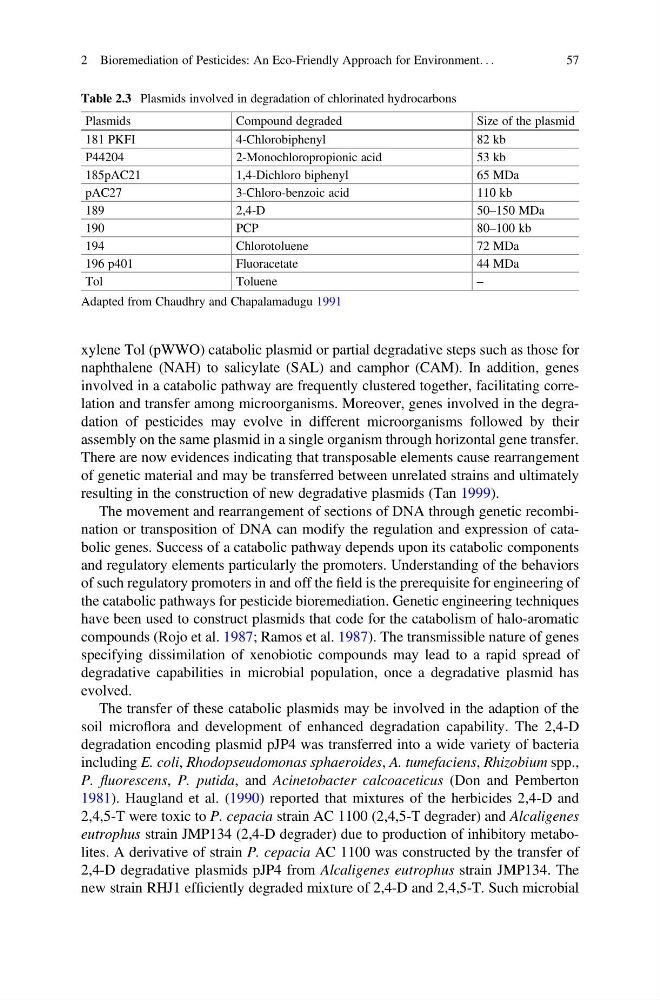
Table 2.3 Plasmids involved in degradation of chlorinated hydrocarbons
Plasmids
Compound degraded
Size of the plasmid
181 PKFI
4-Chlorobiphenyl
82 kb
P44204
2-Monochloropropionic acid
53 kb
185pAC21
1,4-Dichloro biphenyl
65 MDa
pAC27
3-Chloro-benzoic acid
110 kb
189
2,4-D
50–150 MDa
190
PCP
80–100 kb
194
Chlorotoluene
72 MDa
196 p401
Fluoracetate
44 MDa
Tol
Toluene
–
Adapted from Chaudhry and Chapalamadugu 1991
2 Bioremediation of Pesticides: An Eco-Friendly Approach for Environment. . .
57
naphthalene (NAH) to salicylate (SAL) and camphor (CAM). In addition, genes
involved in a catabolic pathway are frequently clustered together, facilitating correlation and transfer among microorganisms. Moreover, genes involved in the degradation of pesticides may evolve in different microorganisms followed by their
assembly on the same plasmid in a single organism through horizontal gene transfer.
There are now evidences indicating that transposable elements cause rearrangement
of genetic material and may be transferred between unrelated strains and ultimately
resulting in the construction of new degradative plasmids (Tan 1999).
The movement and rearrangement of sections of DNA through genetic recombination or transposition of DNA can modify the regulation and expression of catabolic genes. Success of a catabolic pathway depends upon its catabolic components
and regulatory elements particularly the promoters. Understanding of the behaviors
of such regulatory promoters in and off the field is the prerequisite for engineering of
the catabolic pathways for pesticide bioremediation. Genetic engineering techniques
have been used to construct plasmids that code for the catabolism of halo-aromatic
compounds (Rojo et al. 1987; Ramos et al. 1987). The transmissible nature of genes
specifying dissimilation of xenobiotic compounds may lead to a rapid spread of
degradative capabilities in microbial population, once a degradative plasmid has
evolved.
The transfer of these catabolic plasmids may be involved in the adaption of the
soil microflora and development of enhanced degradation capability. The 2,4-D
degradation encoding plasmid pJP4 was transferred into a wide variety of bacteria
including E. coli, Rhodopseudomonas sphaeroides, A. tumefaciens, Rhizobium spp.,
P. fluorescens, P. putida, and Acinetobacter calcoaceticus (Don and Pemberton
1981). Haugland et al. (1990) reported that mixtures of the herbicides 2,4-D and
2,4,5-T were toxic to P. cepacia strain AC 1100 (2,4,5-T degrader) and Alcaligenes
eutrophus strain JMP134 (2,4-D degrader) due to production of inhibitory metabolites. A derivative of strain P. cepacia AC 1100 was constructed by the transfer of
2,4-D degradative plasmids pJP4 from Alcaligenes eutrophus strain JMP134. The
new strain RHJ1 efficiently degraded mixture of 2,4-D and 2,4,5-T. Such microbial
Table 2.3 Plasmids involved in degradation of chlorinated hydrocarbons
Plasmids
Compound degraded
Size of the plasmid
181 PKFI
4-Chlorobiphenyl
82 kb
P44204
2-Monochloropropionic acid
53 kb
185pAC21
1,4-Dichloro biphenyl
65 MDa
pAC27
3-Chloro-benzoic acid
110 kb
189
2,4-D
50–150 MDa
190
PCP
80–100 kb
194
Chlorotoluene
72 MDa
196 p401
Fluoracetate
44 MDa
Tol
Toluene
–
Adapted from Chaudhry and Chapalamadugu 1991
2 Bioremediation of Pesticides: An Eco-Friendly Approach for Environment. . .
57