

self-transmissible plasmid pJP4, possessing 2,4-D degradative genes to local soil
bacteria. It was established that pJP4 plasmid was transferred to the soil through
E. coli D11.156 or its inventive host, R. eutropha JMP134. It was established that
R. eutropha JMP134 possess the capability of mineralizing 2,4-D, but E. coli D11
could not due to the absence of the chromosomal genes together with plasmid genes
that enable total mineralization of 2,4-D. It was further established that it took
28 days for complete biodegradation in the presence of soil receiving R. eutropha
JMP134 while it took 49 days for the complete biodegradation of non-bioaugmented
soil as well as soil receiving E. coli D11 inoculant. It was also established that many
transconjugants isolated from E. coli D11 amended soil were recognized as the
inoculant organisms most especially those that possess the capability to degrade
2,4-D obtained from the soil receiving R. eutropha JMP134. Subsequent deprivation
of the preliminary 2,4-D adjustment, the authors added supplementary 2,4-D to the
soil. Afterwards, the amendment 2,4-D was degraded further swiftly in the microcosms that was treated with the E. coli D11 inoculant when compared to the soil that
was treated with the non-bioaugmented soil and R. eutropha JMP134 inoculant.
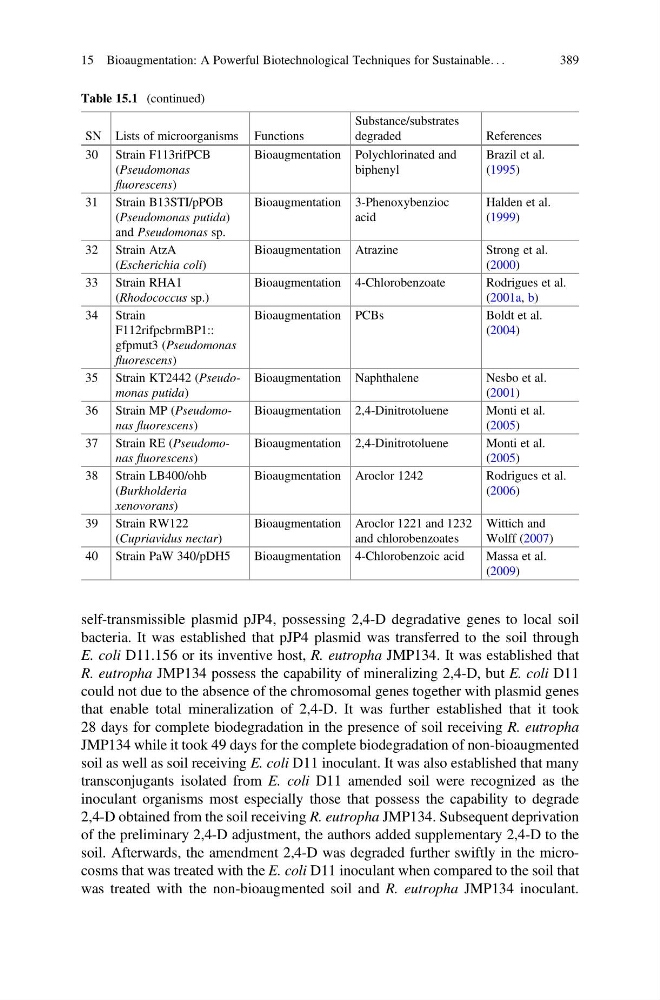
Table 15.1 (continued)
SN Lists of microorganisms Functions
Substance/substrates
degraded
References
30 Strain F113rifPCB
(Pseudomonas
fluorescens)
Bioaugmentation Polychlorinated and
biphenyl
Brazil et al.
(1995)
31 Strain B13STI/pPOB
(Pseudomonas putida)
and Pseudomonas sp.
Bioaugmentation 3-Phenoxybenzioc
acid
Halden et al.
(1999)
32 Strain AtzA
(Escherichia coli)
Bioaugmentation Atrazine
Strong et al.
(2000)
33 Strain RHA1
(Rhodococcus sp.)
Bioaugmentation 4-Chlorobenzoate
Rodrigues et al.
(2001a, b)
34 Strain
F112rifpcbrmBP1::
gfpmut3 (Pseudomonas
fluorescens)
Bioaugmentation PCBs
Boldt et al.
(2004)
35 Strain KT2442 (Pseudomonas putida)
Bioaugmentation Naphthalene
Nesbo et al.
(2001)
36 Strain MP (Pseudomonas fluorescens)
Bioaugmentation 2,4-Dinitrotoluene
Monti et al.
(2005)
37 Strain RE (Pseudomonas fluorescens)
Bioaugmentation 2,4-Dinitrotoluene
Monti et al.
(2005)
38 Strain LB400/ohb
(Burkholderia
xenovorans)
Bioaugmentation Aroclor 1242
Rodrigues et al.
(2006)
39 Strain RW122
(Cupriavidus nectar)
Bioaugmentation Aroclor 1221 and 1232
and chlorobenzoates
Wittich and
Wolff (2007)
40 Strain PaW 340/pDH5
Bioaugmentation 4-Chlorobenzoic acid
Massa et al.
(2009)
15 Bioaugmentation: A Powerful Biotechnological Techniques for Sustainable. . .
389
bacteria. It was established that pJP4 plasmid was transferred to the soil through
E. coli D11.156 or its inventive host, R. eutropha JMP134. It was established that
R. eutropha JMP134 possess the capability of mineralizing 2,4-D, but E. coli D11
could not due to the absence of the chromosomal genes together with plasmid genes
that enable total mineralization of 2,4-D. It was further established that it took
28 days for complete biodegradation in the presence of soil receiving R. eutropha
JMP134 while it took 49 days for the complete biodegradation of non-bioaugmented
soil as well as soil receiving E. coli D11 inoculant. It was also established that many
transconjugants isolated from E. coli D11 amended soil were recognized as the
inoculant organisms most especially those that possess the capability to degrade
2,4-D obtained from the soil receiving R. eutropha JMP134. Subsequent deprivation
of the preliminary 2,4-D adjustment, the authors added supplementary 2,4-D to the
soil. Afterwards, the amendment 2,4-D was degraded further swiftly in the microcosms that was treated with the E. coli D11 inoculant when compared to the soil that
was treated with the non-bioaugmented soil and R. eutropha JMP134 inoculant.
Table 15.1 (continued)
SN Lists of microorganisms Functions
Substance/substrates
degraded
References
30 Strain F113rifPCB
(Pseudomonas
fluorescens)
Bioaugmentation Polychlorinated and
biphenyl
Brazil et al.
(1995)
31 Strain B13STI/pPOB
(Pseudomonas putida)
and Pseudomonas sp.
Bioaugmentation 3-Phenoxybenzioc
acid
Halden et al.
(1999)
32 Strain AtzA
(Escherichia coli)
Bioaugmentation Atrazine
Strong et al.
(2000)
33 Strain RHA1
(Rhodococcus sp.)
Bioaugmentation 4-Chlorobenzoate
Rodrigues et al.
(2001a, b)
34 Strain
F112rifpcbrmBP1::
gfpmut3 (Pseudomonas
fluorescens)
Bioaugmentation PCBs
Boldt et al.
(2004)
35 Strain KT2442 (Pseudomonas putida)
Bioaugmentation Naphthalene
Nesbo et al.
(2001)
36 Strain MP (Pseudomonas fluorescens)
Bioaugmentation 2,4-Dinitrotoluene
Monti et al.
(2005)
37 Strain RE (Pseudomonas fluorescens)
Bioaugmentation 2,4-Dinitrotoluene
Monti et al.
(2005)
38 Strain LB400/ohb
(Burkholderia
xenovorans)
Bioaugmentation Aroclor 1242
Rodrigues et al.
(2006)
39 Strain RW122
(Cupriavidus nectar)
Bioaugmentation Aroclor 1221 and 1232
and chlorobenzoates
Wittich and
Wolff (2007)
40 Strain PaW 340/pDH5
Bioaugmentation 4-Chlorobenzoic acid
Massa et al.
(2009)
15 Bioaugmentation: A Powerful Biotechnological Techniques for Sustainable. . .
389