

food industries. In conclusion, the author recommends the utilization of bacterial
enzymatic and biocomposites or grafting techniques for the degradation of plastic
wastes.
The usefulness of plastics in our current generation is so enormous. The
non-biodegradable nature of plastics has led to their long shelf life in the environment. However, this has led to an uncontrolled proliferation of them in the ecosystem
and persistent pollution. Wierckx et al. (2018) did a review of the opportunities and
challenges faced in the biodegradation of plastic wastes. This is an attempt to reduce
pollution. Moreover, studies have shown the emergence of engineered microorganisms which can degrade or decontaminate recalcitrant high polymers molecular
connection via some enzymatic reactions. In conclusion, the authors recommend a
better viewpoint on plastic remediation by the utilization of pre-treatment-thermochemical and substrates of microbial enzymes as a future panacea.
Philp et al. (2013), in a review, looked at the possibility for a bio-economy using a
bio-based plastic technique in recycling plastic wastes from biodegradation. The
specificity for a bio-economy is derived from the utilization of chemicals and
oil-based materials from the biodegradation of useful materials from biorefineries
by microbes and biomass-derived substances from the process (biocomposting). In
conclusion, the authors recommend more improvement, awareness, and attention in
their shared market values, while anticipating a sustainable contributions toward
climate change alleviation.
Zheng et al. (2005) did a review of the biotechnological improvement in the
degradation of plastics and associated wastes. The authors recounted the importance
of plastics to every facets of human lives. The need of the breakdown of plastics by
microbes is very important because of the ecological and health risks they portend.
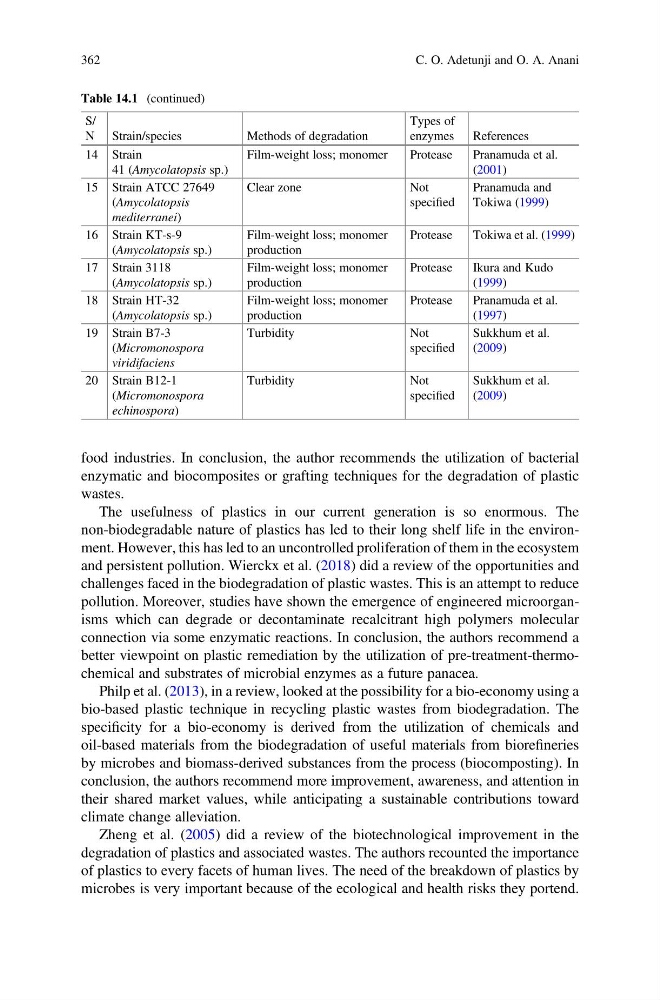
Table 14.1 (continued)
S/
N Strain/species
Methods of degradation
Types of
enzymes References
14 Strain
41 (Amycolatopsis sp.)
Film-weight loss; monomer
Protease
Pranamuda et al.
(2001)
15 Strain ATCC 27649
(Amycolatopsis
mediterranei)
Clear zone
Not
specified
Pranamuda and
Tokiwa (1999)
16 Strain KT-s-9
(Amycolatopsis sp.)
Film-weight loss; monomer
production
Protease
Tokiwa et al. (1999)
17 Strain 3118
(Amycolatopsis sp.)
Film-weight loss; monomer
production
Protease
Ikura and Kudo
(1999)
18 Strain HT-32
(Amycolatopsis sp.)
Film-weight loss; monomer
production
Protease
Pranamuda et al.
(1997)
19 Strain B7-3
(Micromonospora
viridifaciens
Turbidity
Not
specified
Sukkhum et al.
(2009)
20 Strain B12-1
(Micromonospora
echinospora)
Turbidity
Not
specified
Sukkhum et al.
(2009)
362
C. O. Adetunji and O. A. Anani
enzymatic and biocomposites or grafting techniques for the degradation of plastic
wastes.
The usefulness of plastics in our current generation is so enormous. The
non-biodegradable nature of plastics has led to their long shelf life in the environment. However, this has led to an uncontrolled proliferation of them in the ecosystem
and persistent pollution. Wierckx et al. (2018) did a review of the opportunities and
challenges faced in the biodegradation of plastic wastes. This is an attempt to reduce
pollution. Moreover, studies have shown the emergence of engineered microorganisms which can degrade or decontaminate recalcitrant high polymers molecular
connection via some enzymatic reactions. In conclusion, the authors recommend a
better viewpoint on plastic remediation by the utilization of pre-treatment-thermochemical and substrates of microbial enzymes as a future panacea.
Philp et al. (2013), in a review, looked at the possibility for a bio-economy using a
bio-based plastic technique in recycling plastic wastes from biodegradation. The
specificity for a bio-economy is derived from the utilization of chemicals and
oil-based materials from the biodegradation of useful materials from biorefineries
by microbes and biomass-derived substances from the process (biocomposting). In
conclusion, the authors recommend more improvement, awareness, and attention in
their shared market values, while anticipating a sustainable contributions toward
climate change alleviation.
Zheng et al. (2005) did a review of the biotechnological improvement in the
degradation of plastics and associated wastes. The authors recounted the importance
of plastics to every facets of human lives. The need of the breakdown of plastics by
microbes is very important because of the ecological and health risks they portend.
Table 14.1 (continued)
S/
N Strain/species
Methods of degradation
Types of
enzymes References
14 Strain
41 (Amycolatopsis sp.)
Film-weight loss; monomer
Protease
Pranamuda et al.
(2001)
15 Strain ATCC 27649
(Amycolatopsis
mediterranei)
Clear zone
Not
specified
Pranamuda and
Tokiwa (1999)
16 Strain KT-s-9
(Amycolatopsis sp.)
Film-weight loss; monomer
production
Protease
Tokiwa et al. (1999)
17 Strain 3118
(Amycolatopsis sp.)
Film-weight loss; monomer
production
Protease
Ikura and Kudo
(1999)
18 Strain HT-32
(Amycolatopsis sp.)
Film-weight loss; monomer
production
Protease
Pranamuda et al.
(1997)
19 Strain B7-3
(Micromonospora
viridifaciens
Turbidity
Not
specified
Sukkhum et al.
(2009)
20 Strain B12-1
(Micromonospora
echinospora)
Turbidity
Not
specified
Sukkhum et al.
(2009)
362
C. O. Adetunji and O. A. Anani