

molecules to unique biopolymers and enzymes (Tango and Islam 2002). To overcome the limitation of cultivating extremophiles on a production scale, research
work is going on for developing methods and procedures by which extremophiles
can be effectively cultivated for increase in the production of extremophilic biomass,
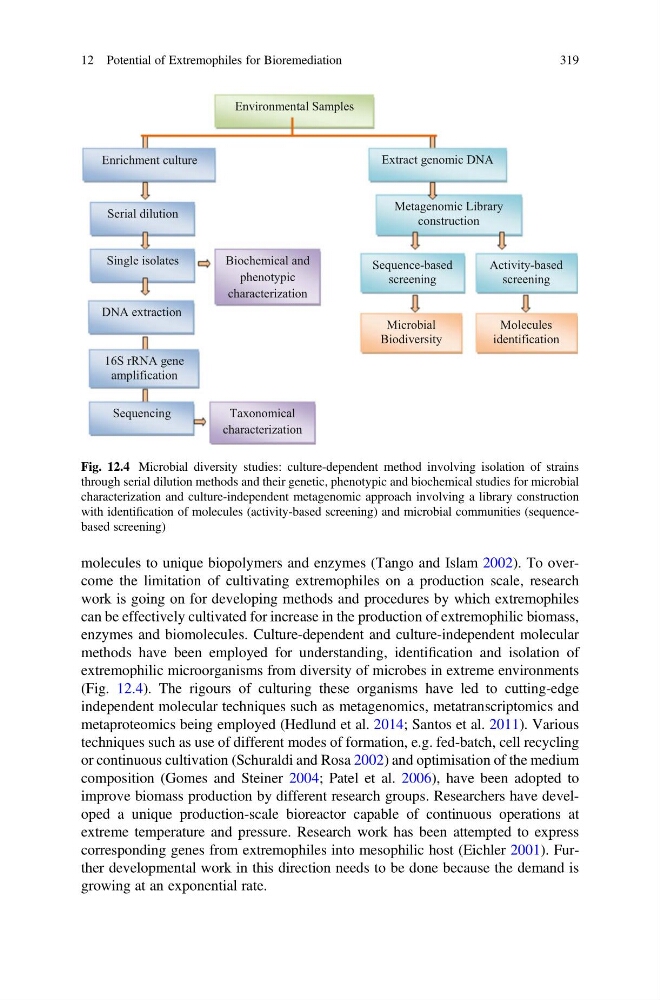
enzymes and biomolecules. Culture-dependent and culture-independent molecular
methods have been employed for understanding, identification and isolation of
extremophilic microorganisms from diversity of microbes in extreme environments
(Fig. 12.4). The rigours of culturing these organisms have led to cutting-edge
independent molecular techniques such as metagenomics, metatranscriptomics and
metaproteomics being employed (Hedlund et al. 2014; Santos et al. 2011). Various
techniques such as use of different modes of formation, e.g. fed-batch, cell recycling
or continuous cultivation (Schuraldi and Rosa 2002) and optimisation of the medium
composition (Gomes and Steiner 2004; Patel et al. 2006), have been adopted to
improve biomass production by different research groups. Researchers have developed a unique production-scale bioreactor capable of continuous operations at
extreme temperature and pressure. Research work has been attempted to express
corresponding genes from extremophiles into mesophilic host (Eichler 2001). Further developmental work in this direction needs to be done because the demand is
growing at an exponential rate.
Environmental Samples
Extract genomic DNA
Enrichment culture
Metagenomic Library
construction
Serial dilution
Biochemical and
phenotypic
characterization
Single isolates
Sequence-based
screening
Activity-based
screening
DNA extraction
Microbial
Biodiversity
Molecules
identification
16S rRNA gene
amplification
Taxonomical
characterization
Sequencing
Fig. 12.4 Microbial diversity studies: culture-dependent method involving isolation of strains
through serial dilution methods and their genetic, phenotypic and biochemical studies for microbial
characterization and culture-independent metagenomic approach involving a library construction
with identification of molecules (activity-based screening) and microbial communities (sequencebased screening)
12 Potential of Extremophiles for Bioremediation
319
work is going on for developing methods and procedures by which extremophiles
can be effectively cultivated for increase in the production of extremophilic biomass,
enzymes and biomolecules. Culture-dependent and culture-independent molecular
methods have been employed for understanding, identification and isolation of
extremophilic microorganisms from diversity of microbes in extreme environments
(Fig. 12.4). The rigours of culturing these organisms have led to cutting-edge
independent molecular techniques such as metagenomics, metatranscriptomics and
metaproteomics being employed (Hedlund et al. 2014; Santos et al. 2011). Various
techniques such as use of different modes of formation, e.g. fed-batch, cell recycling
or continuous cultivation (Schuraldi and Rosa 2002) and optimisation of the medium
composition (Gomes and Steiner 2004; Patel et al. 2006), have been adopted to
improve biomass production by different research groups. Researchers have developed a unique production-scale bioreactor capable of continuous operations at
extreme temperature and pressure. Research work has been attempted to express
corresponding genes from extremophiles into mesophilic host (Eichler 2001). Further developmental work in this direction needs to be done because the demand is
growing at an exponential rate.
Environmental Samples
Extract genomic DNA
Enrichment culture
Metagenomic Library
construction
Serial dilution
Biochemical and
phenotypic
characterization
Single isolates
Sequence-based
screening
Activity-based
screening
DNA extraction
Microbial
Biodiversity
Molecules
identification
16S rRNA gene
amplification
Taxonomical
characterization
Sequencing
Fig. 12.4 Microbial diversity studies: culture-dependent method involving isolation of strains
through serial dilution methods and their genetic, phenotypic and biochemical studies for microbial
characterization and culture-independent metagenomic approach involving a library construction
with identification of molecules (activity-based screening) and microbial communities (sequencebased screening)
12 Potential of Extremophiles for Bioremediation
319