

strength. Extremozymes being extremophilic origin are robust, long-term storage,
resistance to solvents and detergents (Merone et al. 2005) and active over a wide
range of temperature. These enzymes are highly convenient for immobilization and
could be used in filtration devices of bioremediation processes.
12.4 Bioremediation: A Dynamic Process to Remediate
Polluted Sites
Bioremediation is a natural process and is perceived by the public as an acceptable
waste treatment process for contaminated material. This method is less expensive,
and less energy is required as compared to other methods. This is useful for the
complete destruction of wide variety of contaminants. As the biological processes
are often highly specific, site factors are important for the success of bioremediation.
Bioremediation is limited to those compounds which are biodegradable. An advantage of bioremediation over other methods is that it transforms contaminants instead
of simply moving them from one source to another as in the practice of land filing.
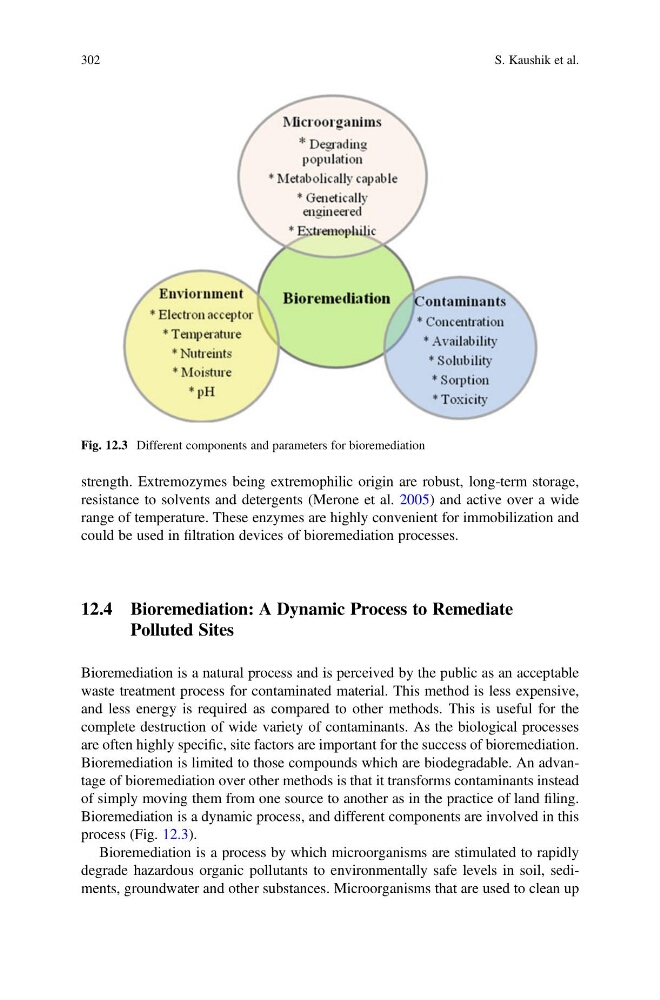
Bioremediation is a dynamic process, and different components are involved in this
process (Fig. 12.3).
Bioremediation is a process by which microorganisms are stimulated to rapidly
degrade hazardous organic pollutants to environmentally safe levels in soil, sediments, groundwater and other substances. Microorganisms that are used to clean up
Fig. 12.3 Different components and parameters for bioremediation
302
S. Kaushik et al.
resistance to solvents and detergents (Merone et al. 2005) and active over a wide
range of temperature. These enzymes are highly convenient for immobilization and
could be used in filtration devices of bioremediation processes.
12.4 Bioremediation: A Dynamic Process to Remediate
Polluted Sites
Bioremediation is a natural process and is perceived by the public as an acceptable
waste treatment process for contaminated material. This method is less expensive,
and less energy is required as compared to other methods. This is useful for the
complete destruction of wide variety of contaminants. As the biological processes
are often highly specific, site factors are important for the success of bioremediation.
Bioremediation is limited to those compounds which are biodegradable. An advantage of bioremediation over other methods is that it transforms contaminants instead
of simply moving them from one source to another as in the practice of land filing.
Bioremediation is a dynamic process, and different components are involved in this
process (Fig. 12.3).
Bioremediation is a process by which microorganisms are stimulated to rapidly
degrade hazardous organic pollutants to environmentally safe levels in soil, sediments, groundwater and other substances. Microorganisms that are used to clean up
Fig. 12.3 Different components and parameters for bioremediation
302
S. Kaushik et al.