

The upper temperature for life was thought to be 73
C at that time. Subsequently,
he isolated and collected many microbes from Octopus Spring, a particular geothermal area having large amounts of pink filamentous bacteria at a temperature of
82–88
C. Taq polymerase, an enzyme used in PCR, was isolated first from Thermus
aquaticus strain YT-1 and later on, his group showed that Thermus aquaticus was
widespread in hot-water environments (Brock 1977). Such microorganisms which
thrive under extreme conditions are known as extremophiles (from Latin “extremus”
meaning “extreme” and Greek “philia” meaning “love”). MacElroy (1974) first
coined the term “extremophile” to designate any organism able to support environmental conditions usually fatal to most eukaryotic cells. Most of the extremophilic
microorganisms belong to the archaeal species. The word “archaea” means “ancient
things” (from Greek), and it refers to a group of prokaryotic single-celled microorganisms characterized for the extreme conditions they need to be alive. The archaea
group was classified as a separate group of prokaryotes by Woese and Fox (1977).
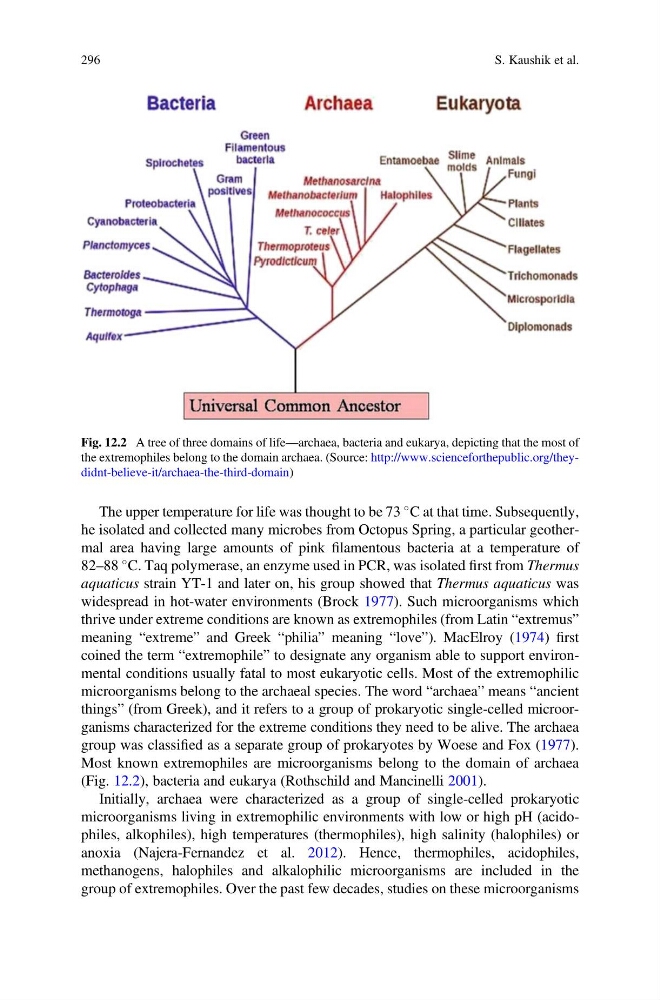
Most known extremophiles are microorganisms belong to the domain of archaea
(Fig. 12.2), bacteria and eukarya (Rothschild and Mancinelli 2001).
Initially, archaea were characterized as a group of single-celled prokaryotic
microorganisms living in extremophilic environments with low or high pH (acidophiles, alkophiles), high temperatures (thermophiles), high salinity (halophiles) or
anoxia (Najera-Fernandez et al. 2012). Hence, thermophiles, acidophiles,
methanogens, halophiles and alkalophilic microorganisms are included in the
group of extremophiles. Over the past few decades, studies on these microorganisms
Fig. 12.2 A tree of three domains of life—archaea, bacteria and eukarya, depicting that the most of
the extremophiles belong to the domain archaea. (Source: http://www.scienceforthepublic.org/theydidnt-believe-it/archaea-the-third-domain)
296
S. Kaushik et al.
C at that time. Subsequently,
he isolated and collected many microbes from Octopus Spring, a particular geothermal area having large amounts of pink filamentous bacteria at a temperature of
82–88
C. Taq polymerase, an enzyme used in PCR, was isolated first from Thermus
aquaticus strain YT-1 and later on, his group showed that Thermus aquaticus was
widespread in hot-water environments (Brock 1977). Such microorganisms which
thrive under extreme conditions are known as extremophiles (from Latin “extremus”
meaning “extreme” and Greek “philia” meaning “love”). MacElroy (1974) first
coined the term “extremophile” to designate any organism able to support environmental conditions usually fatal to most eukaryotic cells. Most of the extremophilic
microorganisms belong to the archaeal species. The word “archaea” means “ancient
things” (from Greek), and it refers to a group of prokaryotic single-celled microorganisms characterized for the extreme conditions they need to be alive. The archaea
group was classified as a separate group of prokaryotes by Woese and Fox (1977).
Most known extremophiles are microorganisms belong to the domain of archaea
(Fig. 12.2), bacteria and eukarya (Rothschild and Mancinelli 2001).
Initially, archaea were characterized as a group of single-celled prokaryotic
microorganisms living in extremophilic environments with low or high pH (acidophiles, alkophiles), high temperatures (thermophiles), high salinity (halophiles) or
anoxia (Najera-Fernandez et al. 2012). Hence, thermophiles, acidophiles,
methanogens, halophiles and alkalophilic microorganisms are included in the
group of extremophiles. Over the past few decades, studies on these microorganisms
Fig. 12.2 A tree of three domains of life—archaea, bacteria and eukarya, depicting that the most of
the extremophiles belong to the domain archaea. (Source: http://www.scienceforthepublic.org/theydidnt-believe-it/archaea-the-third-domain)
296
S. Kaushik et al.