

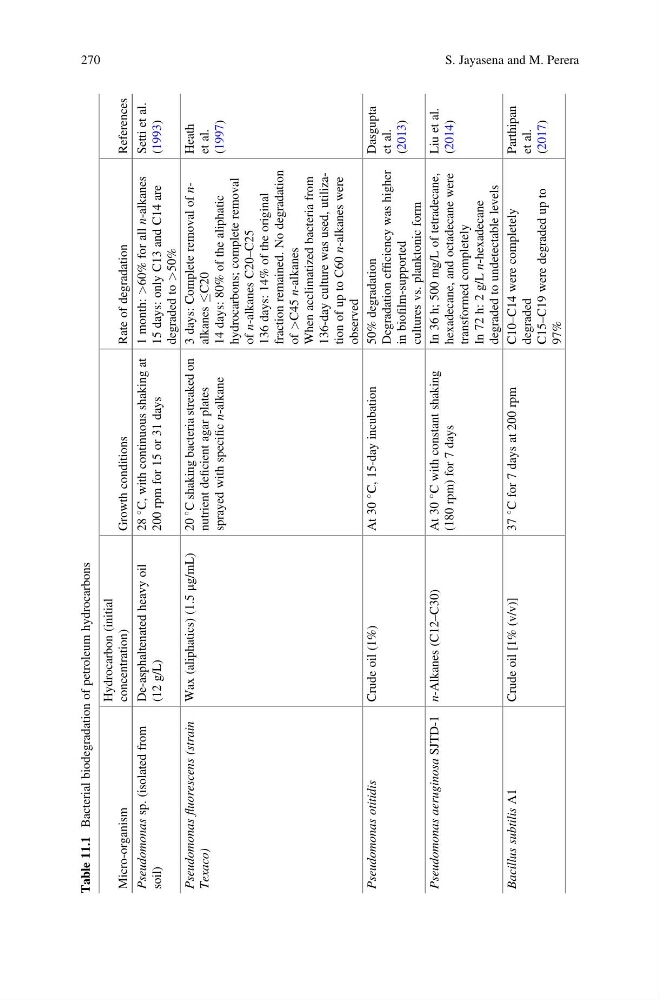
Table 11.1
Bacterial biodegradation of petroleum hydrocarbons
Micro-organism
Hydrocarbon (initial
concentration)
Growth conditions
Rate of degradation
References
Pseudomonas
sp. (isolated from
soil)
De-asphaltenated heavy oil
(12 g/L)
28
C, with continuous shaking at
200 rpm for 15 or 31 days
1 month:
>60% for all n-alkanes
15 days: only C13 and C14 are
degraded to
>50%
Setti et al.
(1993)
Pseudomonas
fluorescens (strain
Texaco)
Wax (aliphatics) (1.5
μg/mL)
20
C shaking bacteria streaked on
nutrient deficient agar plates
sprayed with specific n-alkane
3 days: Complete removal of nalkanes
C20
14 days: 80% of the aliphatic
hydrocarbons; complete removal
of n-alkanes
C20–C25
136 days: 14% of the original
fraction remained. No degradation
of
>C45 n-alkanes
When acclimatized bacteria from
136-day culture was used, utilization of up to C60 n-alkanes
were
observed
Heath
et al.
(1997)
Pseudomonas otitidis
Crude oil (1%)
At 30
C, 15-day incubation
50% degradation
Degradation efficiency was higher
in biofilm-supported
cultures vs. planktonic form
Dasgupta
et al.
(2013)
Pseudomonas aeruginosa
SJTD-1 n-Alkanes
(C12–C30)
At 30
C with constant shaking
(180 rpm) for 7 days
In 36 h; 500 mg/L of tetradecane,
hexadecane, and octadecane were
transformed completely
In 72 h: 2 g/L n-hexadecane
degraded to undetectable levels
Liu et al.
(2014)
Bacillus subtilis
A1
Crude oil [1% (v/v)]
37
C for 7 days at 200 rpm
C10–C14 were completely
degraded
C15–C19 were degraded up to
97%
Parthipan
et al.
(2017)
270
S. Jayasena and M. Perera
Bacterial biodegradation of petroleum hydrocarbons
Micro-organism
Hydrocarbon (initial
concentration)
Growth conditions
Rate of degradation
References
Pseudomonas
sp. (isolated from
soil)
De-asphaltenated heavy oil
(12 g/L)
28
C, with continuous shaking at
200 rpm for 15 or 31 days
1 month:
>60% for all n-alkanes
15 days: only C13 and C14 are
degraded to
>50%
Setti et al.
(1993)
Pseudomonas
fluorescens (strain
Texaco)
Wax (aliphatics) (1.5
μg/mL)
20
C shaking bacteria streaked on
nutrient deficient agar plates
sprayed with specific n-alkane
3 days: Complete removal of nalkanes
C20
14 days: 80% of the aliphatic
hydrocarbons; complete removal
of n-alkanes
C20–C25
136 days: 14% of the original
fraction remained. No degradation
of
>C45 n-alkanes
When acclimatized bacteria from
136-day culture was used, utilization of up to C60 n-alkanes
were
observed
Heath
et al.
(1997)
Pseudomonas otitidis
Crude oil (1%)
At 30
C, 15-day incubation
50% degradation
Degradation efficiency was higher
in biofilm-supported
cultures vs. planktonic form
Dasgupta
et al.
(2013)
Pseudomonas aeruginosa
SJTD-1 n-Alkanes
(C12–C30)
At 30
C with constant shaking
(180 rpm) for 7 days
In 36 h; 500 mg/L of tetradecane,
hexadecane, and octadecane were
transformed completely
In 72 h: 2 g/L n-hexadecane
degraded to undetectable levels
Liu et al.
(2014)
Bacillus subtilis
A1
Crude oil [1% (v/v)]
37
C for 7 days at 200 rpm
C10–C14 were completely
degraded
C15–C19 were degraded up to
97%
Parthipan
et al.
(2017)
270
S. Jayasena and M. Perera