

11.2 Chemical Components of Crude Oil
Natural crude oil is a complex and variable mixture of organic chemicals. Generally,
four main classes have been identified. They are:
1. Aliphatics (mostly saturates)
2. Aromatics
3. Resins
4. Asphaltenes
The mixtures frequently also contain significant percentages of polar molecules
such as nitrogen, oxygen, and sulfur as well as trace metals such as copper,
vanadium, iron, and nickel (Hegazi and El-Gayar 2017).
1. Aliphatics/Saturates
A majority of the aliphatics present in crude oil are saturates, generally
comprising linear alkanes. A much smaller percentage of unsaturated aliphatics
may also be present.
Among the alkanes, as mentioned above, the majority are linear alkanes (nalkanes) ranging from
cyclohexane and cyclopentane may also be present.
The linear alkanes can be divided into four groups based on molecular weight
(Varjani 2017).
C17–C28 medium molecular weight alkanes
>C28 high molecular weight alkane
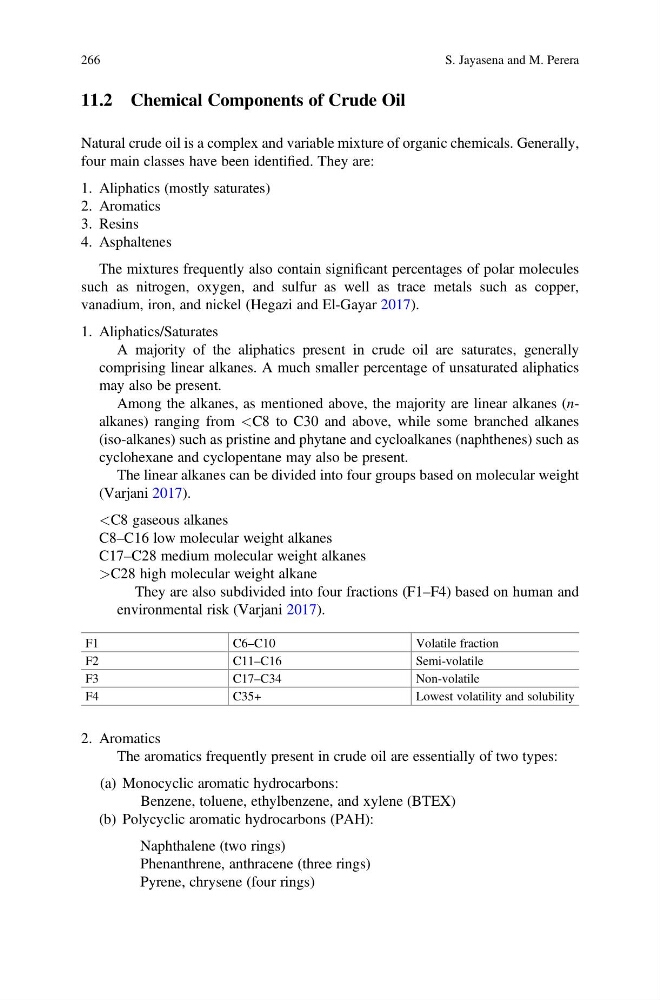
They are also subdivided into four fractions (F1–F4) based on human and
environmental risk (Varjani 2017).
F1
C6–C10
Volatile fraction
F2
C11–C16
Semi-volatile
F3
C17–C34
Non-volatile
F4
C35+
Lowest volatility and solubility
2. Aromatics
The aromatics frequently present in crude oil are essentially of two types:
(a) Monocyclic aromatic hydrocarbons:
Benzene, toluene, ethylbenzene, and xylene (BTEX)
(b) Polycyclic aromatic hydrocarbons (PAH):
Naphthalene (two rings)
Phenanthrene, anthracene (three rings)
Pyrene, chrysene (four rings)
266
S. Jayasena and M. Perera
Natural crude oil is a complex and variable mixture of organic chemicals. Generally,
four main classes have been identified. They are:
1. Aliphatics (mostly saturates)
2. Aromatics
3. Resins
4. Asphaltenes
The mixtures frequently also contain significant percentages of polar molecules
such as nitrogen, oxygen, and sulfur as well as trace metals such as copper,
vanadium, iron, and nickel (Hegazi and El-Gayar 2017).
1. Aliphatics/Saturates
A majority of the aliphatics present in crude oil are saturates, generally
comprising linear alkanes. A much smaller percentage of unsaturated aliphatics
may also be present.
Among the alkanes, as mentioned above, the majority are linear alkanes (nalkanes) ranging from
cyclohexane and cyclopentane may also be present.
The linear alkanes can be divided into four groups based on molecular weight
(Varjani 2017).
C17–C28 medium molecular weight alkanes
>C28 high molecular weight alkane
They are also subdivided into four fractions (F1–F4) based on human and
environmental risk (Varjani 2017).
F1
C6–C10
Volatile fraction
F2
C11–C16
Semi-volatile
F3
C17–C34
Non-volatile
F4
C35+
Lowest volatility and solubility
2. Aromatics
The aromatics frequently present in crude oil are essentially of two types:
(a) Monocyclic aromatic hydrocarbons:
Benzene, toluene, ethylbenzene, and xylene (BTEX)
(b) Polycyclic aromatic hydrocarbons (PAH):
Naphthalene (two rings)
Phenanthrene, anthracene (three rings)
Pyrene, chrysene (four rings)
266
S. Jayasena and M. Perera