

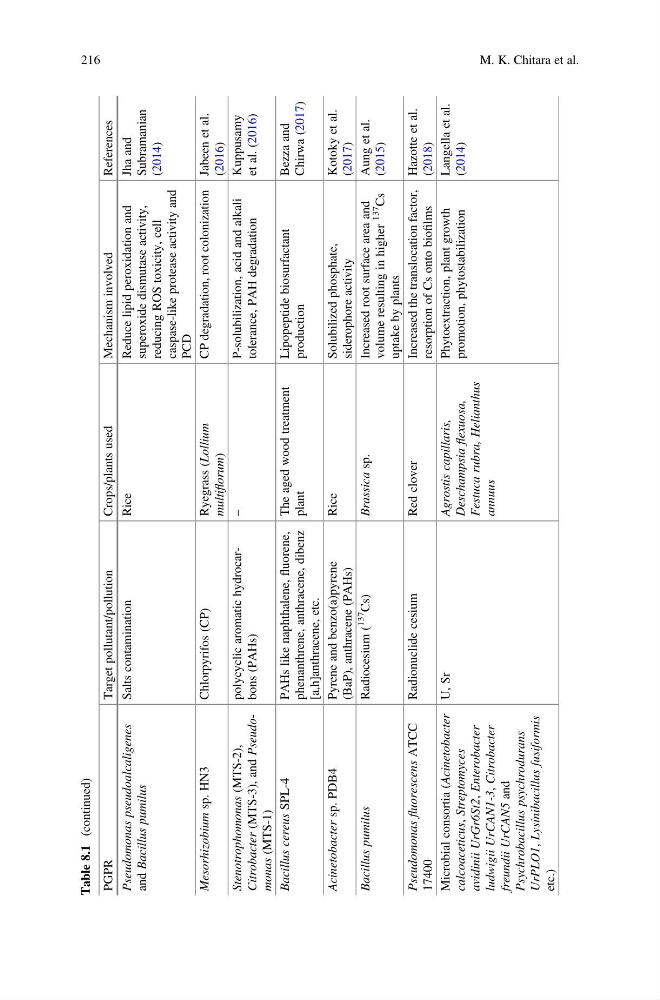
Table 8.1
(continued)
PGPR
Target pollutant/pollution
Crops/plants used
Mechanism involved
References
Pseudomonas pseudoalcaligenes
and Bacillus pumilus
Salts contamination
Rice
Reduce lipid peroxidation and
superoxide dismutase activity,
reducing ROS toxicity, cell
caspase-like protease activity and
PCD
Jha and
Subramanian
(2014)
Mesorhizobium
sp. HN3
Chlorpyrifos (CP)
Ryegrass (Lollium
multiflorum)
CP degradation, root colonization Jabeen et al.
(2016)
Stenotrophomonas
(MTS-2),
Citrobacter
(MTS-3), and Pseudomonas
(MTS-1)
polycyclic aromatic hydrocarbons (PAHs)
–
P-solubilization, acid and alkali
tolerance, PAH degradation
Kuppusamy
et al. (2016)
Bacillus cereus
SPL-4
PAHs like naphthalene,
fluorene,
phenanthrene, anthracene, dibenz
[a,h]anthracene, etc.
The aged wood treatment
plant
Lipopeptide biosurfactant
production
Bezza and
Chirwa (2017)
Acinetobacter
sp. PDB4
Pyrene and benzo(a)pyrene
(BaP), anthracene (PAHs)
Rice
Solubilized phosphate,
siderophore activity
Kotoky et al.
(2017)
Bacillus pumilus
Radiocesium (
137
Cs)
Brassica
sp.
Increased root surface area and
volume resulting in higher
137
Cs
uptake by plants
Aung et al.
(2015)
Pseudomonas
fluorescens ATCC
17400
Radionuclide cesium
Red clover
Increased the translocation factor,
resorption of Cs onto biofilms
Hazotte et al.
(2018)
Microbial consortia (Acinetobacter
calcoaceticus, Streptomyces
avidinii UrGr6St2, Enterobacter
ludwigii UrCAN1-3, Citrobacter
freundii UrCAN5
and
Psychrobacillus psychrodurans
UrPLO1, Lysinibacillus fusiformis
etc.)
U, Sr
Agrostis capillaris,
Deschampsia
flexuosa,
Festuca rubra, Helianthus
annuus
Phytoextraction, plant growth
promotion, phytostabilization
Langella et al.
(2014)
216
M. K. Chitara et al.
(continued)
PGPR
Target pollutant/pollution
Crops/plants used
Mechanism involved
References
Pseudomonas pseudoalcaligenes
and Bacillus pumilus
Salts contamination
Rice
Reduce lipid peroxidation and
superoxide dismutase activity,
reducing ROS toxicity, cell
caspase-like protease activity and
PCD
Jha and
Subramanian
(2014)
Mesorhizobium
sp. HN3
Chlorpyrifos (CP)
Ryegrass (Lollium
multiflorum)
CP degradation, root colonization Jabeen et al.
(2016)
Stenotrophomonas
(MTS-2),
Citrobacter
(MTS-3), and Pseudomonas
(MTS-1)
polycyclic aromatic hydrocarbons (PAHs)
–
P-solubilization, acid and alkali
tolerance, PAH degradation
Kuppusamy
et al. (2016)
Bacillus cereus
SPL-4
PAHs like naphthalene,
fluorene,
phenanthrene, anthracene, dibenz
[a,h]anthracene, etc.
The aged wood treatment
plant
Lipopeptide biosurfactant
production
Bezza and
Chirwa (2017)
Acinetobacter
sp. PDB4
Pyrene and benzo(a)pyrene
(BaP), anthracene (PAHs)
Rice
Solubilized phosphate,
siderophore activity
Kotoky et al.
(2017)
Bacillus pumilus
Radiocesium (
137
Cs)
Brassica
sp.
Increased root surface area and
volume resulting in higher
137
Cs
uptake by plants
Aung et al.
(2015)
Pseudomonas
fluorescens ATCC
17400
Radionuclide cesium
Red clover
Increased the translocation factor,
resorption of Cs onto biofilms
Hazotte et al.
(2018)
Microbial consortia (Acinetobacter
calcoaceticus, Streptomyces
avidinii UrGr6St2, Enterobacter
ludwigii UrCAN1-3, Citrobacter
freundii UrCAN5
and
Psychrobacillus psychrodurans
UrPLO1, Lysinibacillus fusiformis
etc.)
U, Sr
Agrostis capillaris,
Deschampsia
flexuosa,
Festuca rubra, Helianthus
annuus
Phytoextraction, plant growth
promotion, phytostabilization
Langella et al.
(2014)
216
M. K. Chitara et al.