

2005). Among all the heavy metals, cadmium, arsenic, lead, chromium, and mercury
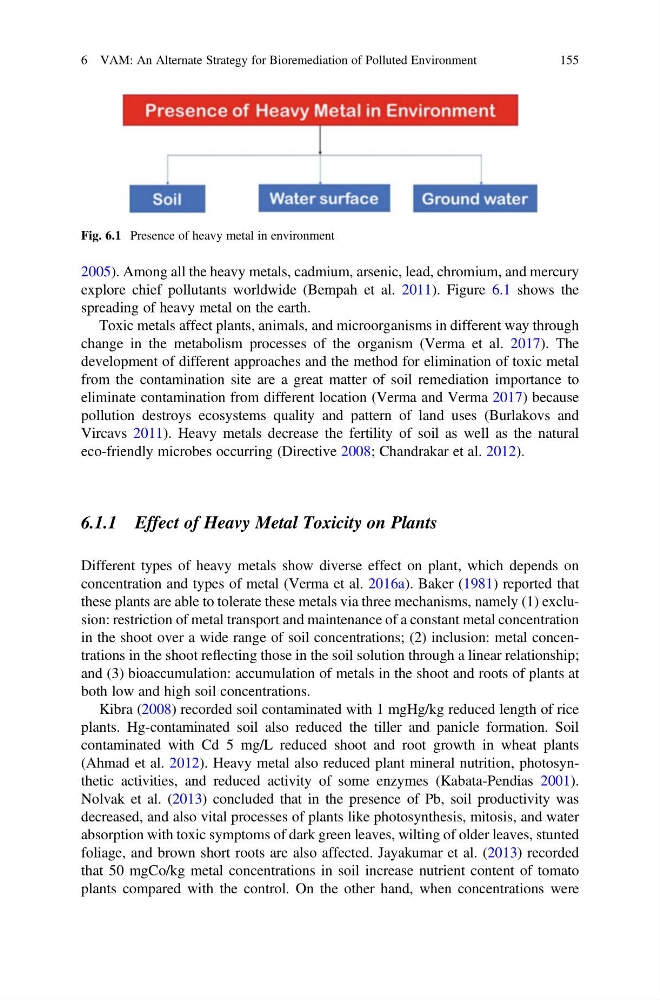
explore chief pollutants worldwide (Bempah et al. 2011). Figure 6.1 shows the
spreading of heavy metal on the earth.
Toxic metals affect plants, animals, and microorganisms in different way through
change in the metabolism processes of the organism (Verma et al. 2017). The
development of different approaches and the method for elimination of toxic metal
from the contamination site are a great matter of soil remediation importance to
eliminate contamination from different location (Verma and Verma 2017) because
pollution destroys ecosystems quality and pattern of land uses (Burlakovs and
Vircavs 2011). Heavy metals decrease the fertility of soil as well as the natural
eco-friendly microbes occurring (Directive 2008; Chandrakar et al. 2012).
6.1.1 Effect of Heavy Metal Toxicity on Plants
Different types of heavy metals show diverse effect on plant, which depends on
concentration and types of metal (Verma et al. 2016a). Baker (1981) reported that
these plants are able to tolerate these metals via three mechanisms, namely (1) exclusion: restriction of metal transport and maintenance of a constant metal concentration
in the shoot over a wide range of soil concentrations; (2) inclusion: metal concentrations in the shoot reflecting those in the soil solution through a linear relationship;
and (3) bioaccumulation: accumulation of metals in the shoot and roots of plants at
both low and high soil concentrations.
Kibra (2008) recorded soil contaminated with 1 mgHg/kg reduced length of rice
plants. Hg-contaminated soil also reduced the tiller and panicle formation. Soil
contaminated with Cd 5 mg/L reduced shoot and root growth in wheat plants
(Ahmad et al. 2012). Heavy metal also reduced plant mineral nutrition, photosynthetic activities, and reduced activity of some enzymes (Kabata-Pendias 2001).
Nolvak et al. (2013) concluded that in the presence of Pb, soil productivity was
decreased, and also vital processes of plants like photosynthesis, mitosis, and water
absorption with toxic symptoms of dark green leaves, wilting of older leaves, stunted
foliage, and brown short roots are also affected. Jayakumar et al. (2013) recorded
that 50 mgCo/kg metal concentrations in soil increase nutrient content of tomato
plants compared with the control. On the other hand, when concentrations were
Fig. 6.1 Presence of heavy metal in environment
6 VAM: An Alternate Strategy for Bioremediation of Polluted Environment
155
explore chief pollutants worldwide (Bempah et al. 2011). Figure 6.1 shows the
spreading of heavy metal on the earth.
Toxic metals affect plants, animals, and microorganisms in different way through
change in the metabolism processes of the organism (Verma et al. 2017). The
development of different approaches and the method for elimination of toxic metal
from the contamination site are a great matter of soil remediation importance to
eliminate contamination from different location (Verma and Verma 2017) because
pollution destroys ecosystems quality and pattern of land uses (Burlakovs and
Vircavs 2011). Heavy metals decrease the fertility of soil as well as the natural
eco-friendly microbes occurring (Directive 2008; Chandrakar et al. 2012).
6.1.1 Effect of Heavy Metal Toxicity on Plants
Different types of heavy metals show diverse effect on plant, which depends on
concentration and types of metal (Verma et al. 2016a). Baker (1981) reported that
these plants are able to tolerate these metals via three mechanisms, namely (1) exclusion: restriction of metal transport and maintenance of a constant metal concentration
in the shoot over a wide range of soil concentrations; (2) inclusion: metal concentrations in the shoot reflecting those in the soil solution through a linear relationship;
and (3) bioaccumulation: accumulation of metals in the shoot and roots of plants at
both low and high soil concentrations.
Kibra (2008) recorded soil contaminated with 1 mgHg/kg reduced length of rice
plants. Hg-contaminated soil also reduced the tiller and panicle formation. Soil
contaminated with Cd 5 mg/L reduced shoot and root growth in wheat plants
(Ahmad et al. 2012). Heavy metal also reduced plant mineral nutrition, photosynthetic activities, and reduced activity of some enzymes (Kabata-Pendias 2001).
Nolvak et al. (2013) concluded that in the presence of Pb, soil productivity was
decreased, and also vital processes of plants like photosynthesis, mitosis, and water
absorption with toxic symptoms of dark green leaves, wilting of older leaves, stunted
foliage, and brown short roots are also affected. Jayakumar et al. (2013) recorded
that 50 mgCo/kg metal concentrations in soil increase nutrient content of tomato
plants compared with the control. On the other hand, when concentrations were
Fig. 6.1 Presence of heavy metal in environment
6 VAM: An Alternate Strategy for Bioremediation of Polluted Environment
155