

The volatile organic compounds occur in microalgae as a consequence of their
primary metabolism, that is, the availability of carbon, nitrogen an energy supply,
impacting the concentration of secondary metabolites, such as volatile organic
compounds (Papaleo et al. 2013, Dudareva et al. 2013). Even some compounds
such as alcohols, aldehydes, and ketones can be formed by the lipid degradation
(Rzama et al. 1995) or alcohols can be oxidized to aldehydes and then to carboxylic
acids, and ketones may be reacted with the hydroxyl radicals in the air to form
aldehydes (Atkinson et al. 2000; Korpi et al. 2009).
In the recent years, volatile organic compounds, especially the volatile fatty acids
which is usually based on non-renewable petrochemical sources, have attracted
much attention due to the production of bioactive compounds, biodegradable materials, and energy by microorganisms through dark fermentation, by using volatile
fatty acids as carbon source (Chalima et al. 2017).
The production of volatile fatty acids by using wastes as alternative culture
media, such as food wastes, sludge, and similar biodegradable organic wastes, can
be an alternative to reduce the production cost. Kim et al. (2006), in order to optimize
volatile fatty acid production in dark fermentation, pretreated the raw food waste by
commercial enzymes and thus the authors reported a 3.3 times higher production of
volatile fatty acids.
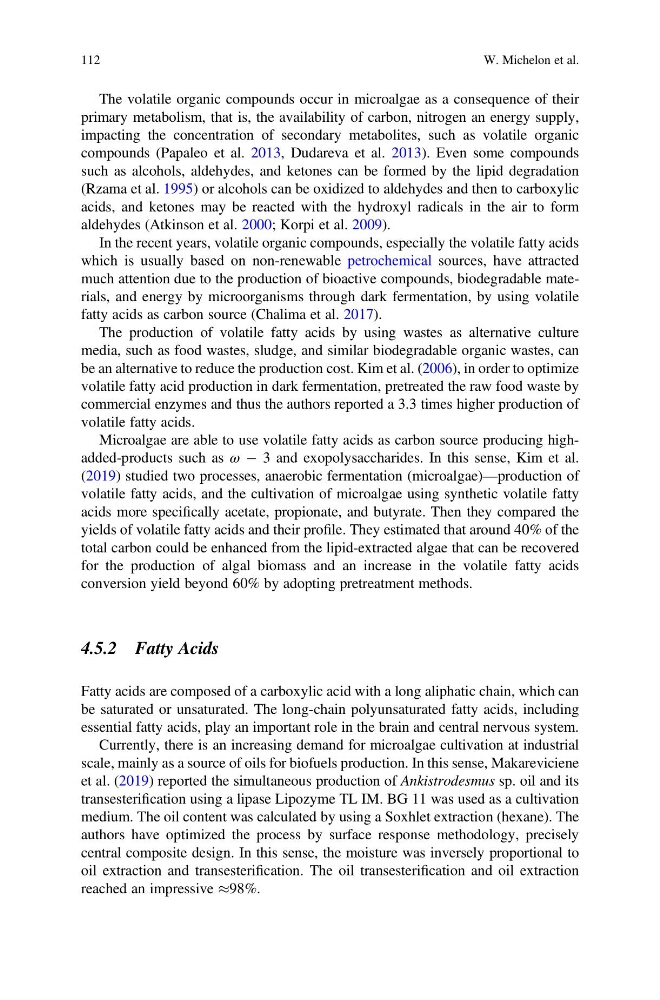
Microalgae are able to use volatile fatty acids as carbon source producing highadded-products such as ω À 3 and exopolysaccharides. In this sense, Kim et al.
(2019) studied two processes, anaerobic fermentation (microalgae)—production of
volatile fatty acids, and the cultivation of microalgae using synthetic volatile fatty
acids more specifically acetate, propionate, and butyrate. Then they compared the
yields of volatile fatty acids and their profile. They estimated that around 40% of the
total carbon could be enhanced from the lipid-extracted algae that can be recovered
for the production of algal biomass and an increase in the volatile fatty acids
conversion yield beyond 60% by adopting pretreatment methods.
4.5.2 Fatty Acids
Fatty acids are composed of a carboxylic acid with a long aliphatic chain, which can
be saturated or unsaturated. The long-chain polyunsaturated fatty acids, including
essential fatty acids, play an important role in the brain and central nervous system.
Currently, there is an increasing demand for microalgae cultivation at industrial
scale, mainly as a source of oils for biofuels production. In this sense, Makareviciene
et al. (2019) reported the simultaneous production of Ankistrodesmus sp. oil and its
transesterification using a lipase Lipozyme TL IM. BG 11 was used as a cultivation
medium. The oil content was calculated by using a Soxhlet extraction (hexane). The
authors have optimized the process by surface response methodology, precisely
central composite design. In this sense, the moisture was inversely proportional to
oil extraction and transesterification. The oil transesterification and oil extraction
reached an impressive %98%.
112
W. Michelon et al.
primary metabolism, that is, the availability of carbon, nitrogen an energy supply,
impacting the concentration of secondary metabolites, such as volatile organic
compounds (Papaleo et al. 2013, Dudareva et al. 2013). Even some compounds
such as alcohols, aldehydes, and ketones can be formed by the lipid degradation
(Rzama et al. 1995) or alcohols can be oxidized to aldehydes and then to carboxylic
acids, and ketones may be reacted with the hydroxyl radicals in the air to form
aldehydes (Atkinson et al. 2000; Korpi et al. 2009).
In the recent years, volatile organic compounds, especially the volatile fatty acids
which is usually based on non-renewable petrochemical sources, have attracted
much attention due to the production of bioactive compounds, biodegradable materials, and energy by microorganisms through dark fermentation, by using volatile
fatty acids as carbon source (Chalima et al. 2017).
The production of volatile fatty acids by using wastes as alternative culture
media, such as food wastes, sludge, and similar biodegradable organic wastes, can
be an alternative to reduce the production cost. Kim et al. (2006), in order to optimize
volatile fatty acid production in dark fermentation, pretreated the raw food waste by
commercial enzymes and thus the authors reported a 3.3 times higher production of
volatile fatty acids.
Microalgae are able to use volatile fatty acids as carbon source producing highadded-products such as ω À 3 and exopolysaccharides. In this sense, Kim et al.
(2019) studied two processes, anaerobic fermentation (microalgae)—production of
volatile fatty acids, and the cultivation of microalgae using synthetic volatile fatty
acids more specifically acetate, propionate, and butyrate. Then they compared the
yields of volatile fatty acids and their profile. They estimated that around 40% of the
total carbon could be enhanced from the lipid-extracted algae that can be recovered
for the production of algal biomass and an increase in the volatile fatty acids
conversion yield beyond 60% by adopting pretreatment methods.
4.5.2 Fatty Acids
Fatty acids are composed of a carboxylic acid with a long aliphatic chain, which can
be saturated or unsaturated. The long-chain polyunsaturated fatty acids, including
essential fatty acids, play an important role in the brain and central nervous system.
Currently, there is an increasing demand for microalgae cultivation at industrial
scale, mainly as a source of oils for biofuels production. In this sense, Makareviciene
et al. (2019) reported the simultaneous production of Ankistrodesmus sp. oil and its
transesterification using a lipase Lipozyme TL IM. BG 11 was used as a cultivation
medium. The oil content was calculated by using a Soxhlet extraction (hexane). The
authors have optimized the process by surface response methodology, precisely
central composite design. In this sense, the moisture was inversely proportional to
oil extraction and transesterification. The oil transesterification and oil extraction
reached an impressive %98%.
112
W. Michelon et al.