

3.4.1 Biostimulation
The process of biodegradation in soil is dependent on various factors, viz. pH,
temperature, moisture content, oxygen availability, soil properties and quantity in
which contaminant is present (Atagana 2008; Al-Sulaimani et al. 2011; Bundy et al.
2002). In this process, limiting nutrients are added in various forms. Phosphorus,
nitrogen, oxygen and carbon (electron acceptors) are added in the form of molasses
or by optimizing conditions by aeration, etc., which stimulates the growth and
activities of microbes (Elektorowicz 1994; Perfumo et al. 2007; Piehler et al.
1999; Margesin and Schinner 2001; Rhykerd et al. 1999).
This method was considered most suitable or appropriate for remediation of
petroleum pollutants present in soil (Margesin and Schinner 2001). In the process
of biostimulation, bioremediation process would be carried out by the microbes
which are already present in the environment, along with well-established and
distributed within the subsurface environment. The local geology of the subsurface
plays an important role in proper distribution, growth and availability of the additives. If the subsurface lithology is tight and impermeable due to the presence of tight
clays, etc., then it becomes a hurdle for the additives to spread thoroughly in the
desired area. On the other hand, preferential pathways may be created by subsurface
with fractures which may create advantages for the additives. Nutrients added to the
subsurface may enable the growth of heterotrophic microbes which may not participate in the process of degradation; hence, rivalry or antagonism may be created
between the resident micro flora (Adams et al. 2014).
3.4.2 Bioaugmentation
Bioaugmentation is the addition of microbes to supplement the indigenous
populations of microbes. The approach of this process is that if the indigenous
microbial populations present are incapable of degrading the complex mixtures,
then the desired and capable microbes can be added (Leahy and Colwell 1990).
Speed of decontamination is the primary factor for deciding any process, and if it is
slow, then bioaugmentation can be followed (Forsyth et al. 1995). For the required
process of degradation to be carried out successfully, it is essential for the seed
microbes to have the features, viz. conduct the degradation process, genetic stability
and viability should not be altered, should acclimatize in foreign habitats effectively
(Atlas 1984; Goldstein et al. 1985).
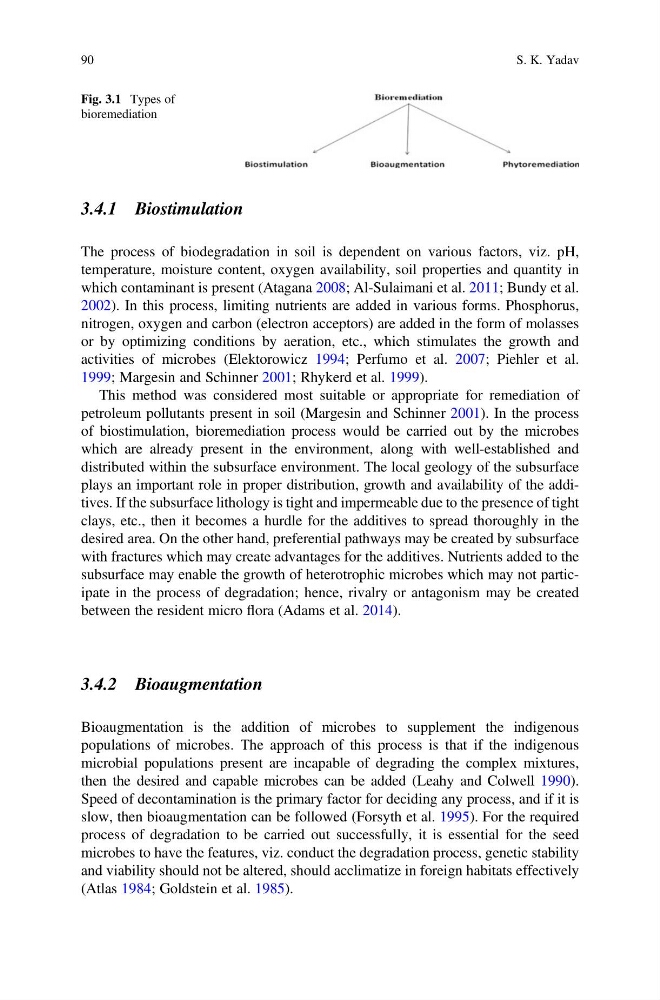
Fig. 3.1 Types of
bioremediation
90
S. K. Yadav
The process of biodegradation in soil is dependent on various factors, viz. pH,
temperature, moisture content, oxygen availability, soil properties and quantity in
which contaminant is present (Atagana 2008; Al-Sulaimani et al. 2011; Bundy et al.
2002). In this process, limiting nutrients are added in various forms. Phosphorus,
nitrogen, oxygen and carbon (electron acceptors) are added in the form of molasses
or by optimizing conditions by aeration, etc., which stimulates the growth and
activities of microbes (Elektorowicz 1994; Perfumo et al. 2007; Piehler et al.
1999; Margesin and Schinner 2001; Rhykerd et al. 1999).
This method was considered most suitable or appropriate for remediation of
petroleum pollutants present in soil (Margesin and Schinner 2001). In the process
of biostimulation, bioremediation process would be carried out by the microbes
which are already present in the environment, along with well-established and
distributed within the subsurface environment. The local geology of the subsurface
plays an important role in proper distribution, growth and availability of the additives. If the subsurface lithology is tight and impermeable due to the presence of tight
clays, etc., then it becomes a hurdle for the additives to spread thoroughly in the
desired area. On the other hand, preferential pathways may be created by subsurface
with fractures which may create advantages for the additives. Nutrients added to the
subsurface may enable the growth of heterotrophic microbes which may not participate in the process of degradation; hence, rivalry or antagonism may be created
between the resident micro flora (Adams et al. 2014).
3.4.2 Bioaugmentation
Bioaugmentation is the addition of microbes to supplement the indigenous
populations of microbes. The approach of this process is that if the indigenous
microbial populations present are incapable of degrading the complex mixtures,
then the desired and capable microbes can be added (Leahy and Colwell 1990).
Speed of decontamination is the primary factor for deciding any process, and if it is
slow, then bioaugmentation can be followed (Forsyth et al. 1995). For the required
process of degradation to be carried out successfully, it is essential for the seed
microbes to have the features, viz. conduct the degradation process, genetic stability
and viability should not be altered, should acclimatize in foreign habitats effectively
(Atlas 1984; Goldstein et al. 1985).
Fig. 3.1 Types of
bioremediation
90
S. K. Yadav